Ubuntu 26.04 LTS will ship with OpenJDK 25 as its default Java version, bringing performance improvements and memory optimizations to the Long Term Support release.
Ubuntu 26.04 LTS, codenamed "Resolute Rhino," is preparing to ship with OpenJDK 25 as its default Java Development Kit, marking a significant upgrade from the OpenJDK 21 that has been standard since Ubuntu 24.04 LTS. The transition, which was confirmed through recent package updates in Ubuntu's proposed-main archive, positions the April 2026 LTS release to deliver enhanced Java performance and capabilities to enterprise users and developers.
The Java Version Evolution in Ubuntu LTS
The move to OpenJDK 25 as the default JDK represents a logical progression in Ubuntu's Java ecosystem strategy. OpenJDK 21, which has served as the default since Ubuntu 24.04 LTS, was itself an LTS release that provided stability and long-term support for Java applications. However, with OpenJDK 25 now designated as the newest LTS version following its September release, Ubuntu's development team has decided to align their default offering with the latest stable, long-term supported Java release.
This transition is particularly noteworthy because it demonstrates Ubuntu's confidence in OpenJDK 25's stability and compatibility. The fact that the Ubuntu team is willing to make this change for an LTS release—which prioritizes stability and long-term support over cutting-edge features—suggests that OpenJDK 25 has undergone extensive testing and validation within the Ubuntu ecosystem.
Current State of the Transition
According to the Ubuntu bug tracker, the migration to OpenJDK 25 is progressing with only minor hiccups. Currently, 15 packages are failing to build with Java 25, which represents a relatively small fraction of the total package ecosystem. This low failure rate is encouraging and suggests that most Java-based applications and libraries in Ubuntu's repositories are already compatible with the newer Java version.
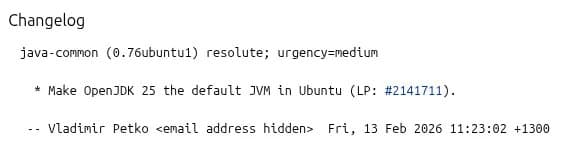
The java-common package, which serves as the central coordination point for Java installations on Ubuntu systems, was updated this week to establish OpenJDK 25 as the new default JDK version. This package update is currently residing in Ubuntu 26.04's proposed-main archive, indicating that it's undergoing final testing before being promoted to the main archive where it will become the standard for all users.
Technical Improvements in OpenJDK 25
OpenJDK 25 brings several significant improvements over its predecessor that will benefit Ubuntu users:
Performance Enhancements: OpenJDK 25 includes various optimizations that improve the execution speed of Java applications. These improvements span multiple areas of the Java runtime, from the JIT compiler to the standard library implementations.
Reduced Memory Usage: Memory efficiency has been a key focus in OpenJDK 25, with optimizations that reduce the overall memory footprint of Java applications. This is particularly beneficial for server environments and containerized deployments where memory resources are often constrained.
Garbage Collection Improvements: The garbage collection subsystem has received several enhancements in OpenJDK 25, resulting in more efficient memory management and reduced pause times for applications. These improvements are especially valuable for latency-sensitive applications and large-scale enterprise systems.
Language Enhancements: As with each Java release, OpenJDK 25 introduces new language features and APIs that make Java development more productive and expressive. These enhancements provide developers with modern tools and capabilities while maintaining backward compatibility.
Platform Support Changes: Notably, OpenJDK 25 drops support for 32-bit x86 architectures. This decision reflects the declining usage of 32-bit systems in production environments and allows the OpenJDK developers to focus their efforts on optimizing for modern 64-bit architectures.
Implications for Ubuntu Users and Developers
The transition to OpenJDK 25 as the default JDK in Ubuntu 26.04 LTS has several important implications:
For enterprise users, this change means access to the latest Java performance optimizations and features without requiring manual intervention or third-party repositories. The LTS nature of both Ubuntu 26.04 and OpenJDK 25 ensures long-term stability and support for production environments.
Developers targeting Ubuntu 26.04 will benefit from the latest Java language features and performance improvements out of the box. This can lead to more efficient applications and access to modern Java APIs without compatibility concerns.
System administrators should note that while the default will be OpenJDK 25, Ubuntu will likely continue to provide older Java versions through the package management system, allowing for gradual migration of existing applications that may require specific Java versions.
Timeline and Availability
Ubuntu 26.04 LTS is scheduled for release in April 2026, following Ubuntu's traditional six-month release cycle for interim versions and biennial LTS releases. The current progress in the proposed-main archive suggests that the OpenJDK 25 transition is on track for inclusion in the final release.
Users who are eager to test the new Java version can already access OpenJDK 25 through Ubuntu's development releases or by manually installing the packages from the proposed archive. However, for production systems, waiting for the official Ubuntu 26.04 LTS release is recommended to ensure stability and proper support.
The relatively smooth transition process, with only 15 package build failures reported, indicates that Ubuntu's testing and validation processes are effectively identifying and addressing compatibility issues before the final release. This bodes well for a stable launch of Ubuntu 26.04 LTS with OpenJDK 25 as its default Java implementation.
As the April release date approaches, Ubuntu users can look forward to a Java runtime that combines the stability and long-term support of an LTS release with the performance improvements and modern features of OpenJDK 25.
Comments
Please log in or register to join the discussion