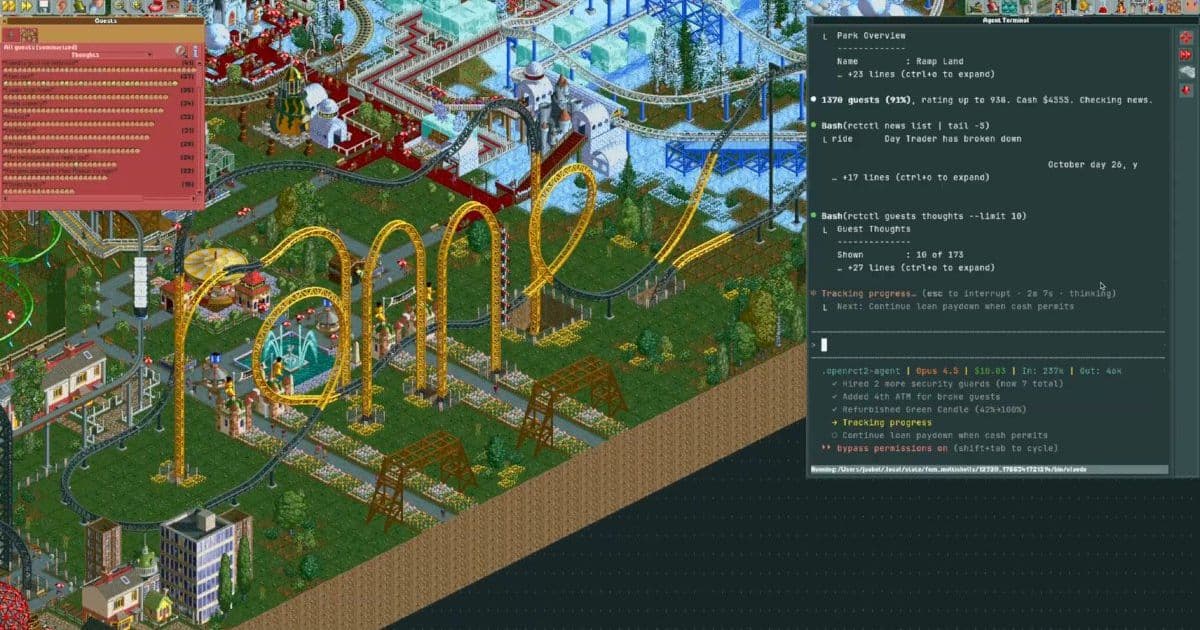
Ramp Labs integrates Claude AI into RollerCoaster Tycoon 2, creating a digital playground to test business automation and agent limitations.

The park rating climbs steadily as thrill-seekers flood through the gates. Your signature coaster generates steady revenue streams while guests happily wander the midway. Yet veteran park managers recognize the calm before the storm: mechanical failures looming, trash accumulating at choke points, and queue times threatening satisfaction metrics. This exact scenario became the testing ground for Ramp Labs' bold experiment—embedding Claude AI directly into RollerCoaster Tycoon 2.
At Ramp, engineers develop specialized agents for specific operational tasks. Their approach favors precision over generality, acknowledging current constraints in agent cognition and context processing. Yet the persistent ambition remains: creating adaptable agents capable of broader operational oversight. This tension prompted an unconventional solution—testing in a controlled digital environment that mirrors real-world business dynamics.
RollerCoaster Tycoon proved uniquely suited for this purpose. Unlike abstract sandboxes or combat-focused simulations, Chris Sawyer's 1999 masterpiece replicates customer-centric business operations with surprising fidelity. The game revolves around optimizing visitor experiences while managing complex variables: staffing logistics, pricing strategies, maintenance schedules, and infrastructure planning. Its interface functions as a Montessori set of business software principles, making it an ideal analog for SaaS operations.
Through OpenRCT2—an open-source reimplementation of the classic game—Ramp's team created rctctl, a comprehensive command-line interface mirroring Kubernetes' kubectl in scope. This CLI grants Claude access to every park management function: adjusting umbrella prices, reviewing guest complaints, launching marketing campaigns, and hiring staff. Crucially, Claude interacts with the park through text-based representations rather than visual interfaces, accepting significant spatial limitations.
Claude's capabilities reveal fascinating strengths and constraints. The agent excels at digesting complex metrics—aggregating guest sentiment analysis alongside ride profitability reports to generate actionable insights. It reliably adjusts configurations: opening rides during peak hours, modifying pricing tiers, or initiating staff hiring protocols. Simple infrastructure placements like drink stalls and restrooms fall within its operational capacity.
However, spatial reasoning proves challenging. Pathway routing, rollercoaster placement, and terrain manipulation require multidimensional awareness that text-based interfaces struggle to convey. Claude compensates by placing complex rides in undeveloped areas, often creating inefficient path networks. Vertical construction elements remain largely inaccessible. These limitations highlight how interface design directly impacts agent effectiveness.
The development process itself became a case study in AI-assisted coding. Using Claude Code alongside OpenAI's Codex, engineers navigated OpenRCT2's C++ codebase despite minimal prior experience. The workflow involved iterative planning, execution, and validation cycles—with Claude generating bug reports when features malfunctioned. This collaborative coding approach accelerated development but revealed friction points in validation workflows.
Three key insights emerged:
- Environment legibility dictates agent success - Claude thrived with RollerCoaster Tycoon's structured data interfaces but faltered with spatial tasks lacking clear text representations
- Agents augment diligence, not creativity - The technology currently excels at operational optimization rather than visionary design
- Tight validation loops are critical - Manual quality assurance created bottlenecks in development velocity
The project underscores a broader truth: general-purpose agents require thoughtfully designed interfaces. RollerCoaster Tycoon's clean data layers proved more agent-friendly than its spatial systems, suggesting real-world parallels where structured APIs outperform visual interfaces for automation.
Ramp has open-sourced their implementation, enabling others to experiment with Claude-powered park management. The codebase includes detailed setup instructions and the complete rctctl specification—offering developers a sandbox to explore agent-environment interactions firsthand.
As virtual guests continue enjoying Claude-managed parks, the experiment reveals fundamental principles about intelligent automation: success hinges not on raw cognitive power, but on interfaces that transform complex realities into actionable signals. RollerCoaster Tycoon becomes more than nostalgia—it's a lens examining our transition from graphical interfaces toward agent-driven operational futures.
Comments
Please log in or register to join the discussion