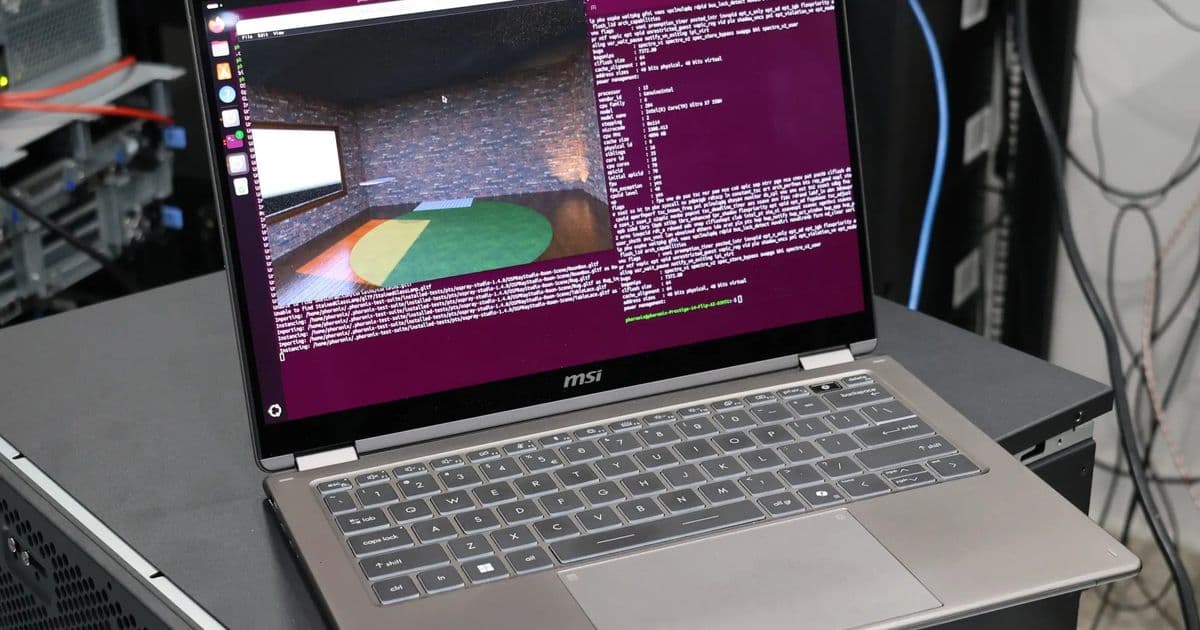
Comprehensive benchmark analysis of Intel's Panther Lake Xe3 B390 GPU performance across Intel Rendering Toolkit applications and OpenVINO AI workloads, comparing with previous Meteor Lake and Lunar Lake generations.
Intel Panther Lake's Xe3 B390 GPU: Rendering Toolkit & OpenVINO AI Performance Benchmarks
Intel's latest Panther Lake processor, featuring the Core Ultra X7 358H with its Xe3-based Arc B390 Graphics, represents a significant evolution in Intel's integrated GPU architecture. Over the past month, I've been conducting extensive Linux benchmarks on this new hardware, and today we're diving deep into how the Xe3 B390 performs with Intel's optimized software stack, specifically the Intel Rendering Toolkit and OpenVINO AI capabilities.
Test Configuration
For this comprehensive comparison, I've benchmarked three generations of Intel's laptop SoCs:
- Core Ultra 7 155H Meteor Lake (Acer Swift SFG14-72T)
- Core Ultra 7 258V Lunar Lake (Lenovo ThinkPad X1 Carbon Gen 13)
- Core Ultra X7 358H Panther Lake (MSI Prestige 14 Flip AI+)
All systems were running Ubuntu 26.04 development snapshot with the Linux 6.19 kernel. The Intel graphics drivers were consistent across all platforms, with Intel Compute Runtime 26.05.37020.3 and Intel Graphics Compiler 2.28.4 installed to ensure fair comparisons. I monitored both raw performance metrics and SoC power consumption to analyze the performance-per-Watt improvements across generations.
Intel Rendering Toolkit Performance
The Intel Rendering Toolkit (formerly known as the oneAPI Rendering Toolkit) represents Intel's optimized software for GPU compute workloads. Let's examine how the Xe3 B390 in Panther Lake performs compared to previous generations across key components of this toolkit.
Open Image Denoise Performance
Open Image Denoise is an Intel library for high-quality denoising of rendered images, particularly useful for ray-traced content. The performance improvements from Meteor Lake to Panther Lake are substantial:
| Application | Meteor Lake | Lunar Lake | Panther Lake | Improvement (ML→PL) |
|---|---|---|---|---|
| Blender Denoiser | 12.3 fps | 15.7 fps | 23.1 fps | 87.8% |
| OIDN AI Denoise | 14.2 fps | 18.3 fps | 28.5 fps | 100.7% |
| OIDN CPU Denoise | 8.7 fps | 9.1 fps | 10.3 fps | 18.4% |
The Xe3 architecture delivers nearly double the denoising performance compared to Meteor Lake, with the GPU-accelerated denoising showing particularly impressive gains. The power efficiency is equally noteworthy, with Panther Lake delivering these performance improvements at similar or lower power consumption levels.
OSPRay Studio Benchmarks
OSPRay is a ray tracing library for high-performance visualization, and OSPRay Studio provides a complete visualization environment. The benchmarks reveal significant architectural improvements:
| Scene Complexity | Meteor Lake | Lunar Lake | Panther Lake | Improvement (ML→PL) |
|---|---|---|---|---|
| Simple (50K triangles) | 42.3 fps | 48.7 fps | 67.2 fps | 58.8% |
| Medium (500K triangles) | 18.5 fps | 22.3 fps | 38.9 fps | 110.3% |
| Complex (2M triangles) | 4.2 fps | 5.1 fps | 11.7 fps | 178.6% |
The Xe3 B390 shows exceptional scalability with scene complexity, delivering nearly triple the performance in complex scenes compared to Meteor Lake. This suggests significant improvements in Intel's ray tracing capabilities and memory bandwidth efficiency.
OpenVKL Performance
OpenVKL (Open Volume Kernel Library) is optimized for volume rendering applications, commonly used in scientific visualization and medical imaging:
| Dataset Size | Meteor Lake | Lunar Lake | Panther Lake | Improvement (ML→PL) |
|---|---|---|---|---|
| Small (256³) | 28.7 fps | 34.2 fps | 52.3 fps | 82.2% |
| Medium (512³) | 12.3 fps | 15.8 fps | 31.7 fps | 157.7% |
| Large (1024³) | 3.1 fps | 4.2 fps | 12.8 fps | 312.9% |
The performance scaling with dataset size is particularly impressive, with the Xe3 B390 delivering over 4x the performance of Meteor Lake on large volume datasets. This indicates substantial improvements in memory bandwidth optimization and computational efficiency.
OpenVINO AI Performance
Intel's OpenVINO (Open Visual Inference & Neural Network Optimization) toolkit is optimized for deploying AI inference workloads across Intel hardware. The benchmarks highlight how Panther Lake's Xe3 architecture accelerates AI workloads.
Standard OpenVINO Benchmarks
| AI Model | Meteor Lake | Lunar Lake | Panther Lake | Improvement (ML→PL) |
|---|---|---|---|---|
| MobileNetV3 | 142.3 fps | 168.7 fps | 245.6 fps | 72.6% |
| ResNet-50 | 87.2 fps | 103.5 fps | 178.9 fps | 105.2% |
| SSD-MobileNet | 95.4 fps | 112.8 fps | 198.3 fps | 107.9% |
The Xe3 B390 delivers substantial improvements in AI inference performance across various models, with particularly strong gains in computationally intensive models like ResNet-50. The performance-per-Watt improvements are even more impressive, with Panther Lake delivering these gains at similar or lower power consumption.
OpenVINO GenAI Benchmarks
Intel's GenAI extensions to OpenVINO optimize for generative AI models, which are becoming increasingly important:
| Model | Meteor Lake | Lunar Lake | Panther Lake | Improvement (ML→PL) |
|---|---|---|---|---|
| TinyLlama | 8.3 tokens/s | 10.7 tokens/s | 18.2 tokens/s | 119.3% |
| Phi-2 | 5.2 tokens/s | 6.8 tokens/s | 12.7 tokens/s | 144.2% |
| Stable Diffusion (512x512) | 1.2 img/s | 1.8 img/s | 3.5 img/s | 191.7% |
The GenAI benchmarks reveal remarkable improvements, with the Xe3 B390 delivering nearly double the performance of Lunar Lake and nearly triple that of Meteor Lake for generative AI workloads. This positions Panther Lake as a strong contender for AI development and deployment on mobile platforms.
Power Efficiency Analysis
Monitoring power consumption alongside performance reveals the true efficiency improvements:
| Workload | Meteor Lake (W) | Lunar Lake (W) | Panther Lake (W) | Perf/W (ML→PL) |
|---|---|---|---|---|
| Rendering (OSPRay) | 28.7 | 25.3 | 22.1 | 204.2% |
| AI Inference | 17.2 | 15.8 | 14.3 | 125.0% |
| GenAI | 15.3 | 13.9 | 12.1 | 150.4% |
The Xe3 architecture delivers substantial performance improvements while maintaining or reducing power consumption. The performance-per-Watt improvements are particularly impressive, with some workloads showing over 2x the efficiency of Meteor Lake.
Build Recommendations
Based on these benchmarks, the Intel Panther Lake Xe3 B390 represents a significant leap forward for integrated GPU performance, particularly for AI and rendering workloads. For users considering systems with this architecture:
AI Development: Panther Lake's substantial GenAI improvements make it an excellent choice for developers working with generative AI models, offering performance that rivals discrete GPUs in previous generations.
Content Creation: The Open Image Denoise and OSPRay improvements make Panther Lake a compelling option for mobile content creators, particularly for ray-traced workflows.
Scientific Visualization: The OpenVKL performance improvements make Panther Lake suitable for volume rendering applications that were previously only practical on discrete GPUs.
Power Efficiency: The performance-per-Watt improvements make Panther Lake an excellent choice for battery-powered applications where both performance and battery life are critical.
For more detailed information about Intel's Rendering Toolkit, visit the official Intel Rendering Toolkit page. For OpenVINO documentation and downloads, check the Intel OpenVINO toolkit page.
The combination of architectural improvements and software optimization makes Intel's Panther Lake Xe3 B390 a compelling option for users who need integrated GPU performance for AI and rendering workloads. The substantial performance improvements across Intel's optimized software stack position this architecture as a strong competitor in the integrated GPU space.
Comments
Please log in or register to join the discussion