New longitudinal study finds AI adoption yields ~10% productivity gains, far below the 2-3x improvements promised by vendors and social media.
A comprehensive longitudinal study tracking AI adoption across 40 companies reveals that engineering teams are seeing productivity gains of approximately 10%, not the 2-3x improvements promised by vendors and social media.
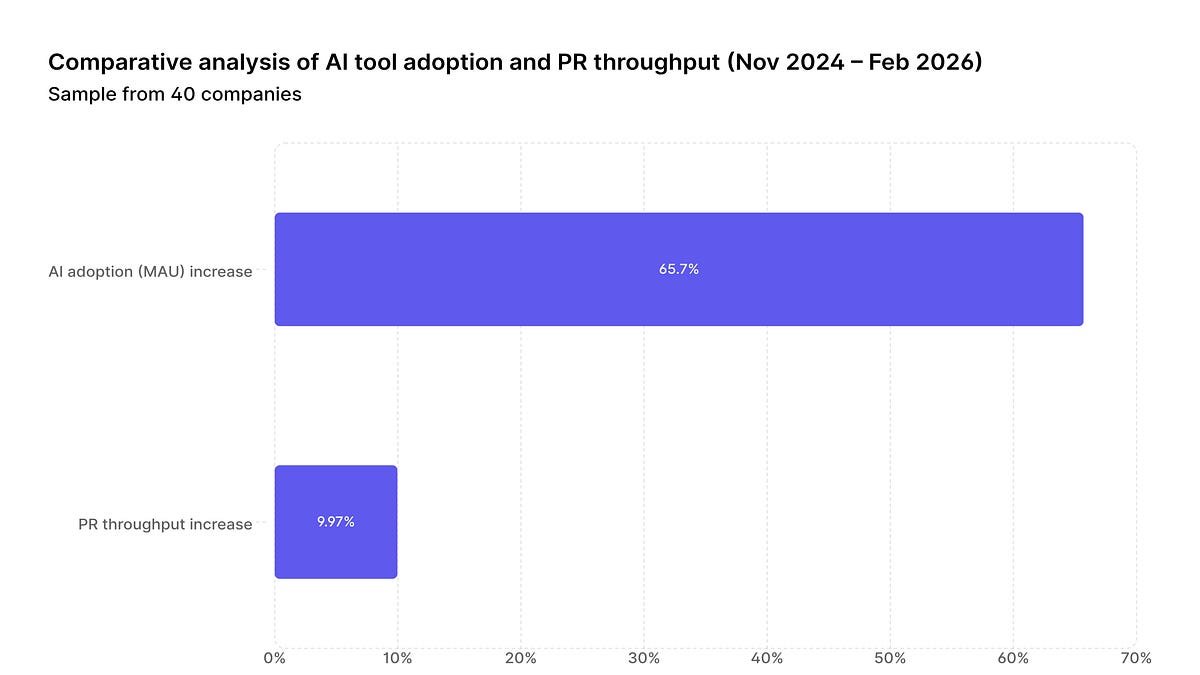
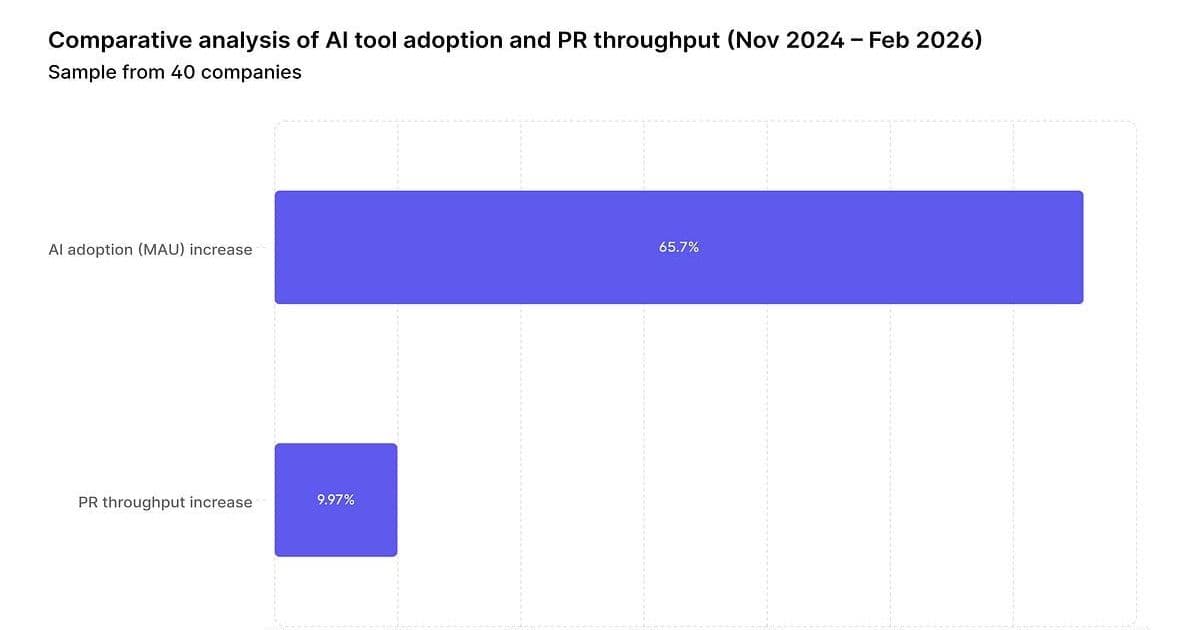
Between November 2024 and February 2026, AI usage among engineering teams increased by an average of 65%, yet pull request throughput only rose by 9.97%. The data, collected by DX as part of an ongoing longitudinal study, suggests that while AI is making a measurable impact, the gains are far more modest than many executives have been led to expect.
Why the disconnect?
The study's findings align with what engineering leaders are reporting anecdotally - most organizations are seeing gains in the 8-12% range. The gap between expectation and reality appears to stem from a fundamental misunderstanding of where developers actually spend their time.
As one senior developer explained to researchers: "The easy tasks are a little easier. The tedious tasks are a little less annoying. A four-day task might take three. But that doesn't mean I'm shipping 3x more PRs."
The bottleneck isn't coding
This insight cuts to the heart of why AI productivity gains are more incremental than transformative. Writing code represents only a fraction of an engineer's workload. The majority of time is spent on planning, alignment, scoping, code review, and handoffs - the human elements of the software development lifecycle that AI hasn't meaningfully impacted.
DX researchers filtered out potential gamification effects by excluding teams that set individual PR throughput targets, making their 9.97% figure particularly robust. Without this filtering, the data might have shown artificially inflated gains as engineers optimized for the metric rather than genuine productivity.
The study's authors note that while AI is accelerating the coding portion of the job, this represents a relatively small slice of how engineers actually spend their time. The human parts of software development - collaboration, decision-making, and coordination - remain largely untouched by current AI tools.
What this means for engineering leaders
For executives and boards who have been promised 2-3x productivity gains, these findings suggest a need to reset expectations. AI is moving the needle, but not at the transformative scale many had hoped for.
The research team is continuing to investigate why some teams are capturing more of AI's potential upside than others, and what leaders can do to close that gap. The full study will explore these variations and provide guidance on maximizing AI's impact.
In the meantime, engineering leaders should view AI as a tool for incremental improvement rather than a revolutionary force. The technology is delivering real value - approximately 10% more output - but it's not the 10x multiplier that has been widely advertised.
For teams looking to maximize their AI investment, the focus should perhaps shift from expecting wholesale transformation to understanding how to optimize the human-AI collaboration within the existing development workflow.
The gap between AI's promise and its practical impact reflects a broader pattern in technology adoption, where initial hype often gives way to more measured assessments of actual value delivered. As with previous transformative technologies, AI's ultimate impact may be significant but incremental rather than revolutionary.
Comments
Please log in or register to join the discussion