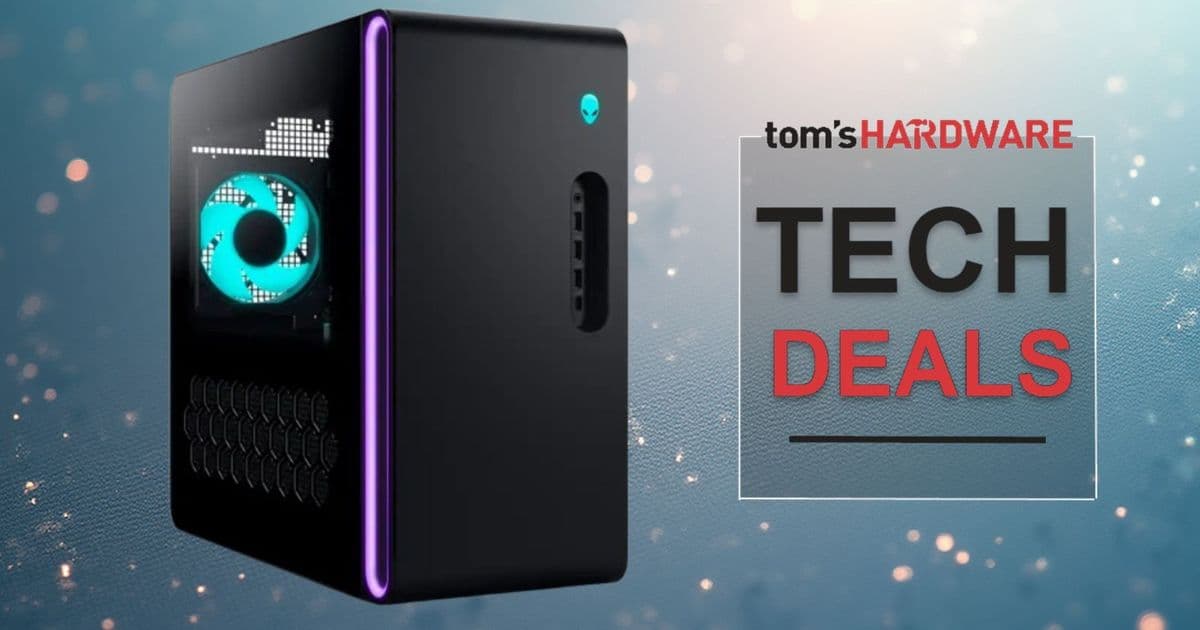
Alienware's President's Day sale offers a $400 discount on the Aurora gaming PC, featuring an RTX 5060 Ti, Intel Core Ultra 7 265F, and 32GB DDR5 RAM for $1,399. We analyze the hardware value, gaming performance expectations, and VRAM limitations.
The President's Day sales event has arrived early at Best Buy, where Alienware's Aurora gaming desktop is seeing a substantial $400 price cut, bringing the total to $1,399.99 from its original $1,799.99 list price. This discount represents one of the more compelling prebuilt gaming PC deals currently available, particularly for those seeking a balance between performance and value in the current GPU market.
Hardware Breakdown and Component Value
Let's examine what's inside this configuration and whether the price reflects genuine value:
Graphics Processing Unit: The system features an Nvidia RTX 5060 Ti with 8GB of VRAM. At current market prices tracked by PCPartPicker, a standalone RTX 5060 Ti 8GB graphics card costs approximately $359, representing one of the more significant components in any gaming PC build.
Memory Configuration: The Aurora comes equipped with 32GB of DDR5-5200 RAM. Individual 32GB DDR5 kits currently retail for around $345, making this an above-average memory configuration for a gaming PC at this price point.
Storage Solution: A 1TB Gen4 SSD is included for the operating system and game storage, with similar drives priced around $169 individually.
Processor: The Intel Core Ultra 7 265F serves as the CPU, paired with a 240mm all-in-one liquid cooler for thermal management.
When we tally just these core components (GPU, RAM, and storage), we reach approximately $873 before accounting for the CPU, motherboard, power supply, case, cooling solution, Windows 11 license, and additional fans. This suggests the remaining $526 covers all other components and assembly costs, which appears reasonable for a prebuilt system.
Gaming Performance Expectations
The hardware configuration positions this Aurora as a capable 1080p to 1440p gaming machine. The combination of the RTX 5060 Ti and Intel Core Ultra 7 265F should handle most modern titles at high settings in these resolution ranges with excellent frame rates.
For 4K gaming, the system's capabilities become more nuanced. While technically capable of running games at 4K resolution, users will encounter limitations. The 8GB VRAM capacity may become a bottleneck in newer, more demanding titles, particularly when running at maximum graphics settings. Texture streaming and asset loading could potentially cause stuttering or require graphics setting adjustments to maintain smooth gameplay.
However, the RTX 5060 Ti's inclusion in Nvidia's 50-series lineup brings DLSS 4 support with multi-frame generation capabilities. This technology can significantly improve frame rates in supported games by generating additional frames, helping to offset some of the performance limitations inherent in the 8GB VRAM configuration.
VRAM Considerations and Longevity
One of the most discussed aspects of this configuration is the 8GB VRAM limitation. While 8GB remains sufficient for the majority of current games at 1080p and 1440p resolutions, the gaming industry continues to push toward higher memory requirements.
Modern game development increasingly incorporates high-resolution textures, complex asset streaming, and advanced rendering techniques that benefit from additional VRAM. As games evolve over the next 2-3 years, the 8GB limitation may become more pronounced, potentially requiring users to lower graphics settings or accept reduced visual fidelity in some titles.
The decision between 8GB and 16GB VRAM configurations often comes down to budget constraints and intended use cases. For users primarily gaming at 1080p or 1440p who don't mind adjusting settings in demanding titles, the 8GB configuration offers excellent value. Those planning to game exclusively at 4K or wanting maximum future-proofing might consider configurations with more VRAM.
Design and Build Quality
The Alienware Aurora case maintains the brand's signature gamer aesthetic with clean lines and customizable RGB lighting. The 240mm AIO cooler ensures adequate thermal performance for the Intel Core Ultra 7 265F, while the overall build quality reflects Alienware's reputation for premium prebuilt systems.
Market Context and Alternatives
This deal arrives during the President's Day sales period, when many retailers offer discounts on gaming hardware. When compared to building a similar system from individual components, the Aurora represents competitive value, particularly considering the current GPU market conditions and component availability.
For users considering alternatives, the market offers various options ranging from budget-friendly builds with older generation hardware to high-end systems with top-tier components. The Aurora strikes a middle ground, offering modern hardware at a price point that balances performance with affordability.
Final Assessment
The $400 discount on Alienware's Aurora gaming PC presents a compelling value proposition for gamers seeking a capable system without building from scratch. The hardware configuration delivers solid 1080p and 1440p performance, with 4K gaming possible but with some limitations due to the 8GB VRAM.
For users prioritizing value and willing to work within the system's constraints, this deal offers excellent bang-for-buck. The combination of modern components, generous RAM allocation, and substantial discount makes it particularly attractive for those entering PC gaming or upgrading from older systems.
The primary consideration remains the 8GB VRAM limitation and its potential impact on future gaming experiences. However, for the majority of current gaming scenarios and at the discounted price point, this configuration delivers substantial performance that justifies serious consideration during the President's Day sales event.
Comments
Please log in or register to join the discussion