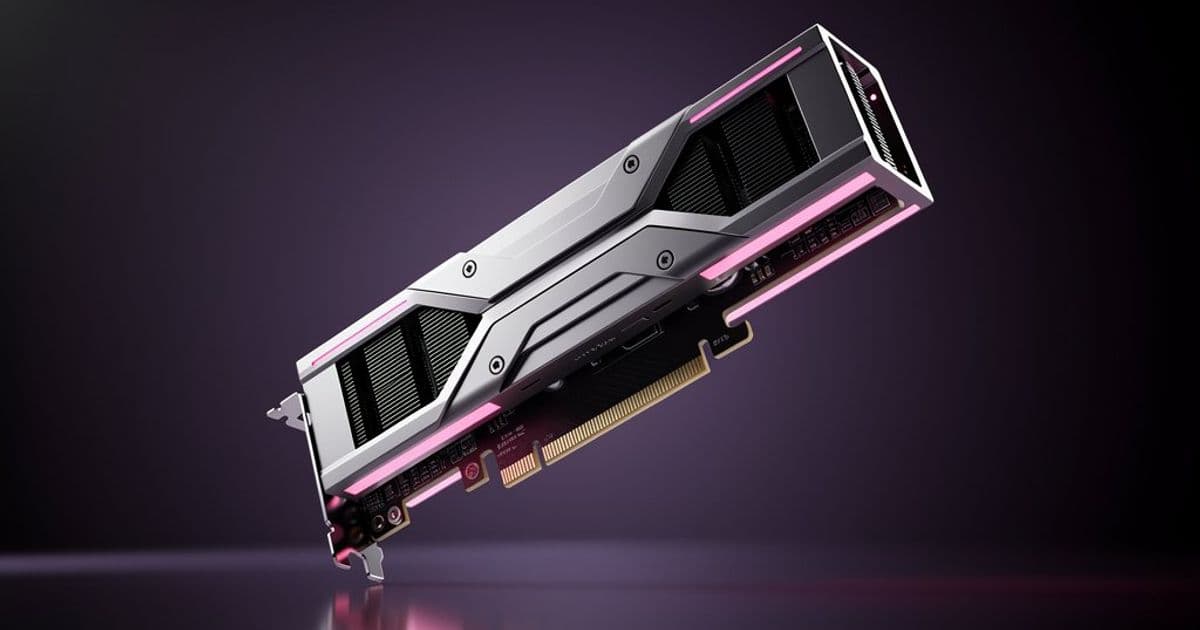
AWS has announced the general availability of EC2 G7e instances, powered by NVIDIA RTX PRO 6000 Blackwell Server Edition GPUs. These instances are designed to deliver cost-effective performance for generative AI inference and high-performance graphics, offering significant improvements in memory, bandwidth, and multi-GPU capabilities compared to previous generations.
AWS has moved its G7e instances from preview to general availability, marking a significant step for workloads requiring GPU acceleration. These instances are built around the NVIDIA RTX PRO 6000 Blackwell Server Edition GPUs, targeting two primary use cases: cost-effective generative AI inference and high-performance graphics. The architecture reflects a deliberate focus on balancing raw power with memory efficiency, which is critical as AI models grow in size and complexity.
The core advancement lies in the GPU itself. Compared to the previous G6e instances, the RTX PRO 6000 Blackwell GPUs offer double the GPU memory (96 GB per GPU) and 1.85 times the memory bandwidth. This isn't just a spec bump; it directly impacts what you can run. For example, a single G7e instance can handle medium-sized generative AI models with up to 70 billion parameters using FP8 precision. This capability allows teams to deploy more capable models without immediately resorting to multi-GPU setups, simplifying architecture and potentially reducing costs for inference workloads that fit within this memory envelope.
However, the real architectural story emerges when models exceed a single GPU's capacity. G7e instances introduce support for NVIDIA GPUDirect P2P over PCIe, enabling direct communication between GPUs within the same instance. This reduces latency for multi-GPU workloads significantly. The inter-GPU bandwidth is up to four times higher than what was available in G6e instances (which used L40s GPUs). For distributed inference or training, this means that splitting a model across multiple GPUs incurs less performance penalty. A single G7e.48xlarge instance, for instance, aggregates 8 GPUs to provide 768 GB of total GPU memory, making it feasible to run very large models within a single node.
Networking is another area where the architecture has been fortified. G7e instances offer four times the networking bandwidth compared to G6e. For multi-node workloads, this is crucial. The instances support NVIDIA GPUDirect RDMA with Elastic Fabric Adapter (EFA), which minimizes the latency of remote GPU-to-GPU communication across nodes. This is a key enabler for scaling out distributed training or inference across multiple instances. Furthermore, support for NVIDIA GPUDirectStorage with Amazon FSx for Lustre allows for data throughput up to 1.2 Tbps, accelerating the process of loading large model weights and datasets from storage to the instance's GPUs.
Instance Specifications and Deployment Patterns
The G7e family offers a range of sizes, allowing you to match the instance to the workload's scale. All instances are powered by Intel Emerald Rapids processors and include local NVMe SSD storage. The table below outlines the key specifications:
| Instance Name | GPUs | GPU Memory (GB) | vCPUs | Memory (GiB) | Storage (TB) | EBS Bandwidth (Gbps) | Network Bandwidth (Gbps) |
|---|---|---|---|---|---|---|---|
| g7e.2xlarge | 1 | 96 | 8 | 64 | 1.9 x 1 | Up to 5 | 50 |
| g7e.4xlarge | 1 | 96 | 16 | 128 | 1.9 x 1 | 8 | 50 |
| g7e.8xlarge | 1 | 96 | 32 | 256 | 1.9 x 1 | 16 | 100 |
| g7e.12xlarge | 2 | 192 | 48 | 512 | 3.8 x 1 | 25 | 400 |
| g7e.24xlarge | 4 | 384 | 96 | 1024 | 3.8 x 2 | 50 | 800 |
| g7e.48xlarge | 8 | 768 | 192 | 2048 | 3.8 x 4 | 100 | 1600 |
This tiered approach allows for granular cost control. A startup experimenting with a 70B parameter model might start with a single g7e.8xlarge, while a large-scale inference service could deploy a fleet of g7e.48xlarge instances to handle concurrent requests for massive models.
Operational Considerations and Trade-offs
When integrating G7e instances into your architecture, several operational patterns and trade-offs emerge:
1. Cost vs. Performance Optimization: G7e instances are positioned as cost-effective for inference. The ability to run larger models on fewer GPUs can reduce total cost of ownership (TCO) compared to older instances that required more nodes for the same workload. However, the pricing structure (On-Demand, Savings Plans, Spot) requires careful analysis. For predictable, long-running workloads, Savings Plans offer significant discounts. For batch processing or fault-tolerant inference, Spot Instances can provide the lowest cost, but with the risk of interruption. The trade-off is between operational simplicity (On-Demand) and cost optimization (Savings Plans/Spot).
2. Multi-GPU Communication Overhead: While GPUDirect P2P and high inter-GPU bandwidth reduce latency, splitting a model across GPUs still introduces communication overhead. The efficiency gain depends heavily on the model's architecture and the parallelism strategy. For some models, the overhead of synchronizing gradients or activations between GPUs may negate the benefits of the larger total memory. This is a classic trade-off in distributed computing: the cost of coordination versus the benefit of scale. Profiling your specific model on a G7e instance is essential to determine the optimal GPU count.
3. Networking and Multi-Node Scaling: The enhanced networking with EFA and GPUDirect RDMA is a major advantage for multi-node workloads. However, it also introduces complexity. You need to ensure your cluster configuration (e.g., in Amazon EKS or ECS) properly leverages these capabilities. The trade-off here is between the performance gains from low-latency inter-node communication and the operational overhead of managing a distributed cluster. For workloads that can fit within a single node (up to 768 GB of GPU memory), the architectural simplicity of a single instance is often preferable.
4. Storage Throughput for Model Loading: GPUDirectStorage with FSx for Lustre can dramatically speed up loading large model weights. This is critical for reducing cold-start times in inference services. The trade-off is cost and complexity. FSx for Lustre is a high-performance file system, and its cost must be justified by the reduction in model loading time. For models that are frequently updated or for services requiring rapid scaling, this investment can be worthwhile. For static models, the benefit may be less pronounced.
Integration with the AWS Ecosystem
G7e instances are designed to integrate seamlessly into existing AWS ML and containerized workflows. You can use the AWS Deep Learning AMIs (DLAMI) to get a pre-configured environment with necessary drivers and libraries. For orchestration, G7e instances are supported by Amazon ECS and Amazon EKS, allowing you to manage GPU workloads as part of a broader microservices architecture. Support for Amazon SageMaker AI is on the roadmap, which will further simplify the deployment of inference endpoints using these instances.
To get started, you can launch G7e instances via the AWS Management Console, AWS CLI, or SDKs. They are currently available in the US East (N. Virginia) and US East (Ohio) regions. For a full list of regional availability and future roadmap items, check the CloudFormation resources tab in AWS Capabilities by Region.
Conclusion
The Amazon EC2 G7e instances represent a targeted evolution in GPU-accelerated computing. By focusing on memory capacity, inter-GPU communication, and high-speed networking, AWS is addressing the specific bottlenecks faced by modern generative AI and graphics workloads. The architectural choices—such as the tiered instance sizing and support for GPUDirect technologies—provide flexibility for different scales of operation. For teams building inference services or high-performance graphics applications, G7e offers a compelling balance of performance and cost, provided the workload characteristics align with the instance's strengths. As with any new instance type, the key is to validate performance against your specific models and use cases before committing to a large-scale deployment.




Comments
Please log in or register to join the discussion