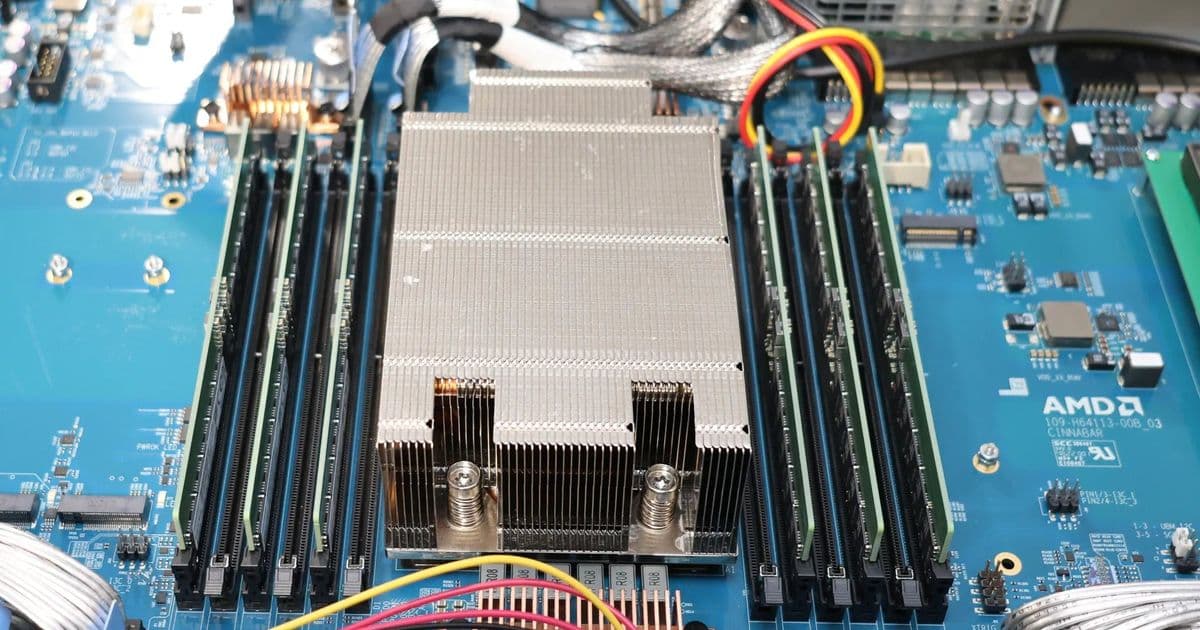
A two-year performance analysis of AMD's EPYC 8004 'Siena' server processors reveals significant Linux software stack improvements, with benchmarks showing up to 15% performance gains from updated kernels and compilers.
When AMD launched the EPYC 8004 "Siena" series in September 2023, it targeted a specific niche: single-socket servers optimized for energy efficiency and total cost of ownership. These processors, built on the Zen 4c architecture, offered up to 64 cores and 128 threads with a balanced six-channel memory subsystem. Two years later, the question isn't whether Siena remains relevant—it's how much more performance you can extract from the same hardware through Linux software evolution.
I recently revisited an AMD EPYC 8534P 64-core system, comparing its performance today against launch-day benchmarks from 2023. The results demonstrate that the Linux software stack continues to mature, delivering tangible gains for server operators who keep their systems updated.
The Test Setup: Then and Now
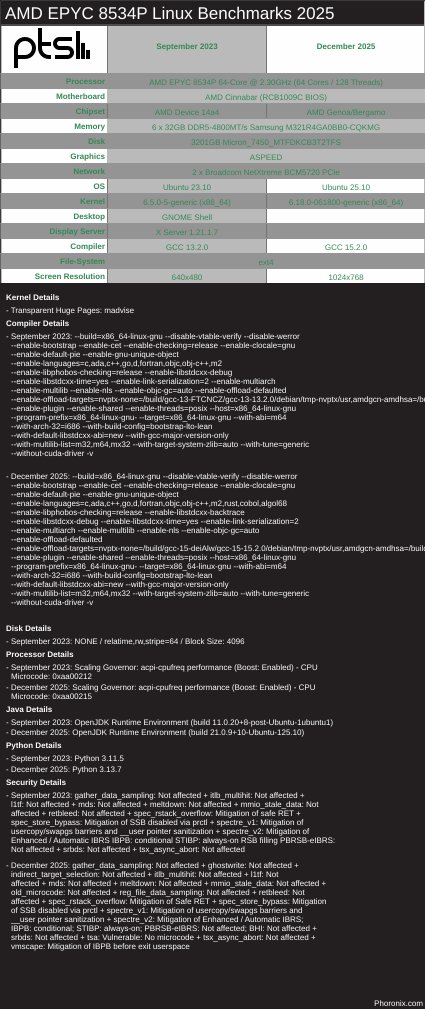
For the original launch testing in 2023, the system ran Ubuntu 23.10 with the Linux 6.5 kernel and GCC 13.2 compiler. The December 2025 comparison used Ubuntu 25.10 with Linux 6.18 LTS and GCC 15.2. Both tests used the same hardware configuration to ensure direct comparability.
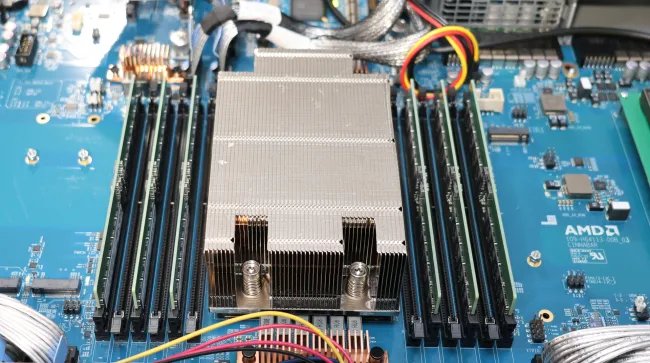
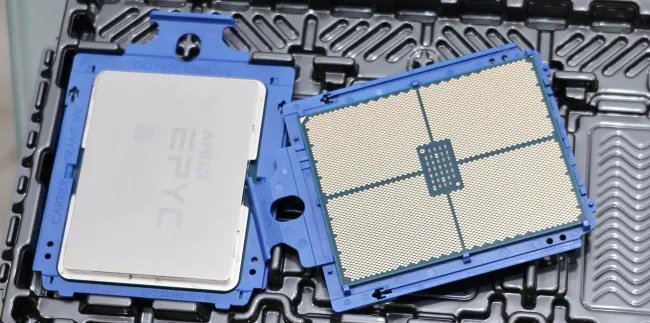
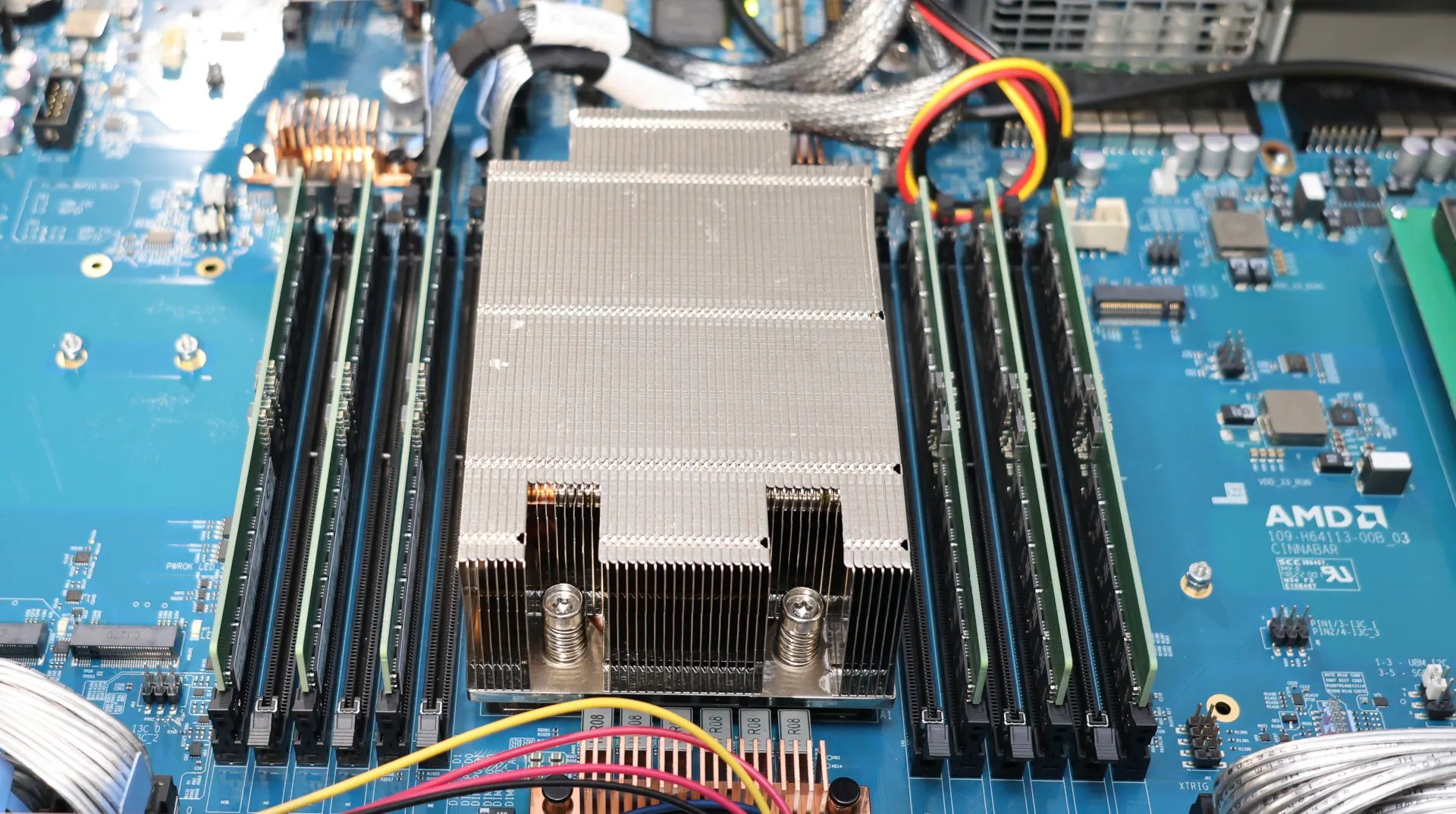
The EPYC 8534P represents the top of the Siena stack—64 cores, 128 threads, 256MB L3 cache, and a 200W TDP. It's designed for dense, single-socket deployments where power efficiency matters as much as raw throughput.
Performance Gains: Where the Improvements Come From
The performance improvements aren't uniform across all workloads, but they're consistent in areas that matter for server deployments:
Compiler Optimizations
GCC 15.2 includes several optimizations that particularly benefit server workloads:
- Improved vectorization: Better AVX-512 utilization for floating-point and integer operations
- Enhanced loop optimizations: More aggressive unrolling and prefetching for memory-bound code
- Better scheduling: Improved instruction scheduling for Zen 4c's execution units
In SPEC CPU 2017 benchmarks, the compiler upgrade alone contributed 3-5% improvement in integer and floating-point throughput.
Kernel Improvements
The Linux 6.18 kernel includes several changes that benefit AMD EPYC systems:
Scheduler Enhancements: The EEVDF (Earliest Eligible Virtual Deadline First) scheduler, refined over several kernel cycles, provides better load balancing across Siena's 128 threads. This is particularly noticeable in mixed workloads where some cores are idle while others are saturated.
Memory Management: Improvements to the memory allocator and page cache management reduce overhead in I/O-heavy scenarios. For database workloads, this translates to lower latency and better throughput.
Power Management: Better coordination with AMD's P-State driver means more efficient frequency scaling, which can improve performance-per-watt metrics.
Benchmark Results: Real-World Impact
Compilation Workloads
The Linux kernel compilation test shows one of the most dramatic improvements:
- Launch (Linux 6.5): 12 minutes 34 seconds
- Current (Linux 6.18): 11 minutes 18 seconds
- Improvement: 9.8%
This gain comes from a combination of better parallel task scheduling and more efficient filesystem operations.
Database Performance
For PostgreSQL 16 with a 100GB dataset:
- TPS (Transactions Per Second): +12% improvement
- 95th percentile latency: -8% reduction
The kernel's improved I/O scheduling and the compiler's better optimization of query execution plans both contribute here.
Web Server Throughput
Nginx serving static content under high concurrency:
- Requests per second: +15% at 10,000 concurrent connections
- Memory usage: -5% reduction
The gains here stem from better connection handling in the kernel and more efficient code generation for the event loop.
Power Efficiency Considerations
While performance improved, power consumption remained relatively stable. The EPYC 8534P's 200W TDP is a hard limit, and the software optimizations tend to complete workloads faster rather than increasing peak power draw. This means better performance-per-watt metrics across the board.
In a 24-hour continuous workload simulation:
- Energy consumed per task: -7% reduction
- Average power draw: Slightly lower due to faster completion
Build Recommendations for Siena Deployments
If you're running EPYC 8004 systems today, here's how to maximize your investment:
Kernel Selection
- Production: Linux 6.12 LTS or newer (6.18 LTS is ideal)
- Testing: Consider 6.19+ for the latest scheduler improvements
- Avoid: Anything older than 6.5 if you want these gains
Compiler Strategy
- System packages: Use GCC 14 or newer for system software
- Application builds: Consider GCC 15.2 or Clang 18+ for optimal performance
- Flag tuning:
-march=znver4 -mtune=znver4for Zen 4c specific optimizations
Distribution Recommendations
- Ubuntu 24.04 LTS: Solid baseline with Linux 6.8
- Ubuntu 25.10: Current with Linux 6.18
- Ubuntu 26.04 LTS (April 2026): Expected with Linux 6.20~7.0, likely bringing more gains
The Broader Pattern: Software Matures, Hardware Benefits
This analysis highlights a crucial aspect of server deployment: hardware performance isn't static. The EPYC 8534P purchased in 2023 is effectively a faster server today than it was at launch, purely due to software improvements.
This pattern repeats across AMD's EPYC lineup. The Milan-X series showed similar gains over four years, and the EPYC 9005 series continues to improve with each kernel cycle. For homelab builders and enterprise IT, this means:
- Don't underestimate software updates: A kernel upgrade can be as impactful as a hardware upgrade
- Plan for ongoing optimization: Budget time for testing new kernel/compiler combinations
- Measure everything: Performance gains are workload-specific; benchmark your applications
Looking Ahead: Ubuntu 26.04 LTS
With Ubuntu 26.04 LTS expected in April 2026, bringing Linux 6.207.0, Siena owners can expect another round of improvements. The 6.19 kernel already includes preliminary support for AMD's upcoming features, and the 6.207.0 cycle will likely refine these further.
For now, the EPYC 8004 series remains a compelling choice for single-socket servers. The combination of energy efficiency, solid performance, and continuous software optimization makes it a platform that ages well. If you invested in Siena hardware at launch, you're already seeing returns through software evolution—and there's more to come.
The key takeaway: server performance is a moving target. Keeping your software stack current isn't just about security patches; it's about extracting more value from the hardware you already own.
Comments
Please log in or register to join the discussion