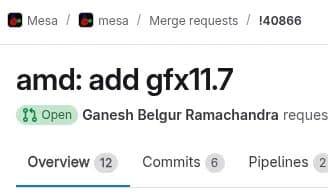
Mesa patches for RADV Vulkan and RadeonSI OpenGL drivers are under review to add support for AMD's GFX11.7 "RDNA 4m" graphics IP, which appears to be an APU product with ISA changes bridging RDNA 3 and RDNA 4 architectures.
AMD's GFX11.7 "RDNA 4m" graphics IP is one step closer to official support in open-source Mesa drivers, with patches for both the RADV Vulkan driver and RadeonSI Gallium3D (OpenGL) driver now under review ahead of Mesa 26.1. The new GPU target, designated as GFX1170, represents an interesting middle ground in AMD's graphics architecture evolution.
What is GFX11.7 "RDNA 4m"?
The GFX11.7 designation (GFX1170) sits within AMD's RDNA 3 family but incorporates ISA changes that align it more closely with the newer RDNA 4 graphics IP. This "RDNA 4m" moniker suggests a transitional architecture that bridges the gap between generations while maintaining compatibility with the broader GFX11 ecosystem.
According to the LLVM shader compiler patches that appeared in February, this graphics IP is destined for an APU (Accelerated Processing Unit) product. However, the specific product line remains unannounced, though it's clear this won't be part of the current Ryzen AI 300/400 series, which utilize the RDNA 3.5 (GFX115x) IP.
Mesa Driver Support in Development
The Mesa enablement process has been methodical, with six patches now under review that cover:
- Common AMD code changes for GFX11.7 support
- RadeonSI driver-specific modifications
- RADV driver-specific modifications
- GFX11.7 ADDRLIB implementation
The development effort requires approximately three thousand lines of new code, which is notably more extensive than typical GPU enablement patches. This larger codebase suggests significant architectural changes or new features that require substantial driver support.
Architectural Context
What makes GFX11.7 particularly interesting is how it fits into AMD's graphics roadmap. Rather than being a straightforward RDNA 3 or RDNA 4 product, it represents a hybrid approach:
- Maintains core RDNA 3 architecture (hence "RDNA 4m" designation)
- Incorporates ISA modifications from RDNA 4
- Bridges compatibility between two generations
- Part of a broader family that includes GFX1171 and GFX1172 targets
This approach allows AMD to leverage RDNA 3's proven manufacturing process and design while incorporating newer instruction set capabilities from RDNA 4, potentially offering improved performance or new features without the full transition to a new architecture.
Timeline and Expectations
The patches are currently under review for inclusion in Mesa 26.1, which typically follows a predictable release schedule. Once merged, users with compatible hardware will gain access to both Vulkan (via RADV) and OpenGL (via RadeonSI) support for this new GPU target.
While the patches don't reveal specific product details yet, the focus on APU integration suggests this could be aimed at mobile or integrated graphics applications where power efficiency and feature set are crucial considerations.
Technical Implications
The substantial code changes required for GFX11.7 support indicate this isn't a simple GPU ID addition. The implementation likely involves:
- New instruction handling for RDNA 4-aligned ISA changes
- Updated memory management and addressing capabilities
- Modified shader compilation paths
- Enhanced feature detection and capability reporting
For developers and enthusiasts, this support means future AMD APUs with GFX11.7 will have full open-source driver support from day one, continuing AMD's strong commitment to Linux compatibility and the open-source graphics stack.
The ongoing development of GFX11.7 support demonstrates the collaborative nature of open-source graphics development, where driver enablement often precedes official product announcements, giving Linux users early access to support for upcoming hardware.
Comments
Please log in or register to join the discussion