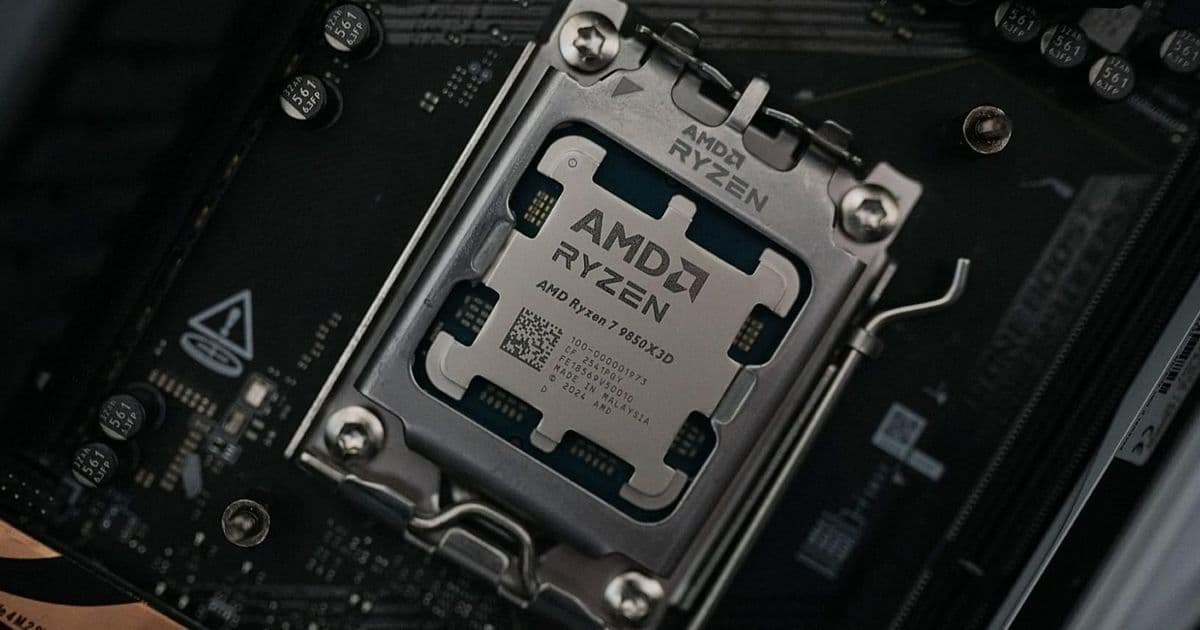
AMD's Ryzen 7 9850X3D claims the title of world's fastest gaming processor, but offers only marginal improvements over the 9800X3D at a higher price point.
The Ryzen 7 9850X3D has officially claimed the title of world's fastest gaming processor, but the victory comes with an asterisk. At $499, AMD's latest 3D V-Cache chip delivers only marginal performance gains over the Ryzen 7 9800X3D while consuming significantly more power, raising questions about its market positioning.
A Familiar Crown with New Complications
For years, AMD has dominated the gaming CPU market with its 3D V-Cache processors. The Ryzen 7 9800X3D has been the undisputed champion, offering exceptional gaming performance that leaves both Intel and AMD's non-X3D chips in the dust. The 9850X3D continues this legacy, but the margins have narrowed considerably.
Unlike previous X3D releases that offered clear generational improvements, the 9850X3D exists in a peculiar space. It's essentially a binned version of the 9800X3D with a 400MHz higher boost clock (5.6GHz versus 5.2GHz), but this modest increase translates to only 5-7% performance gains in lightly-threaded tasks and minimal improvements in gaming scenarios.
The Price-Performance Paradox
The pricing structure reveals the chip's awkward positioning. At $499, the 9850X3D sits between the 9800X3D ($470 street price) and the 12-core 9900X3D ($560 street price). However, the performance delta doesn't justify the price premium over the 9800X3D, especially considering the 9800X3D can already achieve a 200MHz boost with Precision Boost Overdrive enabled.
This creates a strange market dynamic where the 9850X3D seems designed more to protect the 9800X3D's price point than to serve as a genuine upgrade path. If the 9800X3D were to drop below $450, it would create uncomfortable competition for AMD's higher-margin products.
Technical Specifications and Architecture
The 9850X3D shares the same fundamental architecture as its predecessor:
- Core Configuration: 8 Zen 5 cores with 16 threads
- Cache: 104MB total (8MB L2 + 96MB L3 3D V-Cache)
- TDP: 120W (same as 9800X3D)
- Memory Support: DDR5-5600
- Manufacturing: Single compute die with SRAM placed under the CCD for improved thermal performance
The decision to place the SRAM under the compute die represents a significant engineering achievement, allowing for full multiplier-based overclocking that wasn't possible with previous X3D designs where SRAM sat atop the die.
Gaming Performance: The Expected Dominance
In gaming benchmarks, the 9850X3D delivers the performance you'd expect from AMD's flagship gaming processor. It maintains the double-digit improvements over Intel's offerings and AMD's non-X3D chips that have become standard for X3D processors. However, the gains over the 9800X3D are minimal in most titles.
Some games show 5-7% improvements thanks to the higher boost clocks, but many titles see only single-digit gains or no improvement at all. This is particularly noticeable in games that don't benefit significantly from additional cache or higher clock speeds.
Power Consumption Concerns
One of the more surprising aspects of the 9850X3D is its power consumption. Despite maintaining the same 120W TDP as the 9800X3D, the chip consumes approximately 30% more power during gaming workloads. This efficiency regression is concerning, especially when the performance gains don't justify the increased power draw.
The higher power consumption also impacts thermal performance, though the chip still runs relatively cool compared to non-X3D processors thanks to the efficient thermal interface provided by the under-die cache design.
Market Positioning and Target Audience
AMD positions the 9850X3D as the ultimate choice for gamers who want the absolute best performance, particularly in frequency-sensitive titles. However, this marketing message rings hollow when the performance differences are so minimal.
A more plausible explanation for the 9850X3D's existence is its appeal to OEMs and system builders who haven't yet adopted the 9800X3D. It could also serve as a way to clear higher-binned silicon that doesn't quite meet the specifications for the more expensive 9900X3D or 9950X3D models.
The Bigger Picture: X3D's Continued Dominance
Despite the 9850X3D's questionable value proposition, it underscores an important reality: AMD's 3D V-Cache technology remains unmatched in the gaming CPU market. Intel has yet to respond with its own L3 cache technology, though that could change with Nova Lake processors expected later this year.
For now, X3D chips continue to deliver the best gaming performance available, with improvements that are only magnified in cache-sensitive titles. The technology has proven its worth across multiple generations, from Zen 3 through Zen 5.
Should You Buy the 9850X3D?
The answer for most gamers is probably not. The Ryzen 7 9800X3D offers nearly identical gaming performance at a lower price point, and the 9800X3D's ability to achieve similar boost clocks through PBO further diminishes the 9850X3D's appeal.
For those building new systems, the 9800X3D represents a better value. For existing 9800X3D owners, there's no compelling reason to upgrade. The 9850X3D might make sense for specific use cases where every fraction of a frame per second matters, but for the vast majority of gamers, it's an unnecessary expense.
Looking Ahead
The Ryzen 7 9850X3D feels like a stopgap product rather than a genuine next step in AMD's CPU roadmap. It raises questions about AMD's strategy for its X3D lineup and whether we'll see more binned variants in the future.
As Intel prepares its response with bLLC technology in Nova Lake, AMD will need to continue innovating to maintain its gaming performance advantage. The 9850X3D suggests that the low-hanging fruit of clock speed improvements is largely exhausted, and future gains will likely come from architectural improvements or increased cache sizes.
The world's fastest gaming processor title is nice to have, but without meaningful performance improvements to back it up, the Ryzen 7 9850X3D feels more like a technicality than a triumph.
Comments
Please log in or register to join the discussion