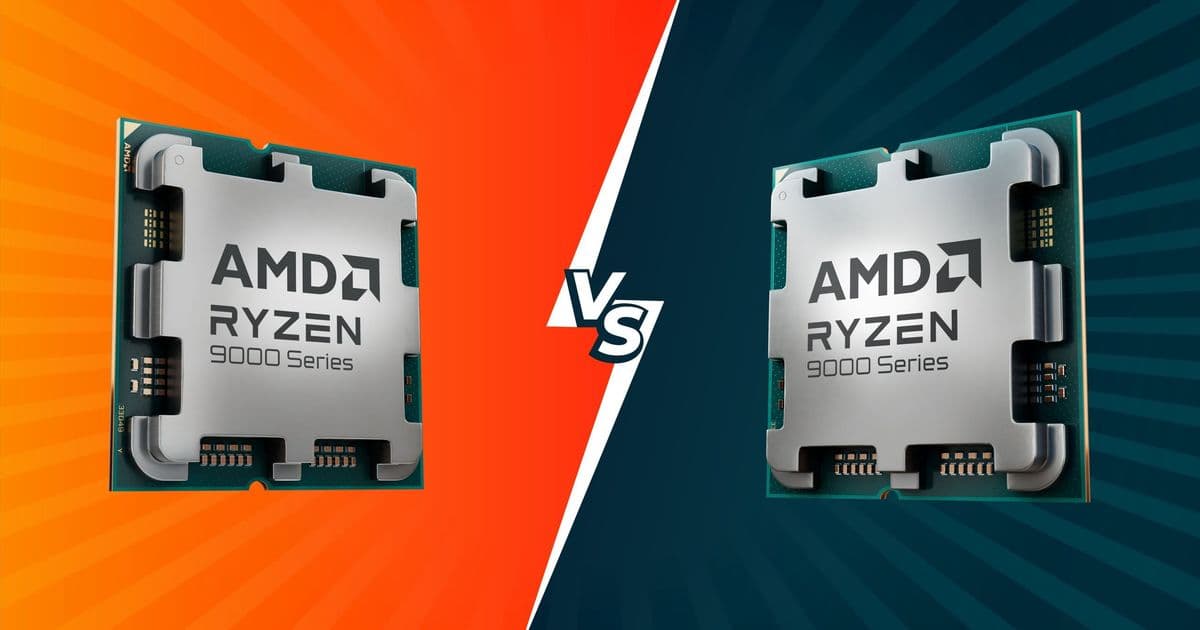
AMD's new Ryzen 7 9850X3D offers only 3.2% better gaming performance than its predecessor, requiring a $30-$70 price premium despite identical core counts and cache configurations.
AMD's Mid-Generation Refresh Delivers Minimal Performance Gains
AMD has released the Ryzen 7 9850X3D as a mid-generation refresh to its Ryzen 7 9800X3D, but the performance improvements are so marginal that they barely justify the price premium.
Nearly Identical Specifications
The two processors share remarkable similarities:
| Specification | Ryzen 7 9850X3D | Ryzen 7 9800X3D |
|---|---|---|
| Architecture | Zen 5 | Zen 5 |
| Process Node | 4nm | 4nm |
| Cores/Threads | 8/16 | 8/16 |
| Base Clock | 4.7 GHz | 4.7 GHz |
| Boost Clock | 5.6 GHz | 5.2 GHz |
| L2+L3 Cache | 104MB (96MB 3D V-Cache) | 104MB (96MB 3D V-Cache) |
| TDP | 120W | 120W |
| Memory Support | DDR5-5600 | DDR5-5600 |
| Socket | AM5 | AM5 |
The only meaningful difference is the 400MHz higher boost clock on the 9850X3D.
Gaming Performance: 3.2% Improvement at Best
In extensive 1080p gaming benchmarks using an RTX 5090 FE to eliminate GPU bottlenecks, the 9850X3D delivered a geomean of 211.2 FPS across 16 modern games, compared to 204.6 FPS for the 9800X3D.
Individual game results showed:
- A Plague Tale: Requiem: +2.8%
- F1 2024: +4.7%
- Flight Simulator 24: +6.2%
- DOOM: The Dark Ages: +12.6% (1% lows only)
- Starfield, Monster Hunter Wilds, Cyberpunk 2077: No meaningful difference
Power Efficiency Takes a Hit
The performance gains come at a significant power cost:
- Gaming power draw: 106W vs 81.4W (30% increase)
- FPS per watt: 1.99 vs 2.51 (20% less efficient)
- Thermals: 61°C vs 58°C (negligible difference)
This means the 9850X3D delivers worse value when considering performance per watt, with an FPS/$ ratio of 0.42 compared to 0.44 for the 9800X3D.
Productivity Performance: Mixed Results
Multi-threaded workloads showed essentially no difference between the two CPUs, as expected from processors with identical core counts and cache configurations.
However, single-threaded performance favored the 9850X3D by approximately 6.5%, with notable improvements in:
- Cinebench 2024 single-core: +7%
- POV-Ray: +6.5%
- Lame audio encoding: +6%
Overclocking Considerations
Both processors support full multiplier-based overclocking and AMD's Precision Boost Overdrive 2 (PBO2). Interestingly, the 9800X3D can match the 9850X3D's gaming performance with PBO enabled, while the 9850X3D gains little from even higher boost clocks.
Pricing Analysis
- Ryzen 7 9850X3D MSRP: $499
- Ryzen 7 9800X3D MSRP: $479 (currently $430-$470 retail)
The 9850X3D costs 6% more but delivers only 2-3% better gaming performance and 3-6% better single-threaded productivity performance.
The price premium becomes harder to justify when considering:
- The 9800X3D's ability to match performance with PBO
- Higher power consumption requiring better cooling
- Worse performance per watt
- The 9800X3D's current street prices being $30-$70 lower
The Verdict
While the Ryzen 7 9850X3D technically outperforms the 9800X3D, the margins are so small that they're often within the margin of error for gaming. The 9800X3D offers better value, better efficiency, and can match the 9850X3D's performance with overclocking.
For new builds where absolute peak performance matters and budget is less constrained, the 9850X3D delivers its promised improvements out of the box.
For upgrades or value-conscious builds, the 9800X3D remains the smarter choice, offering nearly identical real-world performance at a lower price point with better power efficiency.
The comparison represents one of the closest CPU faceoffs in recent memory, with the older model maintaining its position as the better value option despite being technically superseded.
Comments
Please log in or register to join the discussion