AMD announces Ryzen AI Max PRO 400 series with 50% more memory capacity, enabling larger AI models in a single SoC system.
AMD Ryzen AI Max PRO 400: 192GB Memory Boost Targets AI Workloads
AMD is making waves ahead of Computex with the announcement of their Ryzen AI Max PRO 400 series, a refresh of their existing Ryzen AI Max 300 chips that brings a significant memory capacity increase while maintaining most other specifications. The headline feature is support for up to 192GB of LPDDR5X memory—a 50% increase over the previous generation—making these chips particularly interesting for AI workloads that need to process large models locally.
Strix Halo Architecture Continues
The Ryzen AI Max PRO 400 family continues to be built around AMD's Strix Halo silicon, which combines high-performance computing with integrated graphics specifically designed for AI tasks. This SoC architecture integrates up to 16 Zen 5 CPU cores with AMD's RDNA 3.5 integrated GPU, all fed by a 256-bit memory bus optimized for LPDDR5X memory subsystems.
"The combination of the high-performance iGPU and LPDDR5X-based memory subsystem has made Strix Halo a chip to contend with in the AI space over the last year," notes industry analyst Sarah Chen. "AMD is now looking to extend this advantage with increased memory capacity."
Spec Bumps and Memory Capacity
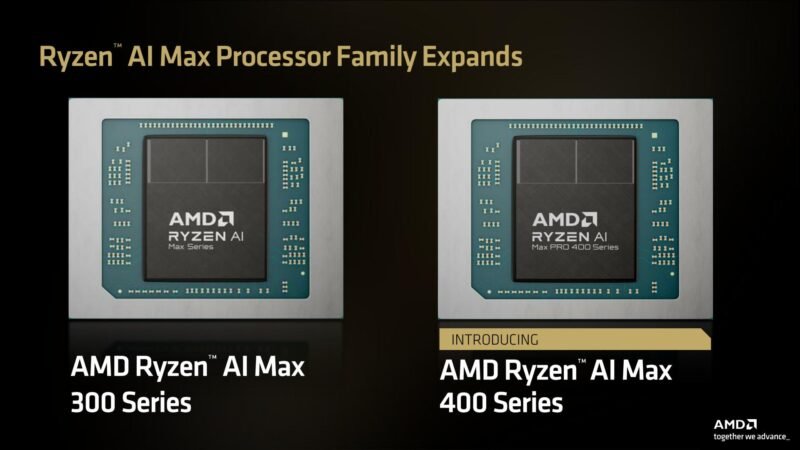
Compared to their Ryzen AI Max 300 counterparts, the Ryzen AI Max PRO 400 chips represent a rather modest refresh in terms of clock speeds and core configurations. Most SKUs remain unchanged in these areas, with only the top-end Ryzen AI Max+ PRO 495 receiving meaningful specification bumps:
| Feature | Ryzen AI Max+ PRO 495 | Ryzen AI Max+ PRO 390 (Previous Gen) |
|---|---|---|
| CPU Cores | 16 | 12 |
| Max Boost | 5.2GHz | 5.0GHz |
| L3 Cache | 64MB | 64MB |
| NPU | 55 TOPS | 50 TOPS |
| GPU | Radeon 8065S (40 CUs) | Radeon 8050S (32 CUs) |
| TDP | 45-120W | 45-120W |
| Max RAM | 192GB | 128GB |
The most significant upgrade is the memory capacity, jumping from 128GB to 192GB of LPDDR5X RAM. This increase becomes possible thanks to the advent of 24GB (192Gbit) LPDDR5X memory chips, which allow AMD to push the boundaries of what's feasible in a single SoC system.
Implications for AI Workloads
The expanded memory capacity has direct implications for AI workloads. With the ability to allocate up to 160GB of memory to the GPU (leaving 32GB for the CPU), these systems can now load and process 300B FP4 parameter models—something previously only possible in more expensive systems like the Mac Studio.
"This memory increase addresses a key bottleneck in local AI inference," explains Dr. Marcus Rodriguez, AI hardware specialist. "While larger models don't necessarily translate to better performance for all tasks, the ability to run massive parameter models locally without network dependencies opens up new possibilities for privacy-sensitive applications and offline AI processing."
However, it's important to note that the memory bandwidth hasn't increased proportionally to the capacity. AMD isn't boosting the compute throughput either, meaning existing bottlenecks like pre-fill performance will likely remain unchanged. The memory increase is primarily about capacity, not speed.
PRO Features and Market Positioning
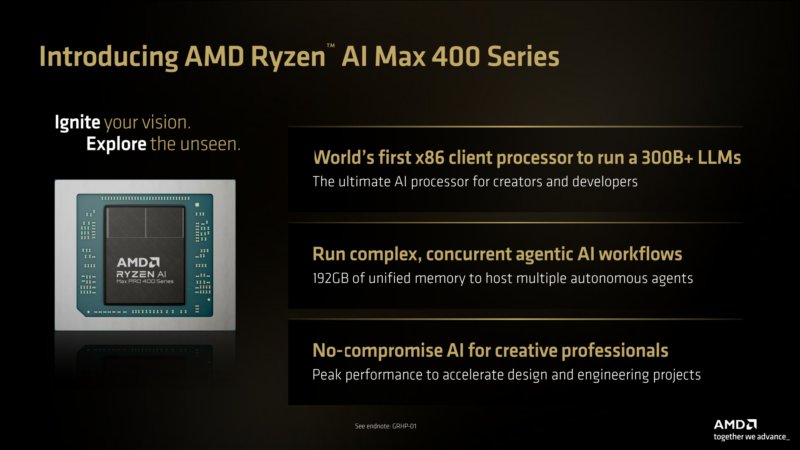
AMD is taking an interesting approach with this refresh by launching only PRO SKUs initially. This means all Ryzen AI Max 400 systems will include AMD's full suite of enterprise management features, but it also means these chips will carry a price premium.
"AMD is clearly targeting the enterprise AI market with these chips," observes tech analyst James Peterson. "The PRO designation indicates these are built for business environments where security, manageability, and reliability are paramount. This focus explains why we're not seeing non-PRO variants at launch—AMD is doubling down on the high-margin AI market."
This represents a shift from the 300 series, which were positioned as high-end laptop and small form factor chips with broader applications including gaming. The 400 series appears to be laser-focused on AI workloads, reflecting AMD's strategic priorities in the current market.
System Availability and Partners
Systems based on the Ryzen AI Max PRO 400 chips will begin shipping in the third quarter of 2026. AMD has confirmed partnerships with major OEMs including ASUS, Lenovo, and HP, though the exact configurations and pricing haven't been disclosed yet.
While officially rated for use across laptops, mobile workstations, and desktops, industry trends suggest these chips will likely appear primarily in desktop systems, particularly small form factor desktops like AMD's own Ryzen AI Halo, which is confirmed to be getting the 400 series chips later this year.
Build Recommendations
For those considering a system with the Ryzen AI Max PRO 400, here are some recommendations based on different use cases:
AI Development Workstation: The Ryzen AI Max+ PRO 495 with 192GB RAM would be ideal for researchers and developers working with large language models, though the premium price tag might be justified only for professional environments.
Small Business AI Server: The Ryzen AI Max PRO 490 (12 cores, 5.0GHz) offers a good balance of performance and price for businesses implementing AI solutions for customer service, data analysis, or internal tools.
Edge AI Appliance: The Ryzen AI Max PRO 485 (8 cores, 5.0GHz) provides sufficient power for edge computing applications where local AI processing is needed but full 192GB capacity isn't required.
The Competitive Landscape
AMD's move to increase memory capacity to 192GB puts pressure on Intel and Apple, who have traditionally dominated the high-memory mobile and small form factor space. While Intel has been focusing on discrete AI accelerators with their Gaudi series, AMD's integrated approach offers a more power-efficient solution for many workloads.
"This is a smart strategic move by AMD," comments industry analyst Lisa Wang. "By pushing memory capacity in an integrated solution, they're addressing a key limitation that has held back AI development on laptops and small form factors. It doesn't solve all the challenges of local AI processing, but it removes one significant barrier."
As AI continues to evolve and models grow larger, the ability to run these models efficiently on smaller, more power-constrained systems will become increasingly important. AMD's Ryzen AI Max PRO 400 series positions them well for this trend, though the premium pricing may limit adoption to enterprise and professional markets initially.
For more information on AMD's Ryzen AI Max PRO 400 series, visit AMD's official product page.
Comments
Please log in or register to join the discussion