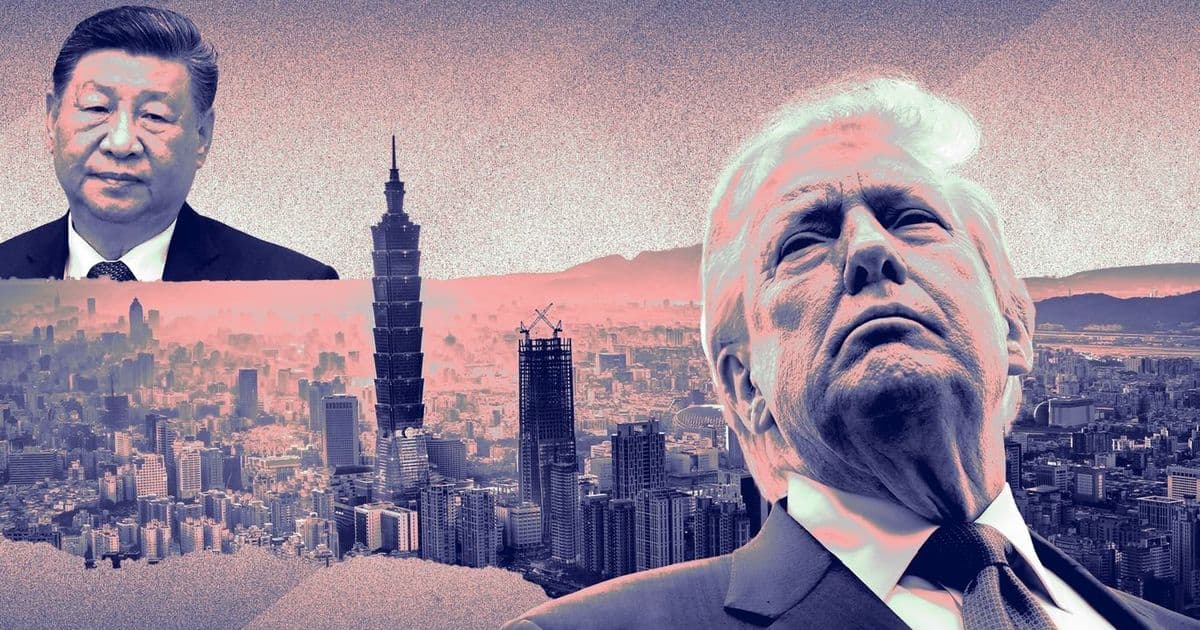
As geopolitical tensions persist, Taiwan's semiconductor industry faces unprecedented pressure while navigating shifting U.S. political stances.
Taiwan continues to maintain its position as a critical global technology hub despite escalating threats from China and uncertainty surrounding U.S. policy commitments. The island's semiconductor industry, which produces over 60% of the world's chips and more than 90% of advanced processors, finds itself at the center of geopolitical tensions that could disrupt global supply chains and impact tech markets worldwide.
China's President Xi Jinping has consistently emphasized Taiwan's reunification with the mainland as a core national objective, with military exercises near the island increasing in frequency and intensity. In 2022 alone, China conducted unprecedented military drills following then-House Speaker Nancy Pelosi's visit to Taiwan, involving fighter jets, warships, and ballistic missiles that penetrated Taiwan's air defense identification zone.
The economic stakes are substantial. Taiwan Semiconductor Manufacturing Company (TSMC), the world's largest contract chipmaker, operates facilities that produce chips for major tech companies including Apple, NVIDIA, and Qualcomm. TSMC's advanced fabrication plants represent billions in investment and years of research and development, with the company controlling approximately 54% of the global foundry market.
Market analysts note that any disruption to Taiwan's semiconductor production could have immediate and severe consequences for global tech supply chains. A 2021 analysis by the Semiconductor Industry Association estimated that a six-month disruption to Taiwanese chip production could result in a global revenue loss of approximately $1 trillion.
Former U.S. President Donald Trump's approach to Taiwan has been characterized by ambivalence. While his administration increased arms sales to Taiwan and passed legislation supporting the island's defense, Trump also questioned the value of U.S. commitments to Taiwan during his presidency. His recent statements have continued to suggest flexibility on the issue, creating uncertainty for tech companies that rely on stable U.S.-Taiwan relations.
Current U.S. policy under President Biden has maintained the "one China" policy while simultaneously strengthening unofficial relations with Taiwan. The administration has approved significant arms packages and increased high-level official exchanges, though avoiding formal diplomatic recognition.
Tech industry executives report continued investment in Taiwan despite geopolitical concerns. TSMC has announced plans to build new facilities in Arizona, Germany, and Japan as part of a diversification strategy, but the company has emphasized that its most advanced production will remain in Taiwan for the foreseeable future.
Market analysts suggest that tech companies are developing contingency plans while maintaining operations in Taiwan. "Companies are dual-sourcing critical components where possible, but the reality is that Taiwan's advanced manufacturing capabilities remain unmatched," said one semiconductor industry analyst who requested anonymity due to sensitivity of the topic.
Taiwan's government has responded to these challenges by increasing defense spending to approximately 2.4% of GDP and pursuing strategies to strengthen its domestic semiconductor ecosystem. The island has also worked to deepen economic ties with other democratic nations, including the U.S., Japan, and European countries.
The global tech industry continues to monitor the situation closely, with market volatility often increasing following periods of heightened tensions. Tech stocks have shown sensitivity to developments in the Taiwan Strait, with semiconductor companies experiencing particular fluctuations during periods of military exercises or diplomatic tensions.
As geopolitical pressures persist, Taiwan's tech industry faces the dual challenge of maintaining its manufacturing dominance while navigating an increasingly complex international environment. The resilience of Taiwan's semiconductor sector will likely continue to play a critical role in global tech markets for years to come.
Comments
Please log in or register to join the discussion