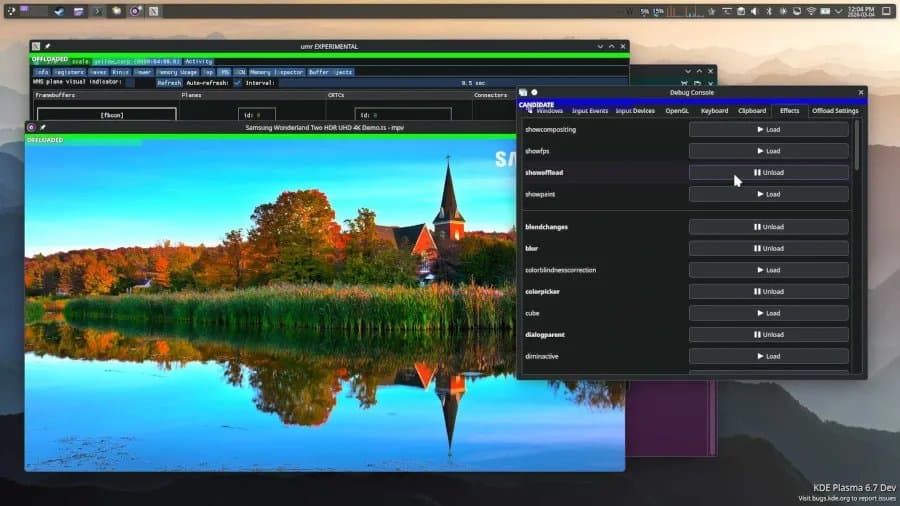
AMD engineer Harry Wentland leverages Claude AI to develop advanced HDR and color pipeline improvements for AMDGPU driver and KDE KWin, introducing color-space conversion support and GPU offload tracking.
AMD is advancing Linux desktop HDR capabilities through new color pipeline improvements co-developed with Claude AI. The work addresses critical gaps in the DRM color pipeline API, particularly around color-space conversion (CSC) support, while also introducing tools for better GPU offload management.
Background on Linux HDR Development
Introduced with Linux 6.19, the DRM Color Pipeline API marked a significant milestone in Linux desktop HDR support. However, as AMD engineer Harry Wentland notes, this was not the endpoint for enhancing Linux's handling of modern high dynamic range displays and color management.
AMD's Latest HDR Improvements
The current focus is on implementing color-space conversion (CSC) drm_colorop support, which addresses a fundamental limitation in the existing DRM color pipeline API. The API lacked proper color-space conversion capabilities, creating bottlenecks for accurate color reproduction on HDR displays.
Wentland has developed both kernel-level patches for the AMDGPU driver and KDE KWin compositor integration to exercise these new kernel capabilities. This dual approach ensures the improvements work at both the hardware driver level and the desktop environment layer.
AI-Assisted Development with Claude
A notable aspect of this development is the extensive use of Claude Sonnet 4.5 in creating the patches. Those examining the DRM code or KWin patches will notice the attribution "Co-developed by Claude Sonnet 4.5" in the commit messages.
Wentland explains his approach to AI-assisted development in a blog post: "I used Claude Sonnet extensively for this work (it basically wrote all the code), so I thought it prudent to leave a couple thoughts on it. LLMs are large language models, not actual artificial intelligence. They're language models, and are designed to work well with language. They're large and can hold much more context than humans. Use them in ways that uses their strength. I've found value in understanding complex code-bases, and creating code that fits within those code-bases."
He emphasizes responsible AI usage: "Don't stop owning your code. Even if it's produced by an LLM, take pride and ownership. This means, review what you get from an LLM. Be active in steering it. Don't throw trash at maintainers. Your name and reputation are on the line."
Beyond Basic HDR Support
The AI collaboration extended beyond simple code generation. Claude also developed a plug-in to mark surfaces and their GPU offload status, adding another layer of optimization for HDR content rendering.
Next Steps for Upstream Integration
Wentland is now working to upstream these changes to both the Linux kernel and KDE KWin after appropriate review and modifications. This upstreaming process will make the improvements available to all Linux users with compatible AMD hardware.
Technical Impact
These enhancements represent a significant step forward for Linux desktop color management. By addressing the CSC limitations in the DRM color pipeline API, AMD is enabling more accurate color reproduction across different display technologies and content types. The integration with KWin ensures these improvements translate to real-world desktop performance rather than remaining at the driver level.
For developers and enthusiasts interested in the technical details, the patches demonstrate sophisticated understanding of both the DRM subsystem and modern display technologies. The AI-assisted development approach also provides an interesting case study in how large language models can accelerate complex systems programming tasks while maintaining code quality and upstream compatibility.
The work exemplifies AMD's continued investment in Linux graphics support, particularly for emerging display technologies like HDR. As these patches move through the review process, they could significantly improve the Linux desktop experience for users with modern HDR-capable displays and AMD GPUs.
Comments
Please log in or register to join the discussion