AMD's Lemonade SDK 10.3 dramatically reduces its footprint by replacing Electron with Tauri, while adding powerful new features for local AI deployment across AMD hardware.
AMD has released Lemonade SDK 10.3, a significant update to their open-source local AI server that brings a remarkable 10x reduction in binary size through the replacement of the Electron framework with Tauri. This change represents a fundamental optimization that dramatically improves deployment efficiency without sacrificing functionality.
The most striking improvement is the size reduction: pre-built binaries for macOS and Windows have shrunk from 101-107 MB in version 10.2 to just 7-9 MB in 10.3. This represents a 90-94% reduction in application size, making distribution significantly more efficient and reducing storage requirements across deployment environments.
Technical Breakdown: Electron to Tauri Migration
Electron, while popular for cross-platform application development, has long been criticized for its resource-heavy nature, bundging entire Chromium instances with each application. Tauri addresses this by using a native GUI framework with Rust for the backend, only embedding the web technologies needed for the specific application.
The performance implications extend beyond just disk space:
- Reduced memory footprint
- Faster application startup times
- Lower CPU utilization during idle states
- More efficient resource usage overall
This migration is particularly significant for local AI applications, which already demand substantial computational resources. By reducing the overhead of the application framework itself, more resources remain available for the actual AI workloads.
New Features in Lemonade 10.3
Beyond the framework migration, Lemonade 10.3 introduces several enhancements that improve the user experience and flexibility:
OmniRouter Integration: This new component unifies multiple back-end engines to create a "true omni-modal" LLM experience. The router intelligently selects the optimal backend based on the specific task, providing a more seamless interaction with different AI models.
Enhanced Llama.cpp Support: Users can now easily switch between specific versions of Llama.cpp, with support for automatic updates to ensure access to the latest optimizations and features.
Flexible ROCm Deployment: The SDK now supports three ROCm configurations:
- ROCm 7.2 stable
- ROCm 7.12 preview builds
- TheRock nightly builds
ROCm 7.12 preview is now the default configuration in Lemonade 10.3, providing users with access to the latest AMD GPU optimizations.
Performance Comparison
| Metric | Lemonade 10.2 | Lemonade 10.3 | Improvement |
|---|---|---|---|
| Binary Size (macOS/Windows) | 101-107 MB | 7-9 MB | 10x smaller |
| Default ROCm Version | 7.2 | 7.12 preview | Latest optimizations |
| Llama.cpp Updates | Manual | Automatic + version selection | Improved flexibility |
| Backend Engines | Multiple | Unified via OmniRouter | Better user experience |
Build Recommendations and Platform Support
For users looking to deploy Lemonade 10.3:
Windows and macOS: The reduced binary size makes installation and distribution significantly more efficient. The 7-9 MB footprint means faster downloads and less storage pressure on systems.
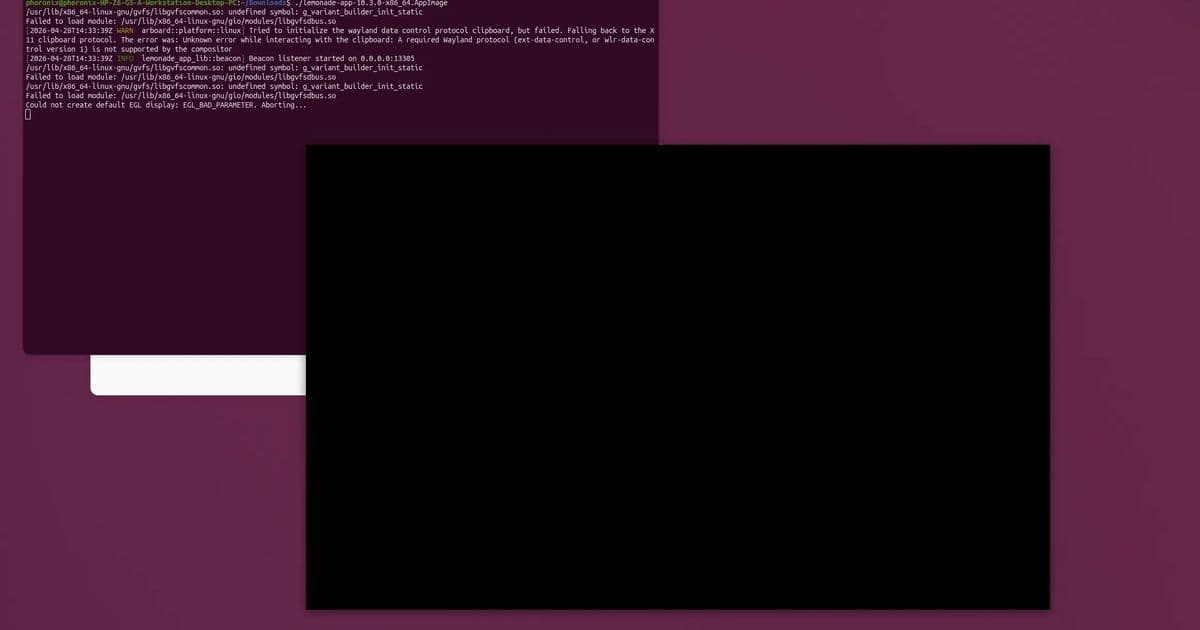
Linux: As noted in the original testing, the Linux AppImage build encountered Wayland compatibility issues on Ubuntu 26.04 LTS. For Linux users:
- Consider testing with X11 sessions initially
- Monitor for Wayland compatibility updates in future releases
- The AppImage format remains convenient for distribution across different distributions
Hardware Optimization
The framework optimization in Lemonade 10.3 complements AMD's hardware advantages:
- CPU Utilization: The lighter Tauri framework frees up CPU resources for actual AI processing
- GPU Efficiency: With ROCm 7.12 preview as default, users benefit from the latest GPU optimizations
- NPU Support: The SDK continues to leverage AMD's NPUs where available, offloading workloads from CPU/GPU
Future Implications
The migration to Tauri sets a precedent for how resource-intensive applications can be optimized for deployment. For local AI specifically, this approach maximizes the utility of available hardware, making more powerful AI models practical on consumer hardware.
The introduction of OmniRouter also signals a move toward more intelligent backend selection, potentially paving the way for automatic optimization based on specific hardware capabilities and workload requirements.
For those interested in exploring Lemonade 10.3, additional details and downloads are available through the GitHub repository. The project's open-source nature ensures continued community-driven development and optimization.
As local AI continues to evolve, frameworks like Lemonade that balance performance, efficiency, and flexibility will become increasingly important for developers and enthusiasts looking to leverage AI capabilities on their own terms and hardware.
Comments
Please log in or register to join the discussion