AMD positions its $3,999 Ryzen AI Halo workstation as a cost-effective alternative to cloud AI APIs, claiming developers could save $750 monthly by running local models. However, technical analysis reveals nuanced trade-offs in performance, software support, and networking compared to Nvidia's DGX Spark, challenging the simplicity of AMD's savings pitch while highlighting the workstation's strengths in x86 flexibility and unified memory architecture.
AMD’s answer to Nvidia’s DGX Spark AI workstation, codenamed Ryzen AI Halo, opens for pre-order next month at $3,999. The company frames this as a pragmatic investment, asserting that developers spending eight hours daily on 'vibe coding' could save approximately $750 monthly by avoiding cloud API fees. This narrative positions the device as self-amortizing—a claim warranting closer examination given the evolving economics of local versus cloud AI workloads.
At its core, the Ryzen AI Halo relies on AMD’s Strix Halo APU (officially Ryzen AI Max+ 395), a 120-watt chip integrating 16 Zen 5 CPU cores, 40 RDNA 3.5 GPU compute units, and a 50 TOPS XDNA 2-based NPU. This configuration delivers 56 teraFLOPS at 16-bit precision via its integrated graphics—a figure AMD contrasts with Nvidia’s DGX Spark, which advertises 125 teraFLOPS at BF16 (scaling to 250/500 with FP8/FP4). Crucially, AMD notes the Halo lacks hardware support for FP8/FP4 data types, a limitation that could impact certain inference workloads despite the company’s claim of 4-14% faster token generation in LLM tasks.
The memory subsystem presents both opportunity and constraint. With 128 GB of LPDDR5x 8000 MT/s memory (expandable to a planned 192 GB variant), the system offers unified bandwidth exceeding 256 GB/s—surpassing non-Pro Threadripper systems. This enables local execution of models up to 200 billion parameters at 4-bit precision, a capability once requiring $20,000+ hardware. However, effective memory bandwidth, not raw FLOPS, often governs token generation speed in LLMs. Here, Nvidia’s advantage emerges: the DGX Spark’s Blackwell-based GB10 APU features superior tensor cores, yielding 2x-3x faster prompt processing in testing—a disparity that becomes significant with longer contexts, even if token generation speeds appear comparable.
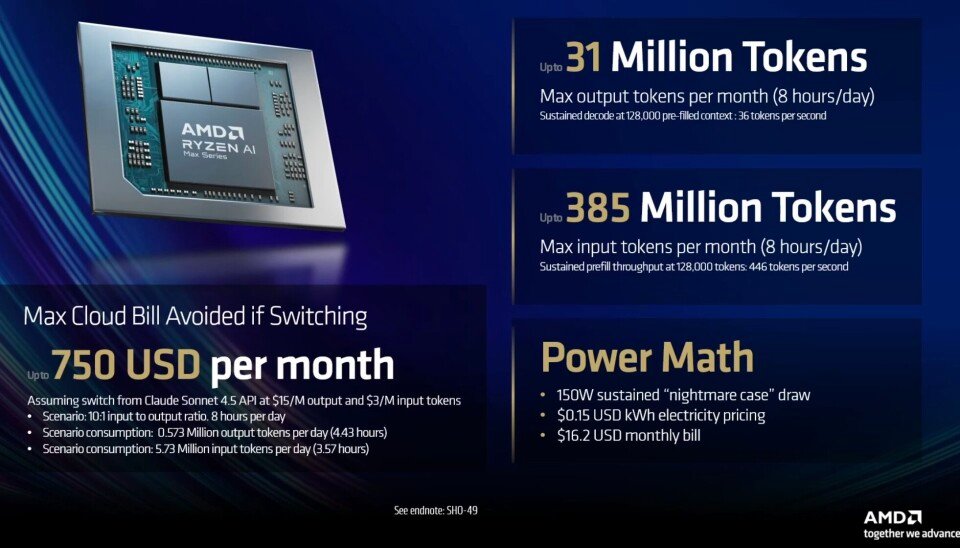
AMD’s $750/month savings claim assumes specific cloud usage patterns. At current rates, running a 70B parameter model continuously via cloud APIs might incur ~$600-$900 monthly depending on provider and instance type. Yet this calculation overlooks several factors: the workstation’s idle power draw (estimated 25-40W), opportunity cost of capital tied up in hardware, and the reality that most developers don’t run models at 100% utilization. Furthermore, the claim presumes consistent need for large-model inference—many workflows benefit more from prompt processing speed (where Nvidia leads) or specialized NPU acceleration (still nascent in software support).
Software ecosystem differences remain pivotal. While the Ryzen AI Halo runs standard Windows or Linux distributions—a boon for developers targeting Microsoft’s NPU-accelerated AI PC stack—the DGX Spark ships with a tuned Ubuntu 24.04 optimized for Nvidia’s CUDA-centric tools. AMD counters with validated playbooks for frameworks like vLLM, Llama.cpp, and Ollama, plus access to ROCm, HIP, and SYCL toolchains. However, the XDNA 2 NPU’s utility is currently limited; few generative AI engines leverage it effectively, though AMD notes growing adoption in content creation applications.
Networking exposes another divergence. The DGX Spark’s 200 Gbps ConnectX-7 NIC enables multi-node clustering for scaling workloads—a feature absent in the Halo’s single 10 Gbps port. Though USB-4 theoretically supports RDMA-like transfers (as demonstrated by Apple over Thunderbolt), AMD has not confirmed this as a supported use case, limiting the Halo’s applicability for distributed training or large-scale inference farms.
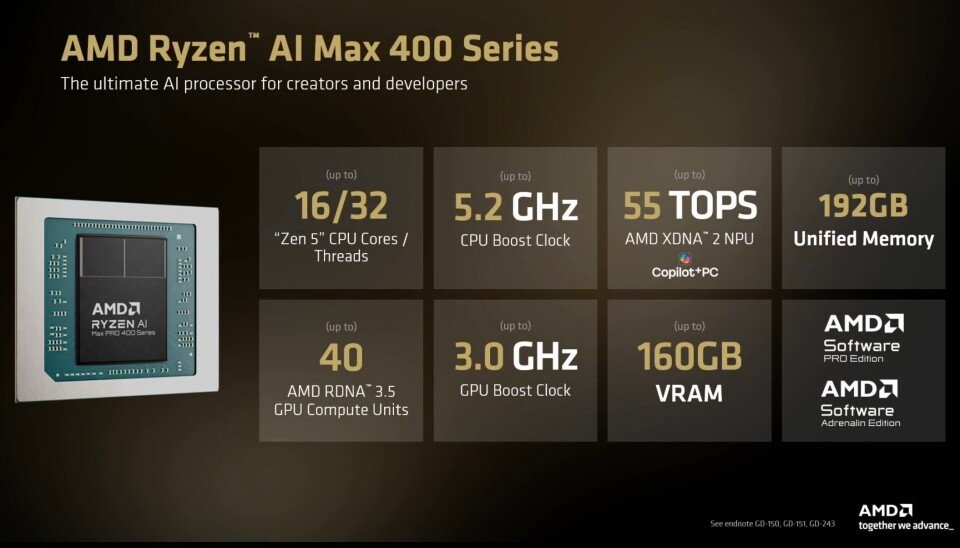
The broader context reveals market pressures shaping this launch. Nvidia recently increased the DGX Spark’s price to $4,699 (from $3,999), reflecting component costs and demand. AMD’s pricing—while higher than the $2,200-$2,999 range seen for similar Strix Halo systems less than a year ago—aligns with stabilized RAM markets post-'RAMpocalypse.' The impending 192 GB variant suggests AMD targets users needing larger model headroom, though pricing remains unspecified.
Ultimately, the Ryzen AI Halo’s value lies not in simplistic savings math but in offering a validated, x86-native platform for local AI experimentation. It excels in memory capacity and software flexibility but trails Nvidia in raw tensor performance, specialized data type support, and clustering capabilities. For developers prioritizing workflow independence from cloud vendors—or those building for Windows-based AI PC ecosystems—the trade-offs may justify the premium. Others may find the Spark’s superior prompt processing and mature CUDA ecosystem worth the extra cost, particularly when utilization rates justify cloud elasticity. The true test will be whether localized workflows deliver tangible productivity gains that offset hardware amortization over realistic usage patterns.
Comments
Please log in or register to join the discussion