AMD has submitted initial Linux kernel patches for their upcoming AIE4 NPU platform, featuring SR-IOV support and laying groundwork for future Ryzen AI integration.
AMD is pushing forward with Linux support for their next-generation NPU (Neural Processing Unit) platform, dubbed "AIE4," by submitting initial kernel patches to the Linux community. The patches, posted to the dri-devel mailing list, provide foundational support for the new AIE4 platform atop the existing AMDXDNA accelerator driver, marking another step in AMD's commitment to early Linux enablement for their hardware.
What's New in AIE4?
The AIE4 patches don't reveal extensive architectural details, but they do highlight several key improvements over the current AIE2 implementation. Most notably, the patches introduce SR-IOV (Single Root I/O Virtualization) support, a feature that allows a single PCIe device to present multiple virtual functions to the system. This is particularly valuable for data center and virtualization scenarios where multiple virtual machines or containers may need dedicated access to NPU resources.
From the driver perspective, the AIE4 implementation appears largely similar to current AMD AIE2 IP, with the primary additions centered around SR-IOV enablement. The patches target specific PCI device IDs (0x17F2 and 0x1B0B), which correspond to the new NPU4 platform and potentially existing NPU3 hardware.
Technical Implementation
The initial support includes several core components:
- Device initialization routines for the new AIE4 hardware
- Basic mailbox communication infrastructure
- SR-IOV enablement for virtualized environments
This lays the groundwork for full AIE4 support, though additional development will be needed to unlock the complete feature set of the new NPU platform. The mailbox communication infrastructure is particularly important as it provides the mechanism for host-to-NPU communication, essential for coordinating AI workloads.
Context: AMD's AIE Evolution
AMD's NPU technology builds on the AI Engine (AIE) processors, which originated from Xilinx technology. Each AI Engine consists of a vector processor, scalar processor, and on-chip memory, creating a flexible architecture for AI and machine learning workloads. The Ryzen AI NPUs that power AMD's current laptop and desktop processors leverage this AIE technology.

Why Early Linux Support Matters
AMD's approach of submitting kernel patches well before hardware availability has become a hallmark of their Linux strategy. This early enablement ensures that:
- The mainline Linux kernel will include support by the time hardware ships
- Distribution maintainers can prepare packages and updates
- The open-source community can begin testing and optimization
- Enterprise customers can plan deployments with confidence
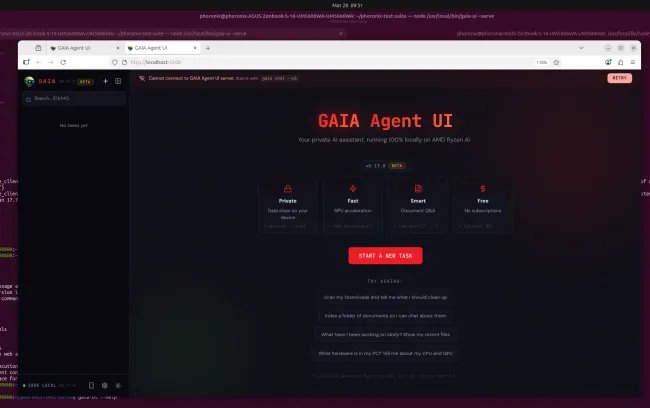
This is especially relevant now that AMD's Ryzen AI NPU IP is becoming increasingly useful under Linux, particularly for running large language models (LLMs) with open-source software. The timing is notable given AMD's recent introduction of a privacy-first web app for local AI agents that works on both Windows and Linux, demonstrating growing momentum in the Linux AI ecosystem.
Looking Ahead
While the current patches provide only initial support, they represent the foundation upon which AMD will build full AIE4 functionality. As with previous NPU generations, we can expect subsequent patches to add performance optimizations, additional features, and support for new use cases.
The inclusion of SR-IOV support suggests AMD is targeting both client and data center markets with AIE4, recognizing the different requirements of these segments. For data center operators, SR-IOV enables better resource utilization and isolation in virtualized environments, while client users will benefit from the underlying architectural improvements even if they don't directly use virtualization features.
As the Linux kernel development cycle progresses, these patches will likely be refined and expanded, with the goal of having comprehensive AIE4 support ready when the first hardware becomes available to customers.
Comments
Please log in or register to join the discussion