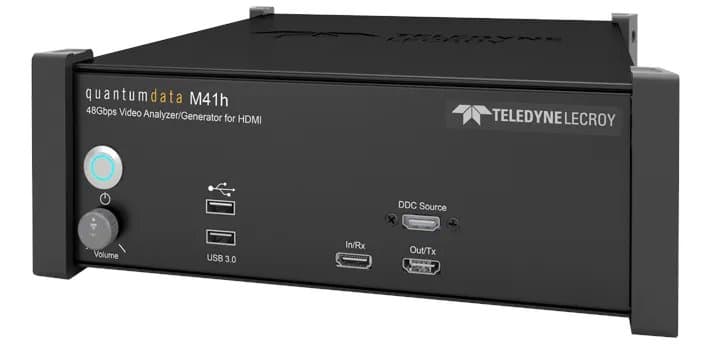
A 32-patch AMDGPU Display Code series lays the groundwork for automated HDMI 2.1 compliance testing against the Teledyne M41h analyzer, plus more KUnit coverage. No new end-user features this round, but it is the unglamorous plumbing that makes open-source FRL and DSC trustworthy on Radeon hardware.
If you have ever wired up a Radeon card to a 4K120 or 8K display over HDMI and wondered why open-source HDMI 2.1 took so long to land, this patch series is part of the answer. Most of the attention goes to the marquee features like Fixed Rate Link (FRL) signaling and Display Stream Compression (DSC). The boring half of the work is proving that those features actually behave correctly against the HDMI specification, and that is exactly what AMD's latest Display Code (DC) drop targets.
{{IMAGE:2}}
What landed
Michael Larabel reported that AMD sent out 32 patches of AMDGPU DC updates on June 10. There are no new HDMI features for end users in this batch. Instead the series does three things:
- Refactors the AMDGPU DM (Display Manager) code to be more modular
- Cleans up the HDMI pipeline and adds minor enhancements
- Preps the driver for HDMI compliance automation, specifically around FRL link rate testing
The headline item is support for driving the compliance flow when paired with the Teledyne M41h. That is the kind of work that never shows up in a benchmark chart but determines whether your display lights up reliably at the rates the marketing box promised.
The Teledyne M41h, and why it matters
The Teledyne M41h is an HDMI video generator and protocol analyzer used for vendor pre-testing and self-testing against HDMI compliance. It exercises the parts of the spec that are easy to get subtly wrong: FRL, DSC, link training, forward error correction (FEC), VRR, HDR10+ Source Side Tone Mapping, and HDCP. In other words, the entire feature stack that HDMI 2.1 advertises.
One of these boxes runs roughly $2,399 USD, which sounds steep until you compare it to the cost of shipping a GPU or a display with a handshake bug that only appears on one TV model in the field. For a homelab builder this is firmly in lab-equipment territory rather than something you keep next to the multimeter, but it is the reference that decides whether a sink and source are allowed to wear the HDMI 2.1 badge.
| Feature exercised | What it covers |
|---|---|
| FRL | Fixed Rate Link high-bandwidth signaling |
| DSC | Display Stream Compression |
| Link training / FEC | Reliable bring-up and error correction |
| VRR | Variable refresh rate |
| HDR10+ SSTM | Source-side tone mapping |
| HDCP | Content protection handshakes |
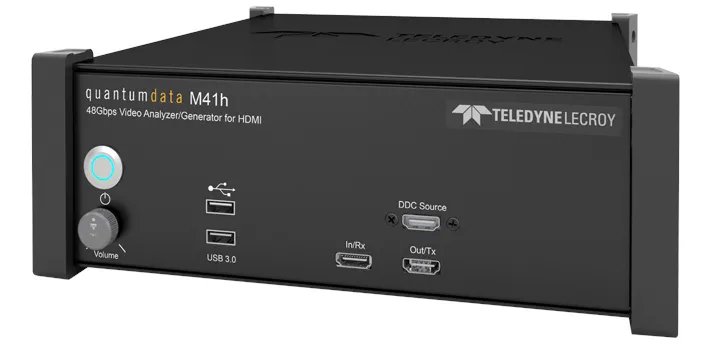
The driver-side change here is the automation hook for FRL link rate testing. Compliance runs are tedious and highly repetitive, sweeping through link rates and configurations, so wiring the M41h into an automated loop is the difference between a few engineers manually poking registers and a regression suite that runs unattended.
KUnit coverage is the quiet win
The patches also expand KUnit test coverage inside the AMDGPU DC code. DC is one of the largest single bodies of code in the kernel's graphics stack, much of it shared with AMD's other platforms, and historically it has been a magnet for display regressions. More in-tree unit tests means a class of those regressions gets caught at build and test time rather than by a user filing a bug after their monitor goes black on resume.
This is the pattern worth paying attention to. AMD's open-source HDMI 2.1 effort is not just about shipping FRL and DSC support, it is about building the test harness around them so the open implementation can be validated to the same standard as a closed one. That harness is what lets distributions and homelabbers trust the driver at the rates they paid for.
When you will see it
Given the timing, this DC series is not expected to be mainlined until the Linux 7.3 cycle later this year, so it will not touch your running kernel for a while. If you are running Radeon hardware on a current stable kernel, nothing changes today. The value lands later, as quieter HDMI 2.1 bring-up, fewer link-training oddities, and a compliance story that AMD can actually point to when someone asks whether the open driver is certifiable. For anyone building displays-heavy setups on AMD silicon, that reliability groundwork is more useful long term than another feature checkbox.
You can follow the AMDGPU DC development directly on the amd-gfx mailing list and track the broader Mesa and kernel display work through the freedesktop.org project pages.
Comments
Please log in or register to join the discussion