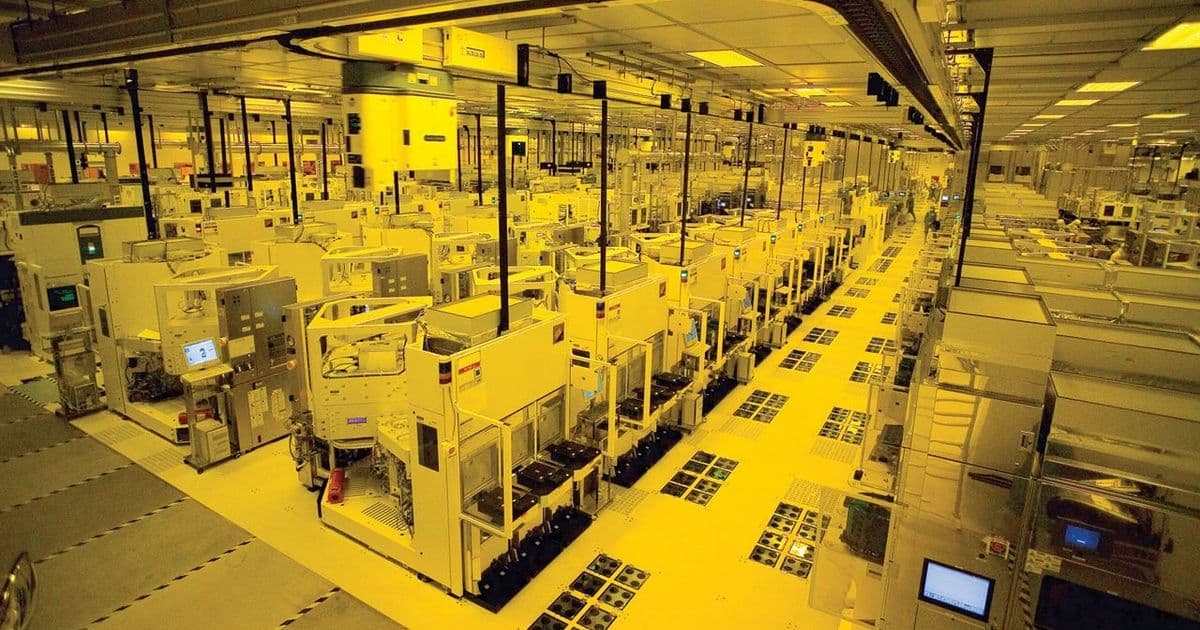
Elon Musk's TeraFab aims to produce 1 TW of AI chips annually, but faces insurmountable challenges in capital, equipment supply, process technology development, and workforce that make the full-scale project unrealistic.
Elon Musk's announcement of TeraFab has sent shockwaves through the semiconductor industry. The ambitious project aims to produce logic chips, HBM4 memory, and advanced packaging under one roof, backed by an initial $20 billion investment. But can this venture realistically achieve its goal of manufacturing chips consuming 1 terawatt of power annually using leading-edge process technology?
The Capital Challenge: A $5 Trillion Mountain
The most immediate barrier to TeraFab's success is financial. To produce 1 TW of AI silicon per year, the venture would need to process the equivalent of 22.4 million Rubin Ultra GPU wafers, 2.716 million Vera CPU wafers, and 15.824 million HBM4E wafers annually.
Based on these requirements, Bernstein estimates TeraFab would need between 142 and 358 fabrication facilities. Using conservative assumptions about modern fab capacity (around 20,000 wafer starts per month for leading-edge logic) and construction costs ($25-35 billion per fab), the capital requirements become staggering.
Even with optimistic 100% yields, producing the necessary logic processors would require approximately 105 leading-edge wafer fabs, totaling around $3.15 trillion. Factoring in more realistic 80% yields pushes this to 126 fabs and $3.78 trillion.
For memory production, a modern DRAM fab typically handles 100,000-200,000 wafer starts monthly. Producing 15.824 million HBM4E wafers would require roughly 9 fabs, though yield constraints and packaging limitations mean the actual number could be 12 or more, adding another $240 billion.
Advanced packaging facilities, while cheaper per phase ($2-3.5 billion), would still require hundreds of billions in investment given the scale needed.
In total, TeraFab would need well north of $4 trillion, with Bernstein's more aggressive analysis suggesting $5 trillion in total investment.
To put this in perspective, even the world's most valuable companies have market capitalizations far below this figure. Nvidia sits at $4.34 trillion, Apple at $3.71 trillion, and Alphabet at $3.5 trillion. Raising $5 trillion would require mobilizing capital exceeding the value of these tech giants combined.
Equipment Supply Chain: The ASML Bottleneck
Capital isn't the only constraint. The semiconductor equipment supply chain simply cannot scale to meet TeraFab's demands within any reasonable timeframe.
A modern 3nm-class logic fab requires 80-100 DUV + EUV lithography scanners, plus hundreds of other specialized tools for etching, deposition, metrology, and inspection. For 126 logic fabs, TeraFab would need approximately 12,600 lithography tools.
Here's where the math becomes impossible: ASML, the world's sole EUV lithography supplier, shipped only 179 scanners in 2025 (48 EUV and 131 ArFi DUV). At this production rate, it would take ASML 70 years to equip TeraFab with just the lithography tools needed for logic production.
ASML's production capacity depends not only on its own manufacturing capabilities but also on the output of its thousands of suppliers who provide the components for each scanner. Scaling this entire ecosystem by 70x is simply not feasible.
DRAM fabs use fewer tools but still require thousands of specialized pieces of equipment. The same supply constraints apply across the board.
Process Technology Development: Five Years Minimum
Even if TeraFab could secure the capital and equipment, developing leading-edge process technologies presents another insurmountable challenge.
Creating a modern 2nm-class fabrication technology requires a minimum of five years and involves:
- Pathfinding and materials research
- Transistor architecture exploration
- Hundreds of simulations for physical effects
- Development of tightly interdependent process steps
- Integration of front-end, middle-of-line, and back-end modules
- Yield optimization and reliability testing
- PDK and design kit development
- High-volume manufacturing transfer
While some elements like transistor designs can be licensed (Rapidus licensed IBM's 2nm GAA design), the vast majority of this process cannot be outsourced or accelerated. The integration phase, which effectively defines the node, must be done in-house and takes years of iterative refinement.
Rapidus, which has IBM's backing and is licensing technology, still won't begin trial production until 2027. It will likely be the 2030s before they achieve meaningful volume production.
The Workforce Crisis: 300,000 Skilled Workers Needed
Building and operating 150+ fabs requires an enormous workforce that simply doesn't exist at the required scale.
Construction alone presents massive challenges. A leading-edge fab employs 4,000-7,000 construction workers at peak, with 10,000+ involved across the full build cycle. TSMC's Arizona expansion expects to create 40,000 construction jobs total.
For 150+ fabs, TeraFab would need hundreds of thousands of construction workers, creating an immediate labor bottleneck, especially for specialized cleanroom and sub-fab systems.
Once operational, these fabs need highly skilled employees. A 20,000 WSPM fab like TSMC's Fab 21 employs around 3,000 people, while Intel's larger facilities create thousands of high-tech manufacturing and tool technician jobs.
Assuming next-generation fabs need only 1,500 employees each, TeraFab would still require over 300,000 highly skilled workers. For context, TSMC had 83,825 full-time employees globally as of late 2024.
Finding, training, and retaining this workforce presents an almost insurmountable challenge, particularly given the specialized nature of semiconductor manufacturing.
Reality Check: Partial Integration as the Likely Goal
When examined comprehensively, TeraFab in its current form appears unrealistic at full scale. The capital requirements exceed what's available in global markets, the equipment supply chain cannot scale to meet demand, process technology development takes years that cannot be compressed, and the workforce simply doesn't exist at the required scale.
However, there's another interpretation: perhaps Musk's real goal isn't wholesale transformation of the global semiconductor market, but rather partial vertical integration for his companies.
If TeraFab aims to produce only a portion of the chips needed by Tesla, SpaceX, and xAI, the economics and feasibility change dramatically. A smaller-scale operation could potentially:
- Focus on specific chip types rather than the full spectrum
- Use licensed process technologies from partners
- Build facilities incrementally as demand grows
- Develop expertise over time rather than starting at scale
This scaled-back approach would still be ambitious but potentially achievable, representing a meaningful step toward semiconductor independence for Musk's ventures without requiring trillions in investment or decades of lead time.
The Bottom Line
TeraFab as announced appears to be an unattainable dream in its current form. The combination of capital requirements exceeding global market caps, equipment supply constraints that would take decades to resolve, process technology development timelines that cannot be accelerated, and workforce shortages creating immediate bottlenecks makes the full-scale project unrealistic.
However, as a step toward partial vertical integration producing some in-house chips for Tesla, SpaceX, and xAI, TeraFab could represent a meaningful, if still ambitious, initiative. The key question is whether Musk's real goal is transforming the entire semiconductor industry or simply securing more control over critical components for his existing businesses.
The answer to that question will determine whether TeraFab becomes another Silicon Valley moonshot or a practical step toward semiconductor independence for Musk's empire.
Comments
Please log in or register to join the discussion