Anthropic’s Claude Design update attacks its launch-era token problem and ties prototypes to GitHub components, Claude Code, and export partners such as Canva, Replit, and Vercel.
{{IMAGE:2}}
Anthropic announced a major Claude Design update Wednesday that gives teams design system imports, two-way Claude Code syncing, lower token use, and exports into tools including Canva, Replit, Vercel, Adobe, Miro, Gamma, Wix, Base44, and Lovable.
The move changes Claude Design from a prompt-based prototype generator into a workflow tool for teams that need brand control. Users can import design systems from GitHub repositories, design files, or uploads. Claude then builds with those components, checks output against approved rules, and corrects mismatches before users see the work.
That matters for companies with mature brand systems. A startup founder may accept a polished mockup that uses Claude’s taste. A bank, software vendor, or retailer needs approved buttons, typography, spacing, colors, and layout patterns. Anthropic added an admin role so a company can approve one standard system and restrict edits.
The update also addresses a launch problem that threatened adoption. After Anthropic introduced Claude Design in April as a research preview, more than 1 million users tried it in its first week, according to the company. The tool also burned through usage limits at a pace that made small-team use hard. A PCWorld reviewer used 80% of a weekly Claude Pro allowance in about 25 minutes while generating three versions of one webpage prototype.
Anthropic now pools Claude Design usage with chat, Claude Cowork, and Claude Code. The company also says it reduced token use per turn and cut error rates. The new editor helps because users can drag, resize, and align elements without asking the model to regenerate a design for each small change.
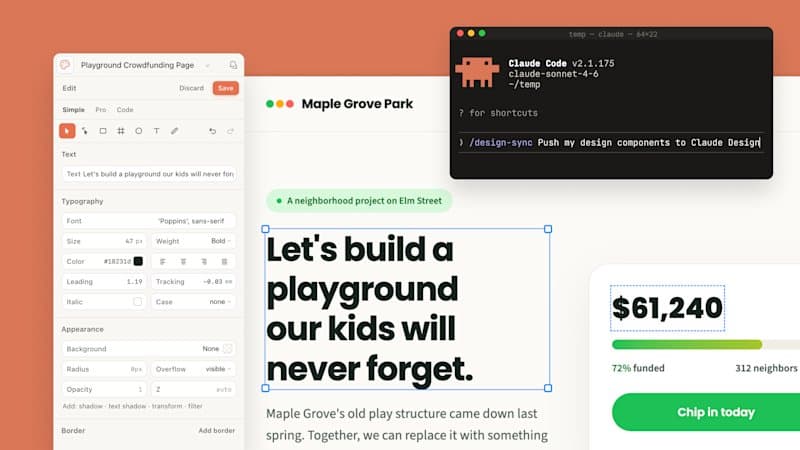
The Claude Code integration gives the product its strongest enterprise angle. Developers can run /design-sync in Claude Code to pull a local codebase’s design system into Claude Design. Designers can send a finished prototype back to Claude Code, where developers can continue from the same component base. Developers can also run /design from a terminal to create and edit design projects without leaving their workflow.
Anthropic wants to reduce the waste that comes from design-to-engineering handoffs. Teams often move from Figma files to specs, code snippets, screenshots, redlines, and visual QA. Each handoff gives designers and engineers another chance to interpret the same layout in different ways. Claude Design and Claude Code share the component system, so Anthropic can pitch a cleaner path from prototype to implementation.
The export list shows the same strategy. Claude Design sends drafts to Canva, Replit, Vercel, Miro, Adobe, Gamma, Wix, Base44, and Lovable, plus PDF and PowerPoint. Anthropic does not need Claude Design to replace those products. It wants Claude Design to generate the first asset, preserve the brand system, and move the work into the tool a team already uses.
That partner strategy also gives Anthropic an answer to open-source pressure. Community projects can offer local control, model choice, and self-hosting. Anthropic can offer business integrations with the products that design, marketing, and engineering teams use each day. Canva export, Vercel deployment, and Replit handoff create value that a smaller project cannot copy through code alone.
Claude Design also fits a broader Anthropic push into workplace systems. The company has expanded Claude across coding, business operations, financial services, and enterprise infrastructure. Design gives Anthropic another entry point: brand assets, product interfaces, slide decks, campaign concepts, and front-end prototypes.
The product still faces three tests. Pro users need token limits that support more than short experiments. Enterprise buyers need design system imports that handle real component libraries, not tidy demo kits. Engineering teams need Claude Code handoffs that produce usable implementation work without adding cleanup.
Anthropic’s bet centers on control. Prompts made Claude Design impressive in April. Design systems, code round-trips, and export paths can make it useful inside companies that need speed without losing brand discipline.
Comments
Please log in or register to join the discussion