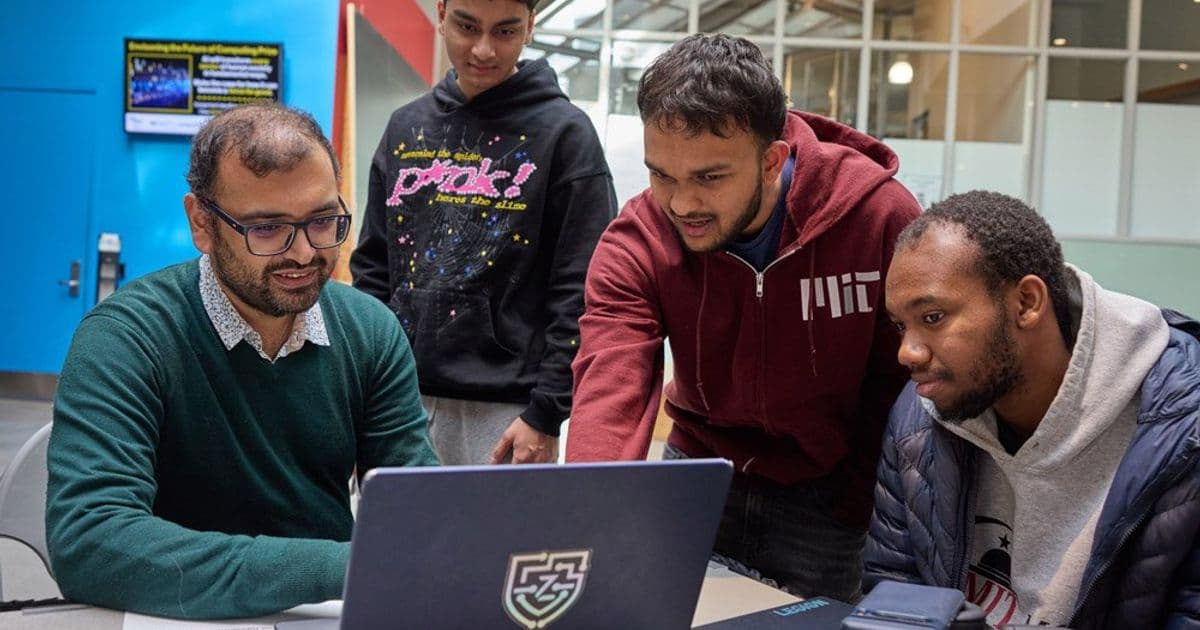
MIT's interdisciplinary class combines computer science and anthropology to create chatbots that serve as social guides rather than addictive distractions, demonstrating how human-centered design principles can transform AI interactions.
Young adults growing up in the attention economy face a digital landscape where social media and chatbots compete for their attention, often leading to unhealthy relationships with technology. But what if chatbots could be designed as moral partners whose purpose is to guide users socially rather than provide an addictive escape? This question lies at the heart of MIT's innovative new course, "Humane User Experience Design" (Humane UXD), which combines anthropology and computer science to reimagine how AI assistants can interact with humans.

The class, officially numbered 6.S061/21A.S02, represents a groundbreaking approach to AI design by merging two seemingly disparate disciplines. Created through a grant from the MIT Morningside Academy for Design (MAD), the course allows computer science majors to fulfill humanities requirements while developing practical skills for their careers.
"There's a way in which you don't really fully externalize what you know or how you think until you're teaching," explains Professor Graham Jones, an anthropologist whose research focuses on communication. "So, it's been really fun for me to see [computer science professor] Arvind Satyanarayan unfurl his expertise as a teacher in a way that lets me see how the pieces fit together — and discover underlying commonalities between our disciplines."
Technical Approach: Bridging Disciplinary Divides
The technical foundation of Humane UXD lies in its unique methodology that integrates linguistic anthropology with human-computer interaction principles. Satyanarayan notes that human-computer interaction has long borrowed methods from anthropology, but these approaches have become "watered down" over time.
"For instance, it was very exciting for me to see how an anthropologist teaches students to interview people. It's completely different than how I would do it," Satyanarayan observes. "With my way, we lose the rapport and connection you need to build with your interview participant. Instead, we just extract data from them."
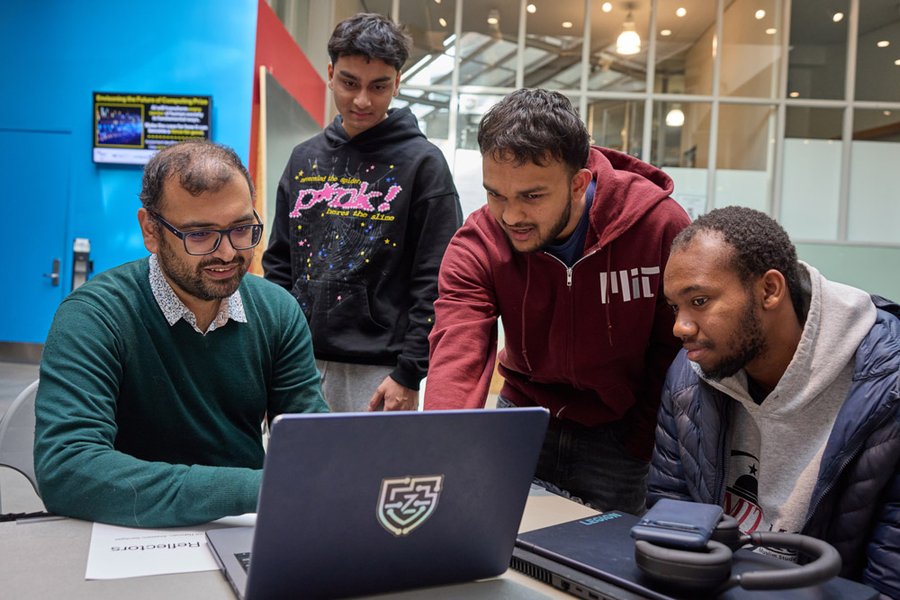
This cross-disciplinary approach provides students with a more comprehensive toolkit for understanding human interaction. Jones explains that human speech and interaction are organized into underlying genres with stable sets of rules that differentiate conversations in different contexts.
"ChatGPT and other large language models are trained on naturally occurring human communication, so they have all those genres inside them in a latent state, waiting to be activated," Jones notes. "As a social scientist, I teach methods for analyzing human conversation, and give students very powerful tools to do that. But it ends up usually being an exercise in pure research, whereas this is a design class, where students are building real-world systems."
The class uses Google's Gemini as its foundation, allowing students to implement their anthropological insights into functional chatbot interfaces. This technical approach enables the creation of AI systems that can recognize and appropriately respond to different social contexts and communication genres.
Real-World Applications: Student Projects Demonstrate Impact
The curriculum's effectiveness is demonstrated through several innovative student projects that showcase how anthropological insights can transform chatbot functionality. These projects represent practical applications of the theoretical framework taught in the class.
Project Pond: Navigating the Transition to Adulthood

One particularly promising project is Pond, designed to help college graduates navigate the challenges of independent adult life. Unlike typical chatbots that either parrot user input or offer sycophantic praise, Pond provides substantive advice for "adulting"—behaving as a responsible adult.
"College is very much a high-proximity and high-context environment, in the sense that everybody around you is going through the same thing, and it's easy to build relationships or find opportunities, because there are structured pathways that you have access to," explains graduate student Emaan Khan. "Post-grad life is low-context. You're not always surrounded by your peers or your professors. It's no-proximity also, in the sense that you don't have opportunities at your doorstep."
Pond addresses this transition by offering expertise in three key areas: social life, professional life, and adult skills. When asked about uncomfortable landlord questions, the chatbot responds with boundary-setting advice: "Politely set boundaries. You are not obligated to answer personal questions. You can gently redirect the conversation back to property-related topics."
The chatbot incorporates a point system allowing users to "graduate" from topics and a treasure chest feature to store prizes, making the learning process engaging. "The ethos of the practice mode is that you are actively building a skill, so that after using Pond for some time, you feel confident that you can swim on your own," Khan emphasizes.
News Nest: Transforming News Consumption

Another innovative project, News Nest tackles the challenge of helping young people engage with credible news sources in an engaging way. The project features ten colorful birds, each specializing in different news categories: Polly the Parrot delivers main headlines, Gaia the Goose covers science news, Flynn the Falcon reports on sports, and so on.
Developed by MIT seniors Tiana Jiang and Krystal Montgomery, and junior Natalie Tan, News Nest intentionally combats "doomscrolling" by providing media transparency—sources and political leanings are always displayed. The bird characters create a healthy buffer from emotional manipulation and engagement traps that human avatars might trigger.
This approach demonstrates how anthropological understanding of human attachment to characters and narratives can be leveraged to create more positive media consumption habits. The playful interface draws users in while the underlying system ensures they receive credible information from diverse sources.
M^3: Multi-Agent Murder Mystery
The M^3 project takes a different approach by making AI interaction fun through a social deduction murder mystery game. Developed by MIT senior Rodis Aguilar, junior David De La Torre, and second-year Deeraj Pothapragada, M^3 incorporates four distinct chatbot personalities: Gemini, ChatGPT, Grok, and Claude.

In this game, the user becomes the fifth player in a murder mystery scenario where the AI opponents may or may not tell the truth. This design creates a more complex interaction than typical chatbot conversations, as users must navigate multiple AI personalities with potentially different communication styles.
"Users can't get too involved with one chatbot, because they're playing all four," explains Aguilar. "Also, as in a real life murder mystery game, the user is sometimes guilty."
This project demonstrates how understanding human social dynamics and game mechanics can create more engaging and ethically complex AI interactions. The multi-agent approach prevents over-attachment to a single AI persona while still providing meaningful social interaction.
Industry Impact and Future Directions
The curriculum appears to be effectively preparing students for industry careers. One student reportedly secured an internship at a chatbot startup after finding that the class work closely mirrored industry practices.
"There's a really deep intertwining of the technology piece with the humanities piece," Jones emphasizes. "The students' design work shows that entirely new ways of programming can be conceptualized when the humane is made a priority."
This interdisciplinary approach addresses a growing need in the tech industry for AI systems that understand and appropriately respond to human social contexts. As chatbots become more integrated into daily life, the ability to design them with genuine social awareness becomes increasingly valuable.
The success of this course suggests that similar interdisciplinary approaches could benefit other areas of AI development. By incorporating insights from anthropology, psychology, and other social sciences, AI systems could become more effective tools for human development rather than mere productivity enhancers.
For more information about the course, you can visit the MIT Morningside Academy for Design website or explore the Anthropology Department and Department of Electrical Engineering and Computer Science offerings at MIT.
Comments
Please log in or register to join the discussion