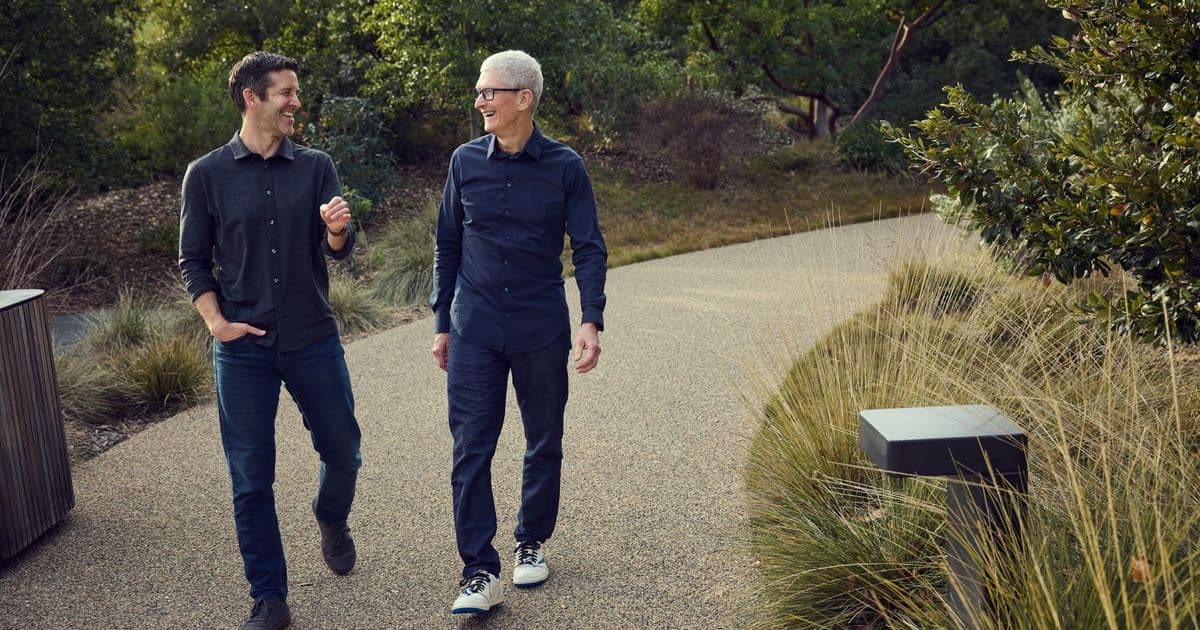
Apple announces Tim Cook will transition to executive chairman while John Ternus takes over as CEO on September 1, marking a significant leadership change at the world's most valuable company.
Apple announced today that CEO Tim Cook will step down from his role on September 1, transitioning to executive chairman of the company's board of directors. The company has named John Ternus, currently senior vice president of hardware engineering, as Cook's successor, marking a significant leadership transition at the world's most valuable technology company.
Cook, 65, will serve as CEO until the transition date, after which Ternus will take over as Apple's eighth CEO. The announcement comes as Apple continues to navigate an increasingly competitive technology landscape, particularly in artificial intelligence where the company has faced challenges keeping pace with rivals.
Cook's Legacy: From $350 Billion to $4 Trillion
During Cook's tenure as CEO, which began in 2011 when he was handpicked by Steve Jobs, Apple has experienced unprecedented growth. The company's market capitalization has grown from approximately $350 billion to $4 trillion, representing a more than 1,000% increase. Annual revenue has nearly quadrupled, rising from $108 billion in fiscal year 2011 to more than $416 billion in fiscal year 2025.
Cook's leadership was characterized by his mastery of Apple's complex global supply chain operations. Having joined Apple in 1998 from Compaq, he transformed the company's manufacturing and logistics into what many consider the gold standard for international operations. His expertise in managing relationships with suppliers and manufacturers in China, India, and other key markets proved crucial to Apple's success.
Beyond hardware, Cook successfully expanded Apple into the services sector, launching Apple TV+, Apple News, and other subscription-based offerings that now generate over $100 billion annually. He also oversaw the introduction of major product categories including the Apple Watch, Apple Vision Pro, and the company's transition to Apple Silicon Macs, moving away from Intel processors.
Cook has also been a vocal advocate for environmental responsibility, setting ambitious goals including achieving carbon neutrality across Apple's entire carbon footprint by 2030. His tenure has seen Apple become increasingly focused on sustainability and reducing its environmental impact.
John Ternus: The Hardware Visionary Taking the Helm
At 50 years old, Ternus brings over 25 years of Apple experience to the CEO role. He began his career at Apple in 2001 as a mechanical engineer on the product design team and has steadily risen through the ranks. Most recently, he has served as the public face of Apple's hardware engineering efforts, showcasing products like the iPhone Air and MacBook Neo.
Ternus is perhaps best known for overseeing Apple's transition from Intel processors to Apple Silicon, a move that has been widely praised for improving performance and efficiency across the Mac lineup. His engineering background includes work at Virtual Research Systems before joining Apple, and he holds a bachelor's degree in Mechanical Engineering from the University of Pennsylvania.
As CEO, Ternus will immediately join Apple's board of directors. The company has also announced significant changes to its leadership structure, with Arthur Levinson, who has served as non-executive chairman for the last 15 years, becoming lead independent director. Additionally, Johny Srouji, senior vice president of hardware technologies, will become chief hardware officer, taking over the department Ternus previously led.
Challenges Ahead for Apple's New Leadership
While Cook's tenure was marked by financial success and operational excellence, it wasn't without challenges. Under his leadership, Apple has faced criticism for falling behind in artificial intelligence development. The company is expected to release an updated version of its Siri voice assistant later this year, but the update has been delayed multiple times and will reportedly be based on Google's Gemini model rather than Apple's own AI technology.
Ternus will inherit these challenges as he takes the helm. The technology industry is rapidly evolving, with AI becoming increasingly central to product development and user experience. Apple's ability to compete in this space will be crucial to its future success.
Cook's transition to executive chairman suggests he will continue to play an important role in Apple's leadership, particularly in areas requiring his expertise in global policy and international relations. The company notes that in his new role, Cook will continue to engage with "policymakers around the world," likely maintaining his involvement in relationships with the Trump administration, China, India, and other regions where Apple has significant manufacturing and political interests.
Leadership Continuity and Change
The timing of the transition is notable, as Ternus is the same age Cook was when he became CEO. This suggests Apple is positioning Ternus for a long tenure at the company's helm, providing stability during what could be a period of significant technological change.
The leadership changes extend beyond the CEO position. Srouji's promotion to chief hardware officer represents a significant expansion of his role, particularly important given his previous hints about seeking greater responsibility or potentially leaving the company. His experience, including previous work at Intel and IBM and leadership of Apple's chip development since 2008, will be crucial as Apple continues to push the boundaries of its hardware capabilities.
As Apple prepares for this leadership transition, the technology industry will be watching closely to see how Ternus guides the company forward. His deep understanding of Apple's hardware engineering, combined with his experience overseeing major product transitions, positions him well to lead the company into its next chapter. However, the challenges of maintaining Apple's market leadership while catching up in AI and other emerging technologies will test his leadership capabilities from day one.
The transition from Cook to Ternus represents not just a change in leadership but potentially a shift in Apple's strategic focus. While Cook was known for his operational excellence and supply chain mastery, Ternus brings deep technical expertise and a track record of successful hardware innovation. How he balances these strengths with the need to address Apple's weaknesses in areas like AI will likely define his tenure as CEO.
Comments
Please log in or register to join the discussion