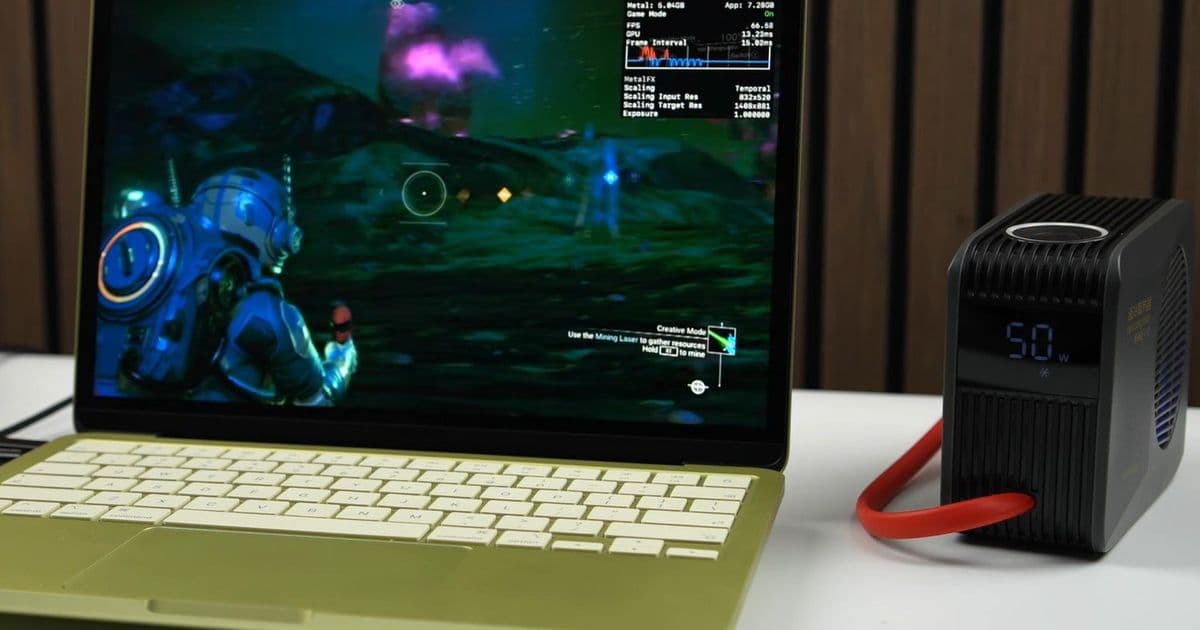
A simple copper plate mod doubles MacBook Neo gaming performance, revealing how Apple's passive cooling limits the A18 Pro's potential.
The Apple MacBook Neo's passive cooling design represents a compromise that limits the performance of its Apple A18 Pro chip. While the fanless approach ensures silent operation, it also causes the system to throttle under sustained loads, dropping power consumption from 8.8W to around 5W during stress tests.
YT: ETA Prime demonstrates that even basic thermal upgrades can dramatically improve performance. By applying thermal paste and attaching a copper plate to the Apple A18 Pro, operating temperatures dropped from 105°C to the mid-80s in No Man's Sky. This temperature reduction translated to a remarkable performance boost - average frame rates jumped from 30 FPS to nearly 60 FPS, effectively doubling gaming performance.
The benefits extend beyond gaming. Synthetic benchmarks show the copper-modded MacBook Neo achieving 9.7% better multi-core and 15.2% better single-core performance in Geekbench 6.6. These gains reveal how thermal constraints, not silicon limitations, are holding back the A18 Pro.
YT: ETA Prime's thermoelectric water cooling experiment pushes these improvements even further. The water cooler maintained mid-70°C temperatures in No Man's Sky, keeping frame rates consistently above 60 FPS. Geekbench scores improved by 17.5% in single-core and 18.6% in multi-core performance compared to stock cooling.
These modifications highlight a fundamental design choice in the MacBook Neo. The laptop succeeds as an affordable, quiet alternative to the MacBook Air for everyday tasks, but its passive cooling system prevents the A18 Pro from reaching its full potential under sustained workloads.
The performance gains from simple cooling upgrades suggest Apple could have significantly enhanced the MacBook Neo's capabilities with minimal design changes. Whether through active cooling or even a basic copper heat spreader, the current thermal solution appears to be the primary bottleneck rather than the processor itself.
For users considering the MacBook Neo, these findings indicate that performance limitations are largely thermal rather than architectural. While the laptop handles typical workloads admirably, those planning to use it for gaming or other sustained high-performance tasks may find its capabilities constrained by heat management rather than processing power.
Source: ETA Prime on YouTube
Comments
Please log in or register to join the discussion