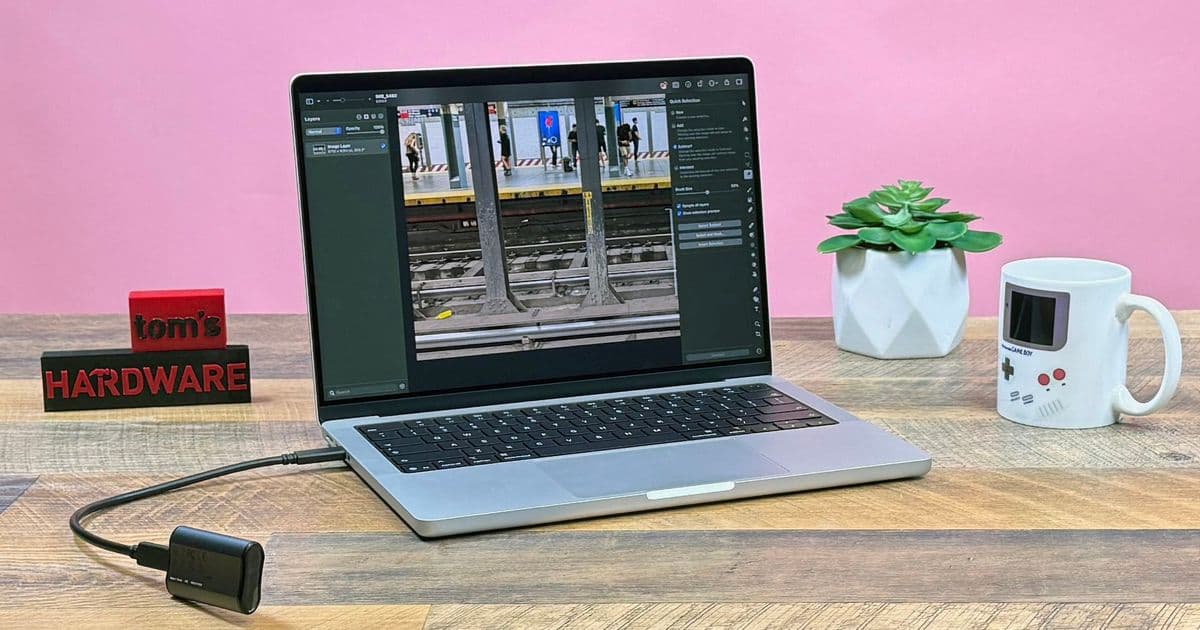
The M5 Max MacBook Pro combines 18-core CPU with 40-core GPU and 128GB RAM for unprecedented performance in a 14-inch ultraportable, though at a premium price.
Apple's M5 Max MacBook Pro represents the pinnacle of portable workstation computing, delivering unprecedented performance in a 14-inch form factor. With its 18-core CPU featuring six super cores, 40-core GPU, and up to 128GB unified memory, this system targets professionals who demand maximum power without sacrificing mobility.
The M5 Max chip employs Apple's Fusion Architecture, separating CPU and GPU dies connected by high-speed interconnect. This design enables the 40-core GPU to access substantial portions of the 128GB LPDDR5 unified memory, creating a formidable combination for video editing, VFX work, and local AI development. The 18-core CPU configuration includes six super cores—Apple's fastest performance cores yet—paired with twelve performance cores that balance power and efficiency.
Performance That Redefines Mobile Computing
In our testing, the M5 Max demonstrated crushing superiority over competing systems. On Geekbench 6, the super cores achieved a single-core score of 4,338, while multi-core performance reached 29,430. This demolished the competition, with the next closest system (Asus ZenBook Duo) scoring 3,031 and 17,283 respectively.
File transfer speeds showcase Apple's claimed doubling of SSD performance. The MacBook Pro completed our 25GB transfer test at 3,835.38 MBps—more than double the Framework Laptop 16's 1,724.69 MBps. Video encoding proved equally impressive, with the system transcoding 4K to 1080p in just 1 minute and 55 seconds, nearly 90 seconds faster than the Samsung Galaxy Book6 Ultra.
Graphics and Gaming Capabilities
The 40-core GPU delivers workstation-class graphics performance. In 3DMark Steel Nomad testing, the MacBook Pro scored 3,865, surpassing the Framework Laptop 16 with dedicated RTX 5070 (3,009). Gaming performance impressed as well—Cyberpunk 2077 ran at 30.84 FPS with ray tracing ultra at 1920 x 1200, climbing to 80.39 FPS at native resolution with MetalFX enabled.
Real-world testing with InZoi, a demanding life simulation game, showed the system maintaining 40-50 FPS at high settings without specialized upscaling technologies. This performance level approaches what dedicated gaming laptops achieve, demonstrating the M5 Max's graphics prowess.
Display Excellence with Nano-Texture Option
Apple's 14.2-inch Liquid Retina display offers 3024 x 1964 resolution with mini-LED backlighting and ProMotion up to 120Hz. The optional nano-texture finish ($150) eliminates reflections effectively, making it ideal for field work near windows or bright environments. Our colorimeter measurements showed exceptional brightness at 529.4 nits, exceeding most competitors.
The screen covers 87% of DCI-P3 color volume and 122.9% of sRGB, providing accurate, vibrant colors for creative work. While not quite matching OLED's perfect blacks, the mini-LED implementation delivers excellent contrast and HDR performance.
Refined User Experience
Apple's keyboard continues to impress with comfortable chiclet keys, full-sized function row, and inverted-T arrow keys. Typing speeds reached 118 WPM with 98% accuracy in our tests. The Force Touch trackpad remains industry-leading, offering smooth glass surface, comfortable haptics, and intuitive gesture support.
Audio quality stands out with a six-speaker system featuring force-cancelling woofers. Music playback demonstrated clear vocals, energetic instruments, and powerful bass that easily fills a room. The 3.5mm headphone jack supports high-impedance headphones for audiophiles.
Battery Life and Thermal Performance
Battery endurance proves exceptional at 17 hours and 58 minutes in our web browsing test with 150-nit brightness. This surpasses competitors by over two hours and approaches the vanilla M5 version (18:14). The system maintains reasonable temperatures during stress testing, though the keyboard center reached 116.5°F during intensive workloads.
Software and Ecosystem
macOS Tahoe introduces Liquid Glass design language with translucent effects and aesthetic changes that have proven controversial. However, the update brings valuable features including enhanced Spotlight with actions, built-in clipboard history, and expanded automation capabilities. Pre-installed apps cover all essential productivity needs, with optional Creator Studio subscription providing professional-grade software like Final Cut Pro and Logic Pro.
Configuration and Pricing Considerations
Our review configuration—M5 Max with 18-core CPU, 40-core GPU, 128GB RAM, 4TB SSD, and nano-texture display—costs $5,849. The base M5 Max starts at $3,599 with 18-core CPU, 32-core GPU, 48GB RAM, and 2TB storage. Upgrades prove expensive: 40-core GPU ($300), nano-texture display ($150), 64GB RAM ($200), 128GB RAM ($1,000), 4TB SSD ($600), 8TB SSD ($1,800).
These prices reflect current memory and storage market conditions, though they remain significantly higher than DIY PC upgrades. The 128GB configuration targets professional users whose workflows justify the premium—video editors working with 8K footage, AI developers training large models, or 3D artists handling complex scenes.
The Bottom Line
The MacBook Pro with M5 Max delivers unprecedented performance in a 14-inch ultraportable. For professionals whose workloads demand maximum CPU, GPU, and memory capacity, the system justifies its premium through unmatched speed and efficiency. The combination of blazing-fast super cores, powerful integrated graphics, exceptional battery life, and premium build quality creates a compelling package.
However, the extreme pricing—particularly for higher memory and storage configurations—limits this system to users who truly need its capabilities. Those with recent M3 or M4 systems may find limited reasons to upgrade, while professionals with older hardware will appreciate the substantial performance gains.
If your work involves intensive video editing, 3D rendering, AI development, or other memory-hungry tasks, and you need portability without compromise, the M5 Max MacBook Pro delivers in ways no other 14-inch laptop can match. The question isn't whether it's fast enough—it's whether your budget and workflow justify the investment.
Comments
Please log in or register to join the discussion