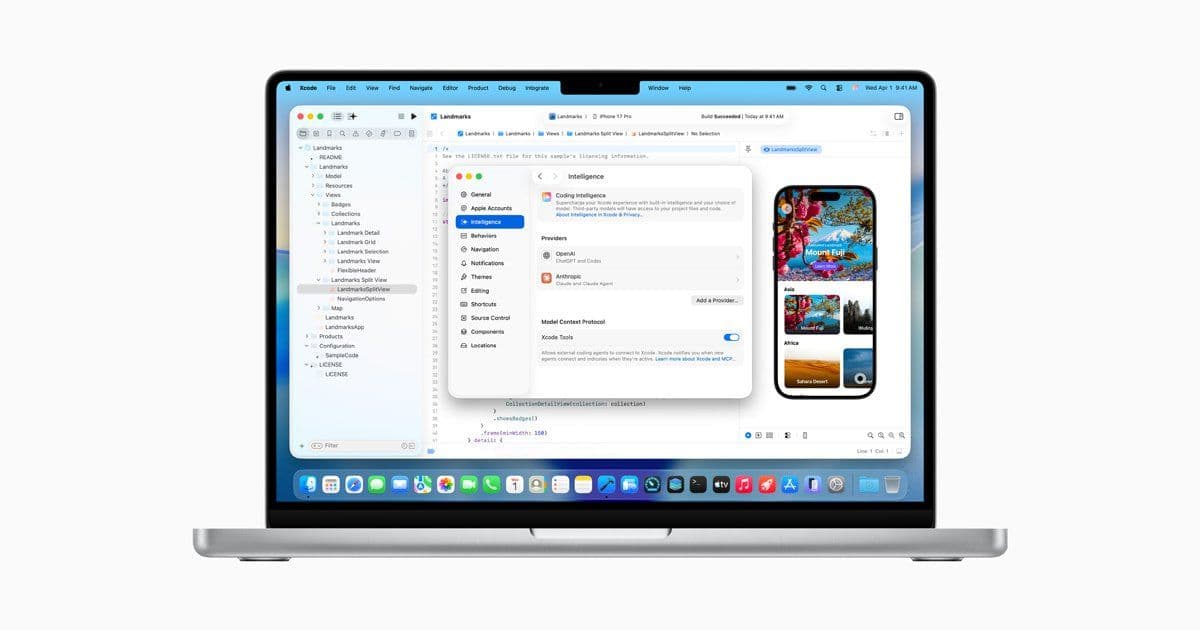
Apple's Xcode 26.3 introduces agentic coding, allowing developers to use AI agents like Claude and Codex directly within Xcode to automate complex tasks and accelerate app development.
Apple has unveiled Xcode 26.3, a major update that introduces agentic coding capabilities to its flagship development environment. This release marks a significant shift in how developers can interact with Xcode, bringing powerful AI agents like Anthropic's Claude Agent and OpenAI's Codex directly into the development workflow.
What Is Agentic Coding?
Agentic coding represents a new paradigm in software development where AI agents can work with greater autonomy toward a developer's goals. Unlike traditional code completion tools, these agents can break down complex tasks, make architectural decisions based on project context, and use Xcode's built-in tools to execute their plans.
The concept builds upon the intelligence features introduced in Xcode 26, which brought a brand-new coding assistant for writing and editing in Swift. However, Xcode 26.3 takes this much further by giving coding agents access to even more of Xcode's capabilities throughout the entire development lifecycle.
How It Works
With Xcode 26.3, developers can leverage AI agents to:
- Search documentation and explore file structures automatically
- Update project settings without manual intervention
- Verify work visually by capturing Xcode Previews
- Iterate through builds and fixes autonomously
- Make architectural decisions based on project context
These agents can collaborate with developers from initial concept through deployment, streamlining workflows and enabling faster iteration cycles. The system is designed to handle complex, multi-step tasks that would typically require significant manual effort.
Built-in Integrations
Xcode 26.3 comes with seamless access to two major AI models:
- Anthropic's Claude Agent - Known for its advanced reasoning capabilities
- OpenAI's Codex - Specialized in code generation and understanding
This integration combines the power of these agents with Xcode's native capabilities, providing optimal results when developing for Apple platforms. Developers can choose the model that best fits their project requirements, offering flexibility in how they approach different development challenges.
Open Standards Support
Beyond the built-in integrations, Apple has embraced open standards by making Xcode's capabilities available through the Model Context Protocol (MCP). This open standard gives developers the flexibility to use any compatible agent or tool with Xcode, ensuring the platform remains extensible and future-proof.
The MCP integration means developers aren't locked into specific AI providers and can experiment with different agents as the ecosystem evolves. This approach aligns with Apple's broader strategy of providing powerful tools while maintaining an open development environment.
Developer Experience
According to Susan Prescott, Apple's vice president of Worldwide Developer Relations, "Agentic coding supercharges productivity and creativity, streamlining the development workflow so developers can focus on innovation."
This statement reflects Apple's vision for the technology: not to replace developers, but to augment their capabilities. By automating routine tasks and handling complex multi-step processes, agentic coding allows developers to focus on higher-level design decisions and creative problem-solving.
Availability and Access
Xcode 26.3 is currently available as a release candidate for all members of the Apple Developer Program. The final release is expected to arrive soon on the App Store. This staged rollout allows Apple to gather feedback from the developer community and refine the agentic coding features before the general release.
The Future of iOS Development
The introduction of agentic coding in Xcode 26.3 represents a significant milestone in the evolution of software development tools. By bringing sophisticated AI agents directly into the development environment, Apple is positioning Xcode at the forefront of the AI-assisted coding revolution.
This move also signals Apple's commitment to staying competitive in the rapidly evolving AI landscape, where tools like GitHub Copilot and Amazon CodeWhisperer have already gained traction. By integrating these capabilities natively into Xcode, Apple is ensuring that iOS developers have access to cutting-edge AI assistance without leaving their preferred development environment.
As agentic coding matures, we can expect to see increasingly sophisticated workflows emerge, where AI agents handle progressively more complex aspects of the development process. This could lead to faster development cycles, reduced bugs, and more innovative applications as developers are freed from routine coding tasks to focus on creative problem-solving.
The integration of AI agents into Xcode also raises interesting questions about the future of software development education and the skills developers will need to thrive in an AI-augmented environment. While the technology promises to make development more accessible, it also requires developers to understand how to effectively collaborate with AI agents and leverage their capabilities appropriately.
Xcode 26.3's agentic coding features represent not just a new tool, but a new way of thinking about the development process itself. As these capabilities become more sophisticated, they may fundamentally change how we approach software development, making it more accessible while simultaneously raising the bar for what's possible in application design and implementation.
Comments
Please log in or register to join the discussion