
Argo CD 3.3 introduces PreDelete hooks for safe application teardown, background OIDC token refresh to prevent random logouts, and shallow Git cloning for faster repository operations.
The latest release of Argo CD, version 3.3, delivers a set of practical improvements that address long-standing operational pain points in GitOps workflows. Rather than introducing major architectural changes, this release focuses on making day-to-day operations safer and more predictable for teams managing Kubernetes applications at scale.

PreDelete Hooks Complete the Application Lifecycle
The most significant addition in Argo CD 3.3 is the introduction of PreDelete hooks, which complete the application lifecycle alongside existing PreSync, Sync, and PostSync phases. Historically, teams have relied on external scripts, manual cleanup, or Kubernetes finalizers to prepare for application deletion—approaches that often proved fragile and opaque when predictable teardown sequences were needed.
PreDelete hooks allow teams to define Kubernetes resources, such as Jobs that must run and succeed before Argo CD proceeds with deleting the rest of an application's resources. A failing hook will block deletion, turning the process into an explicit lifecycle phase that can include data export, traffic draining, or notifying dependent systems. This change addresses a critical gap in GitOps workflows where safe, automated teardown was previously difficult to achieve.
Background OIDC Token Refresh Eliminates Random Logouts
Another major improvement targets authentication reliability. Users integrating Argo CD with providers like Keycloak frequently experienced being logged out of the user interface after short access token lifetimes, even while actively working. This frustration was particularly acute during longer debugging or deployment sessions.
The new background OIDC token refresh automatically renews tokens before expiry, governed by a configurable threshold that determines when to trigger a refresh. Community feedback has been overwhelmingly positive, with one LinkedIn commentator summarizing the change as "Goodbye random logouts," highlighting how strongly this issue was felt across the user base.
Shallow Git Cloning for Faster Repository Operations
For teams working with large monorepos or long-lived projects, optional shallow cloning of Git repositories offers significant performance improvements. When enabled, Argo CD fetches only the required commit history instead of the full repository, potentially reducing fetch times from minutes to seconds.
This feature is implemented as a flag in repository configuration, making it an opt-in performance optimization for operators who have assessed that they don't need full history for their workflows. Community posts consistently highlight shallow cloning alongside PreDelete hooks and OIDC refresh as top highlights of the 3.3 release.
Enhanced Source Hydrator and Configuration Management
The release also improves the Source Hydrator, an increasingly central part of Argo CD's handling of complex configuration workflows. The new version introduces inline parameter support, eliminating the need to commit separate parameter files for each configuration change. It also adds better support for monorepo layouts and includes performance work to avoid unnecessary calls to the repo server.
These changes, attributed to community contributors, are framed as part of an ongoing effort to make Argo CD more appropriate for large-scale configuration management. They place the Source Hydrator alongside earlier work on ApplicationSets as a mechanism for handling growing configuration complexity in multi-application deployments.
Granular Cluster Resource Control
Granular control over cluster resources has been improved with extensions to clusterResourceWhitelist in AppProjects. The release now allows access to be restricted not only by API group and kind but also by individual resource names. This enables a project to manage only specific CustomResourceDefinitions rather than all CRDs, addressing a long-standing request from users who maintain multiple teams and controllers on shared clusters.
Commentary on LinkedIn highlights this change as part of broader improvements in RBAC controls, noting that more precise scoping of CRDs aligns better with organizational security policies and separation of duties.
First-Class KEDA Support
Argo CD 3.3 introduces first-class support for KEDA (Kubernetes Event-driven Autoscaling), allowing the tool to pause and resume KEDA ScaledObjects and ScaledJobs directly from the user interface. The release also enables Argo CD to understand ScaledJob health states, replacing earlier generic "Unknown" indicators.
Community posts describe this as particularly useful for maintenance windows and debugging, since operators can temporarily suspend event-driven workloads through the same GitOps control surface they use for other application resources.
Smaller Improvements Add Up
Beyond these headline features, the release includes several smaller changes that collectively support a more incremental view of improvement. These include using volume mounts for Redis credentials, adding Ceph CRD health checks, evolving the ApplicationSet user interface, supporting CLI filtering by API group, configurable Kubernetes API timeouts, and several user interface refinements around refresh behavior and view extensions.
Argo CD vs. Flux: Complementary Approaches
Alongside Argo CD, Flux has emerged as the other major CNCF-incubated project implementing GitOps for Kubernetes, but it emphasizes a controller-driven model rather than a centralized web application. Flux runs a set of controllers that reconcile Git, Helm repositories, and container registries with the cluster, supporting Helm and Kustomize natively, and offering optional visualization through the Weave GitOps interface rather than a bundled dashboard.
Flux uses concepts such as pruning and protective annotations on resources to do safe deletions, allowing operators to prevent specific objects from being removed during reconciliation and to tune how aggressively Flux cleans up resources that disappear from version control. The two tools are often positioned as complementary rather than strictly competing. Argo CD's built-in UI and close integration with Argo Rollouts make it attractive for organizations that want visual control and first-class canary or blue-green deployments. Flux's GitOps Toolkit provides a composable, CLI-oriented stack that monitors image registries and automatically updates manifests.
Users on Reddit report running both tools together, using Flux to manage core cluster infrastructure and Argo CD to orchestrate application-level deployments.
Available Now
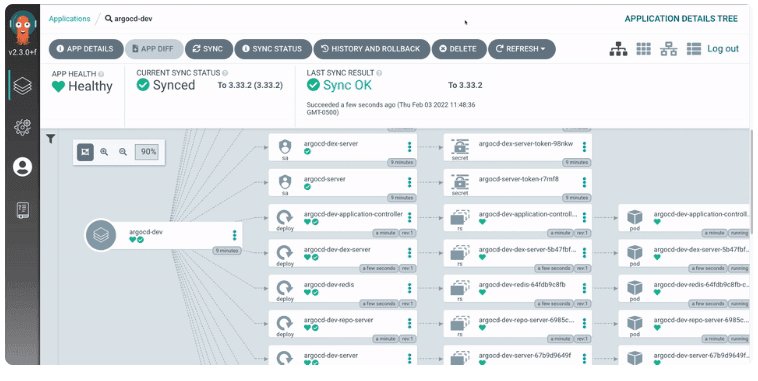
Argo CD 3.3.2 is available immediately, with the release candidate having been published earlier to allow community testing. The improvements in this version reflect a maturation of the GitOps ecosystem, where operational concerns and user experience are becoming as important as core functionality.
As Deepak Yadav noted in his LinkedIn commentary, "Well done to the Argo CD maintainers and contributors—this is a solid step forward." The release demonstrates how listening to community feedback and addressing real operational pain points can result in meaningful improvements that make GitOps workflows more reliable and user-friendly.
Comments
Please log in or register to join the discussion