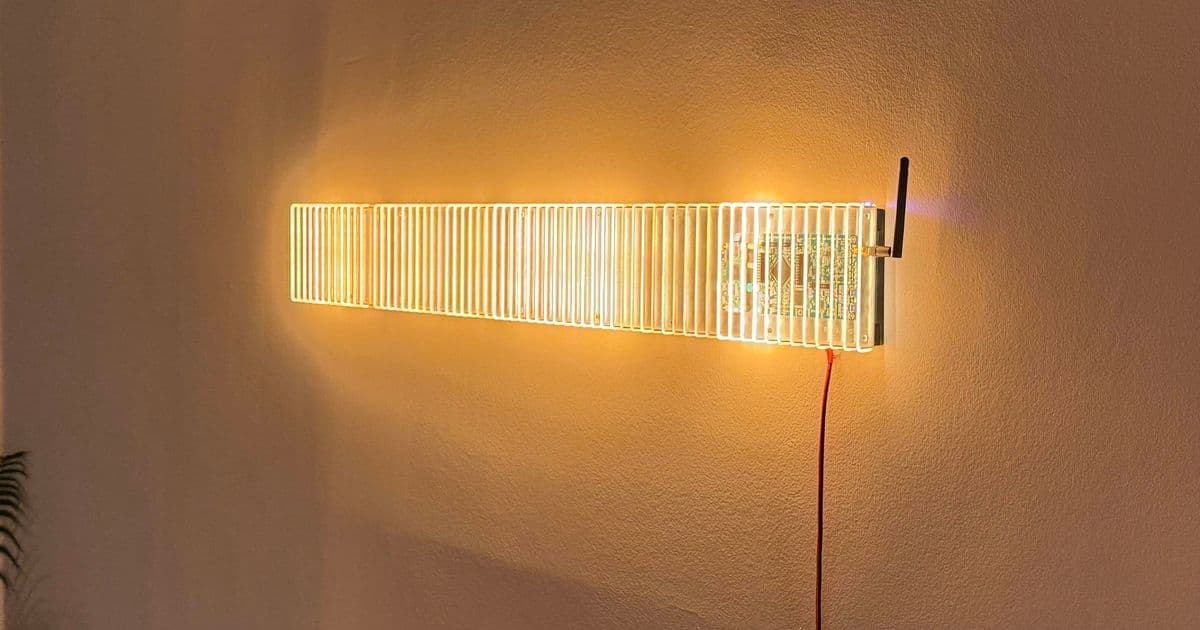
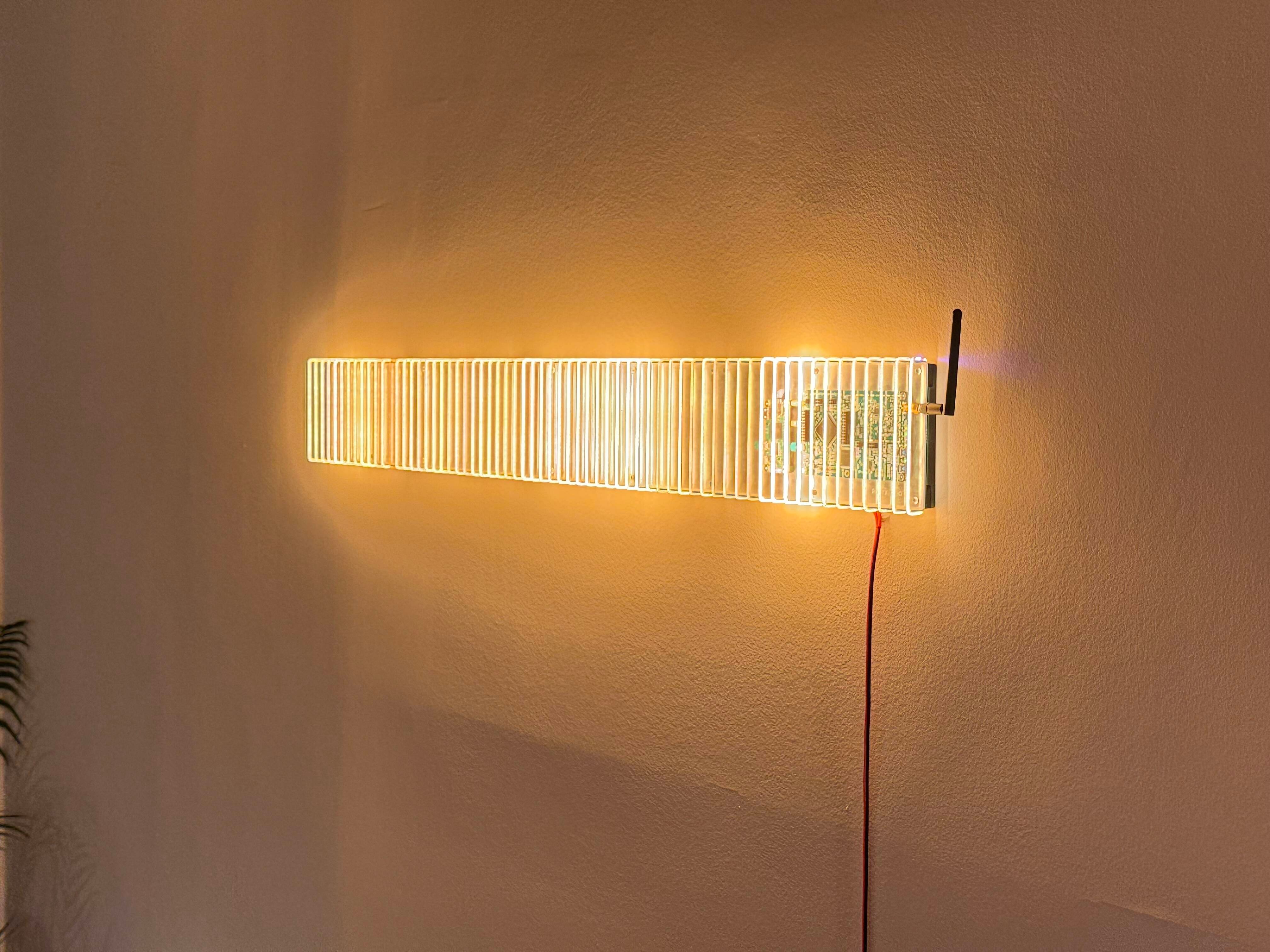
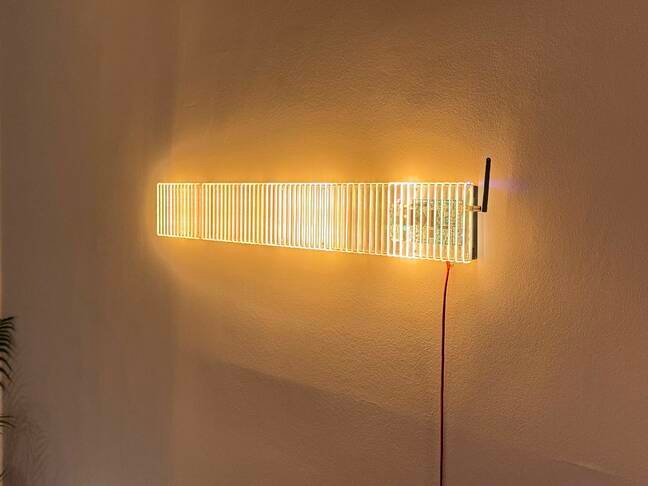
French artist Théo Champion has created 'Spectrum Slit,' a Raspberry Pi-powered art installation that visualizes 2.4GHz and 5GHz radio signals as light patterns on 64 LED filaments, turning invisible wireless traffic into tangible visual art.
In the invisible spectrum of radio waves that constantly surrounds us, French artist Théo Champion has found a way to make the unseen visible. His latest creation, "Spectrum Slit," transforms the ubiquitous wireless signals from Wi-Fi, Bluetooth, and cellular traffic into a striking wall-mounted light sculpture using a Raspberry Pi and software-defined radio.
The installation consists of 64 LED filaments arranged in a linear array, each corresponding to a specific segment of the radio spectrum. The system samples wireless signals in the 2.4 GHz and 5 GHz bands—frequencies commonly used by Wi-Fi, Bluetooth, and other consumer technologies—and converts them into data that drives the LED array. When network activity is low, the sculpture emits faint, intermittent light, reflecting ambient background noise. As wireless activity increases, the filaments surge with intense illumination, creating dense bands of light that pulse with the rhythm of digital communication.
The Technical Architecture
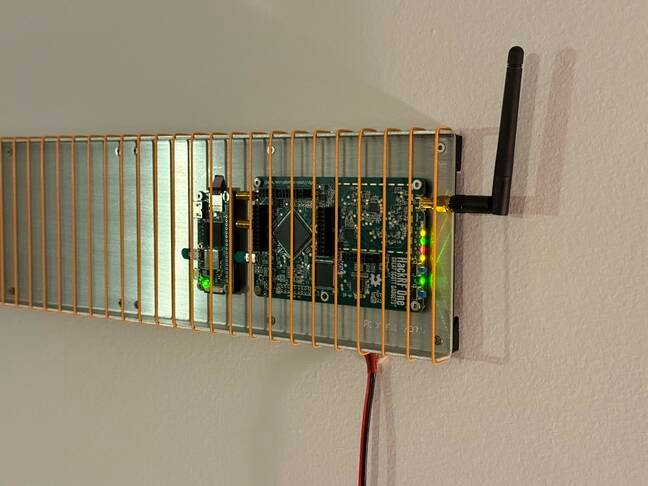
The build relies on a HackRF One software-defined radio connected to a Raspberry Pi. The SDR captures radio frequency signals across the target bands, while the Raspberry Pi processes this data using custom Python software Champion developed. The system samples the RF spectrum in real-time, analyzing signal strength and frequency distribution, then maps these measurements to the 64 individual LED filaments.
The electronics assembly includes custom-designed printed circuit boards that interface between the Raspberry Pi and the LED array. Champion outsourced the fabrication of both the sheet metal frame and the PCBs, with each component costing several hundred dollars. The total build cost approximately $1,000, with Champion estimating three weeks for research and experimentation followed by one week for the actual assembly.
Engineering Meets Artistic Vision
"For all my projects, the motivation is the same," Champion explained. "We tend to look past the technology that surrounds us and shapes our lives. My work is about forcing us to look at it, and seeing the beauty in engineering." This philosophy drives his approach to creating art that reveals the hidden infrastructure of modern digital life.
The project required significant technical problem-solving. Champion had to develop algorithms to translate RF signal characteristics into visual patterns that are both aesthetically compelling and technically accurate. The Python software needed to handle real-time signal processing while maintaining stable performance on the Raspberry Pi's limited hardware resources.
Broader Context in Tech-Inspired Art
Spectrum Slit represents part of a larger series of technology-focused artworks by Champion. His portfolio includes a device that launches a dark web marketplace for stolen data when a user presses a single button, and a Raspberry Pi running a Llama LLM that contemplates its own existence until memory limitations force a reset. Each piece explores different aspects of our relationship with technology, from data privacy to artificial consciousness.
Champion is currently in discussions to display Spectrum Slit and his other works in galleries or exhibitions. He has also indicated openness to creating additional copies of the installation if commissioned, suggesting the piece could become available to collectors or institutions interested in technology-inspired art.
The project demonstrates how accessible hardware like Raspberry Pi can serve as a platform for sophisticated artistic expression. By combining open-source software, affordable computing hardware, and specialized RF equipment, artists can create installations that reveal the invisible technological landscape we inhabit daily. For those interested in similar projects, the HackRF One software-defined radio and Raspberry Pi provide a foundation for exploring RF visualization and signal processing applications.
The finished piece offers a tangible representation of our wireless world, transforming abstract radio waves into something we can see and experience directly—a reminder that even the most mundane technological infrastructure contains unexpected beauty when viewed through an artistic lens.
Comments
Please log in or register to join the discussion