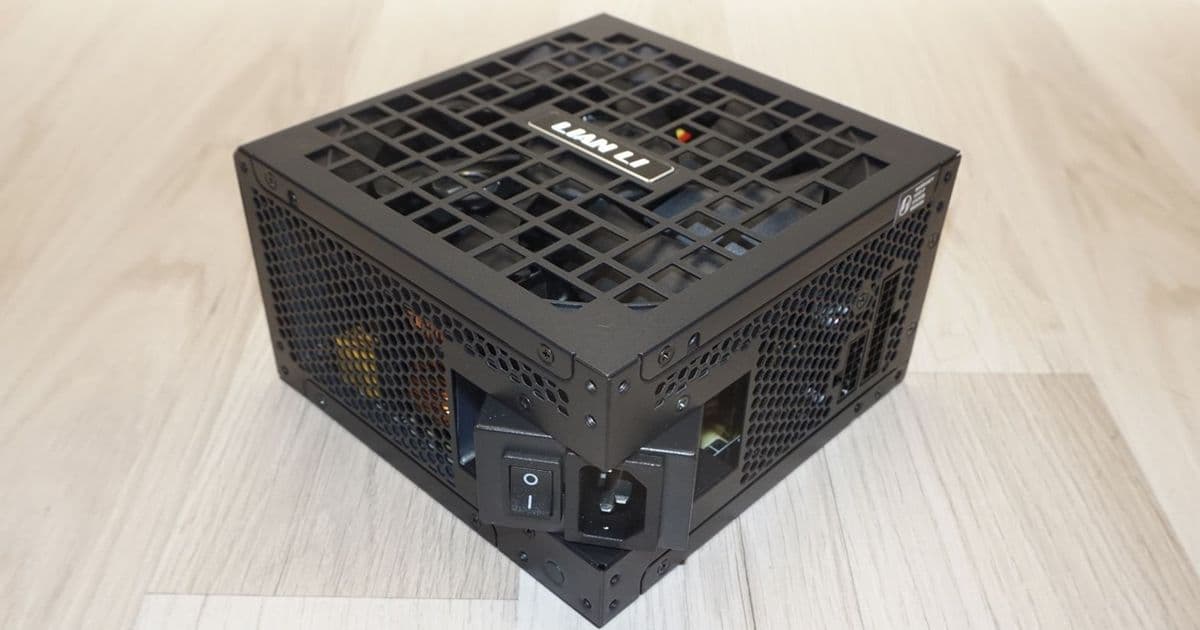
The Lian Li RS1200G introduces a world-first rotatable AC inlet, enabling dual-sided modular cable routing. While its electrical performance is exceptional, the design imposes specific case compatibility requirements that challenge universal adoption.
The Lian Li RS1200G ATX 3.1 power supply represents a deliberate departure from conventional PSU design philosophy. Rather than focusing solely on electrical specifications, Lian Li has engineered a mechanical innovation—the rotatable AC power receptacle—that fundamentally rethinks how power cables interface with the chassis. This 1200W unit, sourced from OEM Sirfa, delivers exceptional power quality and build standards, but its unique design introduces specific compatibility constraints that potential buyers must carefully evaluate.
Mechanical Innovation: The Rotatable AC Inlet
The RS1200G's defining feature is its rotatable AC power receptacle, a mechanism that allows the modular cable connectors to exit from either the rear or left side of the chassis. This innovation directly addresses cable management challenges in modern cases, particularly those with dual-chamber designs or side-mounted cable routing channels. Unlike competing solutions that offer limited orientation options, Lian Li's implementation provides full rotational control, enabling builders to adapt the PSU's cable exit points to match their specific case architecture.
However, this flexibility comes with a critical limitation: the 24-pin ATX connector's position inverses relative to other connectors based on the AC receptacle's orientation. When standard connectors exit rearward, the 24-pin exits left; when standard connectors exit left, the 24-pin exits rearward. This design choice means cases must always accommodate at least the 24-pin connector routing behind the motherboard, effectively eliminating compatibility with chassis lacking appropriate cable management provisions. The rotational mechanism itself appears robust, but this inherent constraint requires careful case selection.
Technical Specifications and Component Selection
The RS1200G operates with a single +12V rail rated at 100A (1200W), with auxiliary rails providing 20A each on +3.3V and +5V (100W combined), 3A on +5Vsb (15W), and no -12V output. The unit carries a 10-year warranty and is rated for full output at 40°C ambient temperature. The 150mm depth is remarkable for a 1200W unit, barely exceeding standard ATX dimensions while packing substantial power capacity.
Component selection reflects a pragmatic engineering approach. The APFC stage employs two SRC60R608BS MOSFETs and a diode, paired with massive EPCOS (TDK) capacitors totaling 1210 μF. These German-manufactured components offer superior thermal and mechanical stress resistance but are rarely seen even in top-tier units due to their premium cost. The primary stage uses two SRC60R095BS MOSFETs in a half-bridge topology, mounted on generous heatsinks.
The secondary stage utilizes eight Infineon 10N04NM6 MOSFETs for synchronous rectification on the 12V rail, distributed across two vertical daughterboards. DC-to-DC converters on another daughterboard generate the 3.3V and 5V rails from the primary 12V output. Secondary capacitors are sourced from Teapo, a reputable Taiwanese manufacturer, representing a cost-conscious choice appropriate for the 10-year warranty but not matching the prestige of premium Japanese alternatives like Nippon Chemi-Con or Rubycon.
Cable Configuration and Accessories
The RS1200G includes a comprehensive accessory bundle that exceeds typical PSU offerings. Beyond the standard AC cable and mounting hardware, Lian Li provides a magnetic USB hub capable of mounting anywhere within the chassis or directly on the PSU. Two USB cables offer flexibility for internal motherboard header connection or rear panel USB routing. A specialized backplate with a cable routing notch enables clean exits when necessary. Magnetic cable organizers replace traditional zip ties, offering repositionable cable management. Cable combs arrive pre-attached to select cables, with additional units included for user customization.
The cable configuration proves conservative for a 1200W unit. The bundle includes one 12V-2x6 connector and five 6+2 pin PCI Express connectors distributed across four cables. This limitation, combined with the unit's 40°C rating, suggests the platform may be optimized for high-quality power delivery rather than extreme multi-GPU configurations. All cables utilize an all-black aesthetic with flat, ribbon-line construction that simplifies routing in tight spaces. The ATX 24-pin and PCIe 12V-2x6 cables receive premium treatment with per-wire sleeving and factory-installed combs.
Electrical Performance: Exceptional Power Quality
Cold testing at 25°C ambient revealed outstanding electrical performance. The RS1200G achieved average nominal load efficiency of 90.0% with 115 VAC input and 92.0% with 230 VAC input across the 10% to 100% load range, comfortably exceeding 80 Plus Gold requirements. The unit received Cybenetics Platinum certification based on average efficiency calculations, though efficiency dips at maximum load prevented higher certifications from other certifying bodies.
Voltage regulation proved exceptional, maintaining 0.9% deviation on the 12V rail, 0.7% on the 5V rail, and 0.6% on the 3.3V rail. These figures indicate precise control under varying loads. Ripple suppression achieved outstanding results: maximum ripple measured 26 mV on the 12V rail, 14 mV on the 5V rail, and 14 mV on the 3.3V rail, all substantially below industry safety limits and representing excellent performance given the 1200W output capability and compact form factor.
Protection circuits responded with sharp precision. Over Current Protection (OCP) activated at 126% on the 3.3V rail, 128% on the 5V rail, and 112% on the 12V rail. Over Power Protection (OPP) triggered at 110% during hot testing. These thresholds are exceptionally sharp for an ATX 3.1 certified unit, balancing safety with practical operational requirements.
Thermal Performance and Acoustic Behavior
The RS1200G employs a Hong Hua 135mm fluid dynamic bearing fan with a 2300 RPM maximum speed. The unit's zero-RPM mode means extended periods of fanless operation while idling. Fan activation occurs at approximately 300 Watts load, maintaining very low speeds up to 800 Watts. Beyond 900 Watts, fan speed increases substantially, though it remains below half maximum capability under moderate loads.
Hot testing at ~45°C ambient revealed predictable efficiency degradation. Average nominal load efficiency dropped to 88.4% with 115 VAC input and 90.3% with 230 VAC input. Fan behavior shifted considerably, activating earlier at approximately 250 Watts and reaching maximum speed at 90% load. Maximum load operation produced significant noise levels, though this represents expected behavior for a compact, Gold-certified 1200W unit under thermal stress. Internal temperatures remained within acceptable operational levels throughout testing.
Market Positioning and Compatibility Considerations
Priced at approximately $180 MSRP, the RS1200G occupies a premium position in the 1200W PSU market. Competition exists from conventional high-wattage units offering lower pricing but lacking the RS1200G's distinctive rotational capability. The value proposition depends heavily on individual compatibility requirements and appreciation for the mechanical innovation.
The primary concern remains case compatibility. Builders must ensure their chassis accommodates behind-motherboard routing for at least the primary ATX cable. This requirement eliminates compatibility with many traditional mid-tower designs but aligns perfectly with modern dual-chamber cases and those with dedicated cable routing channels. For builders with compatible cases, the RS1200G offers unprecedented installation flexibility.
Conclusion: Innovation with Measured Trade-offs
The Lian Li RS1200G ATX 3.1 PSU succeeds in delivering meaningful innovation beyond incremental specification improvements. Its rotatable AC inlet represents genuine engineering creativity, addressing real-world cable management challenges through mechanical ingenuity. Exceptional electrical performance, comprehensive protection features, and thoughtful accessory inclusion demonstrate engineering competence.
However, the unit's performance at maximum load suggests the platform may be a little stressed at 1200 Watts, although it can deliver its maximum power output under adverse circumstances if necessary. The conservative cable configuration and thermal limitations at extreme loads indicate this platform is optimized for high-quality power delivery rather than extreme multi-GPU configurations.
For builders with compatible cases seeking innovative solutions and exceptional power quality, the RS1200G merits serious consideration despite its premium pricing. The rotational design provides tangible benefits for cable management in appropriate chassis, while the electrical performance justifies the investment for high-end systems. However, builders with traditional cases lacking behind-motherboard cable routing should carefully evaluate compatibility before purchase, as the 24-pin connector placement creates an inherent limitation that cannot be circumvented.
The RS1200G represents a calculated evolution in PSU design, prioritizing installation flexibility and power quality over universal compatibility. It may not be the right choice for every build, but for those it fits, it offers a compelling combination of innovation and performance that sets a new benchmark for thoughtful PSU engineering.
Official Lian Li RS1200G Product Page ATX 3.1 Power Supply Specification Cybenetics Power Supply Certification 80 Plus Certification Database Teapo Capacitor Specifications Infineon Power MOSFET Portfolio TDK EPCOS Capacitor Solutions Hong Hua Fan Technology Sirfa Electronics OEM Services
Comments
Please log in or register to join the discussion