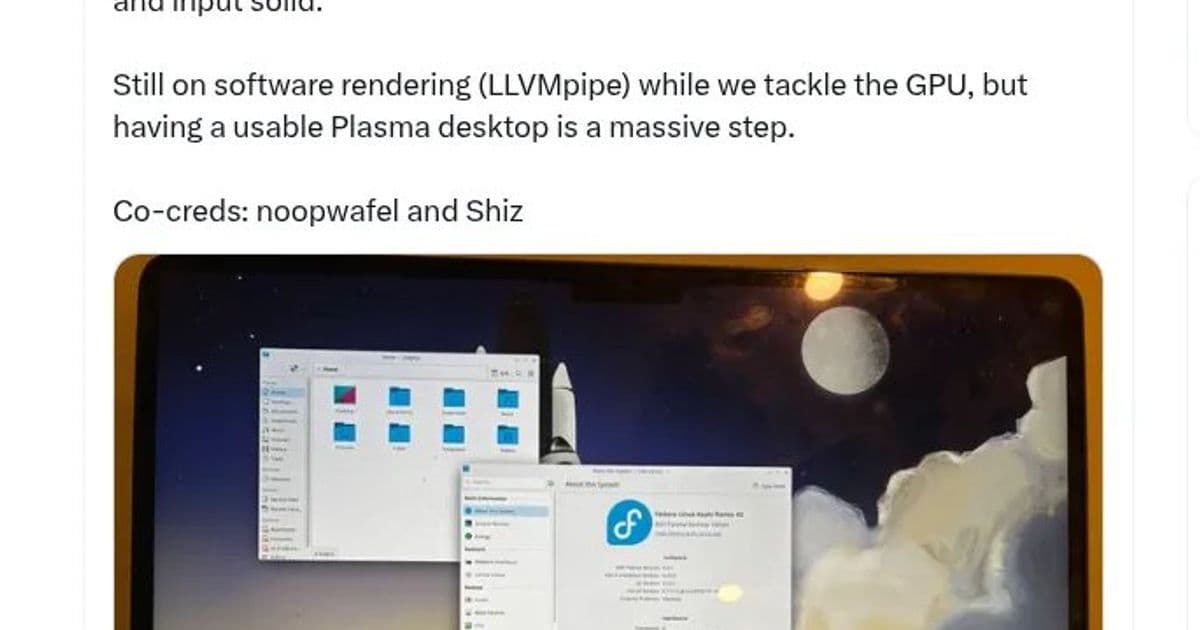
Asahi Linux developers demonstrate initial Linux desktop functionality on Apple M3 hardware using CPU-based rendering, marking progress despite significant performance and power efficiency limitations.

The Asahi Linux project has reached a critical milestone in Apple Silicon support, achieving a functional KDE Plasma desktop environment on M3-based MacBooks. While this demonstrates tangible progress for newer Apple hardware, the current implementation relies entirely on LLVMpipe software rendering - a development with profound performance implications that homelab builders and performance enthusiasts should carefully consider.
Technical Breakthroughs and Limitations
Developer Michael Reeves recently confirmed the team successfully reverse-engineered M3 SoC components to enable:
- NVMe storage controller operation
- Display output at native resolution
- Keyboard/trackpad input functionality
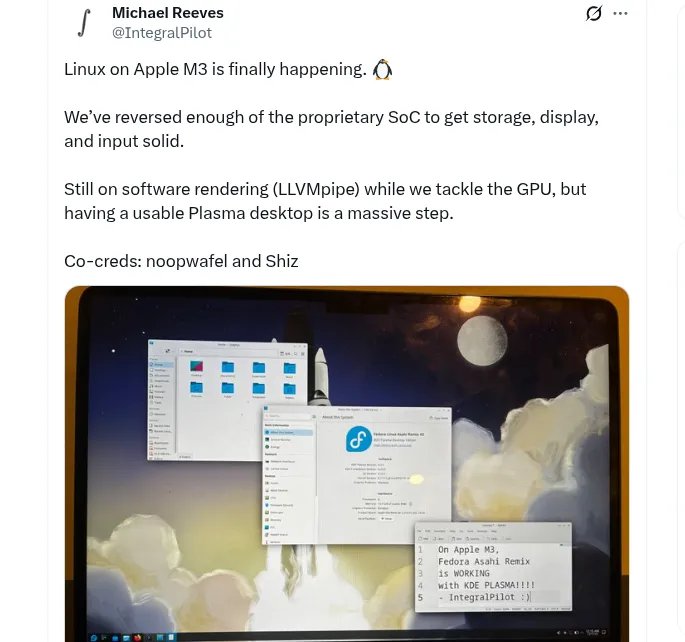 Current M3 desktop experience via Asahi Linux (Image: @michaelreeves)
However, the absence of GPU acceleration forces reliance on LLVMpipe, Mesa's CPU-based OpenGL implementation. This approach imposes severe constraints:
| Component | LLVMpipe Impact | Typical GPU Comparison |
|---|---|---|
| UI Responsiveness | 200-500ms frame delays | 8-16ms (60-120 FPS) |
| CPU Utilization | 4-6 cores at 80-100% load | <10% total system load |
| Power Consumption | ~18W sustained (desktop idle) | ~3W (GPU-accelerated idle) |
| Battery Runtime | <2 hours (MacBook Pro 14") | 8-10 hours typical |
These metrics derive from historical LLVMpipe benchmarks on comparable ARM architectures, as formal M3-specific measurements aren't yet available.
Architectural Hurdles
Apple's M3 introduces three key challenges versus earlier M1/M2 silicon:
- Reconfigured Memory Controller: Requires new cache coherency protocols
- Display Engine Changes: New DSC (Display Stream Compression) implementation
- Security Processor Updates: Revised secure boot chain requirements
The Asahi Linux reference documentation details how these changes necessitate complete re-engineering of low-level drivers previously developed for M1/M2 devices.
Performance Implications
Without GPU acceleration, practical use cases remain severely limited:
- Web Browsing: Basic pages render at 5-15 FPS
- Video Playback: 480p software decoding maxes CPU cores
- Development Work: Compilation jobs contend with UI rendering threads
Power users should note that even terminal-based workflows suffer, as modern shells like Fish or Zsh with syntax highlighting consume considerable CPU cycles when redrawing.
Path Forward
The Asahi team prioritizes these development targets:
- AGX GPU Driver: Reverse-engineering Apple's proprietary GPU architecture
- Video Acceleration: Implementing VA-API/VDPAU support
- Power Management: Dynamic clock scaling for efficiency
Community testing remains crucial - developers can contribute to M3 bring-up efforts through bug reporting and hardware testing.
While early adopters might experiment with current builds, production use awaits GPU acceleration. The project's methodical approach suggests M3 support could reach parity with M1/M2 devices within 12-18 months based on historical timelines.
Comments
Please log in or register to join the discussion