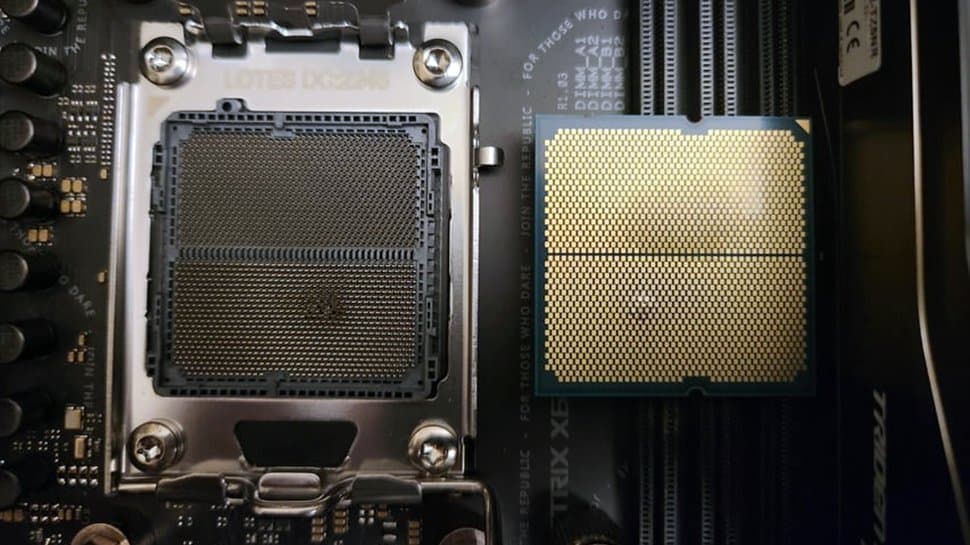
ASRock has issued an official statement acknowledging the ongoing investigation into Socket AM5 processor failures, joining ASUS and MSI in addressing the rare but concerning issue affecting AMD's latest CPUs.
ASRock has finally broken its silence on the persistent issue affecting Socket AM5 processors, joining ASUS and MSI in publicly acknowledging the investigation into Ryzen 9000 CPU failures. The motherboard manufacturer issued an official statement through its website's "News" section, confirming it is "closely monitoring recent discussions regarding the performance and behavior of AMD Ryzen™ 9000 series processors on ASRock AMD platforms."
This development comes after weeks of community speculation and mounting pressure from users reporting burned CPUs and damaged sockets. The timing is particularly noteworthy given that ASRock had remained notably quiet while competitors addressed the issue earlier.
The Scope of the Problem
While the images of scorched processors and melted CPU sockets circulating on social media are certainly alarming, it's crucial to understand the scale of this issue. At the time of writing, there are approximately 350 reported cases of failure, which sounds substantial until you consider the hundreds of thousands of Socket AM5 CPUs currently deployed in the wild.
These failures represent an infinitesimally small fraction of the total user base, yet the visual impact of burned silicon has understandably created significant concern within the enthusiast community. The problem initially surfaced with the Ryzen 7000 series in 2023 and was frequently associated with AMD's "X3D" gaming processors featuring 3D V-Cache technology.
ASRock's Response Strategy
ASRock's statement carefully avoids specifics about which processors are affected or what exactly is causing the failures. Instead, the company emphasizes its collaborative approach: "working in seamless coordination with AMD continuously to further validate system performance across a wide range of hardware configurations, while optimizing BIOS and enhancing overall system stability."
This language mirrors similar statements from ASUS and MSI, suggesting a coordinated industry response to what appears to be a complex technical challenge rather than a simple manufacturing defect. The repeated use of "seamless coordination" and "continuous validation" indicates this is likely to be an ongoing process rather than a quick fix.
The BIOS Update Controversy
Some users have interpreted ASRock's silent deployment of BIOS updates that modify voltage behavior and power profiles as an implicit admission of fault. However, this interpretation may be overly simplistic. From a business perspective, minimizing support requests and reducing the number of processors AMD must replace under warranty represents sound operational strategy rather than an acknowledgment of culpability.
Hardware YouTubers at Gamers Nexus have conducted extensive testing attempting to reproduce these failures intentionally, even using motherboards previously known to have killed processors. Their largely unsuccessful efforts suggest this may be more complex than a straightforward design flaw.
The Root Cause Debate
One prevailing theory points to a potential mismatch between AMD's wide range of possible voltage and power values and motherboard manufacturers' selection of extreme settings. This scenario creates a gray area where determining fault becomes challenging. Is it AMD's responsibility for providing aggressive default settings, or the motherboard vendor's for selecting the most extreme options?
AMD's willingness to replace failed CPUs under standard warranty complicates the blame assignment further. This approach suggests the company may be taking responsibility as a customer service measure rather than an admission of technical fault.
Industry-Wide Implications
The coordinated response from major motherboard manufacturers indicates this is being treated as a serious industry issue rather than isolated incidents. Each company's public statement represents a careful balance between acknowledging customer concerns and avoiding premature conclusions about root causes.
For users currently running Ryzen 9000 series processors, the low failure rate suggests continued normal operation is reasonable. However, the persistence of reports despite BIOS updates indicates this may be an ongoing challenge requiring sustained attention from both AMD and its motherboard partners.
The situation bears similarities to Intel's 13th and 14th-generation CPU issues, where complex interactions between processor design, motherboard firmware, and user configurations created unexpected failure modes. These cases highlight the increasing complexity of modern computing systems and the challenges of ensuring stability across diverse hardware configurations.
As the investigation continues, users should monitor official communications from their motherboard manufacturers and AMD while maintaining appropriate system monitoring practices. The collaborative approach being taken by industry leaders suggests a methodical rather than rushed response to this challenging technical problem.
Comments
Please log in or register to join the discussion