
Astera Labs expands its Scorpio PCIe switch family with a 320-lane X-Series model, targeting high-density AI server deployments and challenging Broadcom's dominance in the server switching market.
Astera Labs Scorpio 320-Lane PCIe Switch Update - Technical Analysis
Astera Labs has announced an update to its Scorpio family of PCIe switches, headlined by a new 320-lane X-Series model. This expansion represents a significant development in server connectivity, particularly for AI and hyperscale applications where high-bandwidth, low-latency connectivity between accelerators is critical.
Technical Specifications and Architecture
The new Scorpio X-Series 320-lane smart fabric switch is now shipping to leading hyperscalers, according to Astera Labs. This expansion brings the broader Scorpio P-Series family to span 32 to 320 lanes, providing system designers with a range of options depending on their specific connectivity requirements.
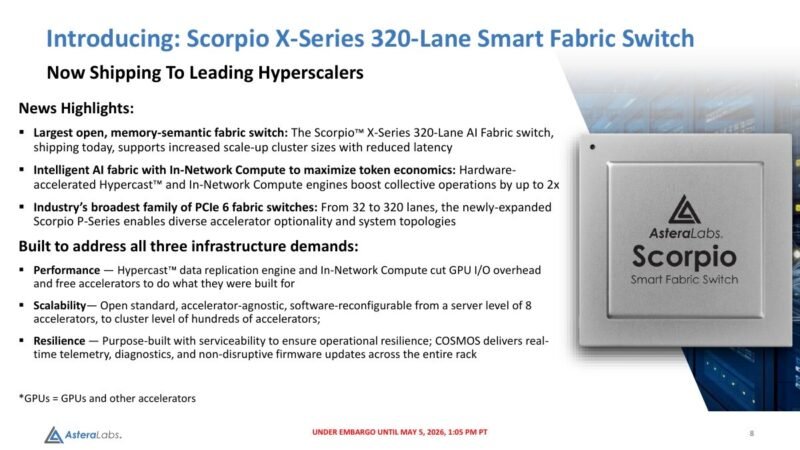 Astera Labs Scorpio X-Series 320-lane smart fabric switch overview
The 320-lane capacity is particularly noteworthy in today's PCIe switch market. To put this in perspective, with 16 lanes per PCIe device and 20 devices, the 320-lane switch can connect up to 20 high-bandwidth peripherals directly. This eliminates the need for cascading multiple smaller switches, reducing latency and simplifying system design.
The switch incorporates Astera's Hypercast data replication engine for operations such as all-gather, all-scatter, and all-to-all, along with In-Network Compute capabilities targeting operations like all-reduce and reduce-scatter. These features are particularly valuable in large GPU systems where significant time is spent on data movement rather than computation.
Topology Advantages and System Design Implications
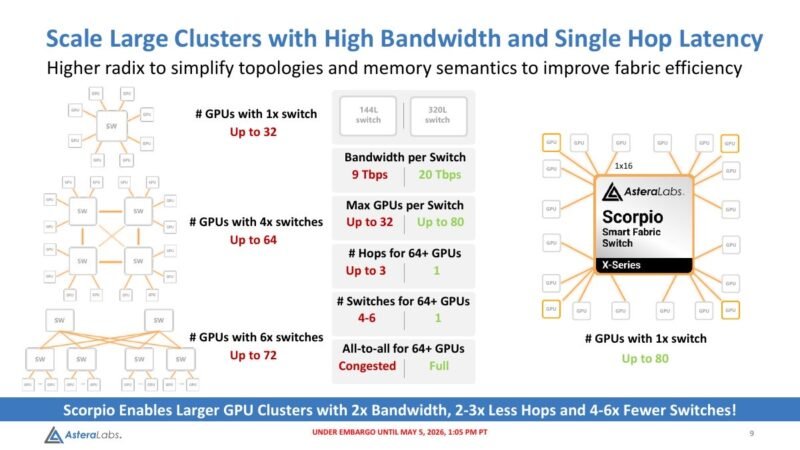 Astera Labs Scorpio 144-lane versus 320-lane topology comparison
The most significant technical advantage of the 320-lane switch is its impact on system topology. As Astera's comparison slides demonstrate, a larger switch enables more efficient topologies by reducing the number of required switches and hops between devices.
This concept is analogous to radix in networking switches—higher radix switches can connect more devices directly, reducing the need for multi-hop connections that increase latency and complexity. In server systems, this translates to:
- Reduced latency: Fewer hops mean lower latency for critical communications between accelerators
- Simplified PCB design: Fewer switch chips reduce routing complexity and board space requirements
- Improved power efficiency: Fewer components and potentially lower signal repeaters reduce power consumption
- Enhanced reliability: Fewer components mean fewer potential points of failure
Market Context and Competitive Positioning
Astera Labs' expansion into PCIe switching represents a strategic shift beyond their traditional focus on PCIe retimers. This positions them directly against Broadcom, which has historically dominated the server PCIe switching market.
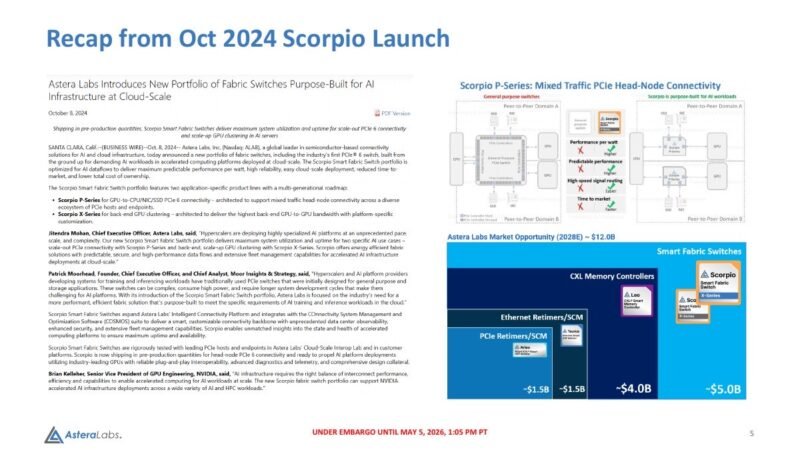 Astera Labs Scorpio launch recap
The timing of this announcement is significant. With the explosive growth of AI/ML workloads, demand for high-bandwidth connectivity between GPUs, DPUs, and other accelerators has increased dramatically. Systems like NVIDIA's DGX and other AI servers require sophisticated interconnect fabrics to efficiently distribute workloads and data.
The 320-lane capacity addresses a specific need in high-density AI server designs where multiple accelerators must communicate with minimal latency. This is particularly important for collective communication patterns common in distributed training frameworks.
Practical Deployment Considerations
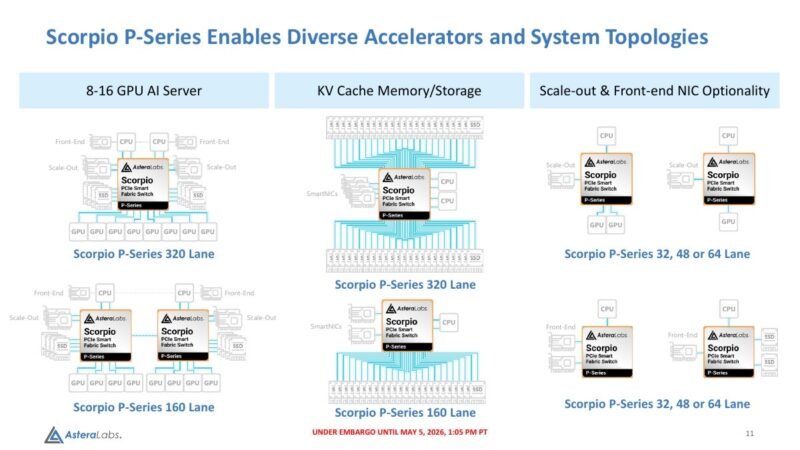 Astera Labs Scorpio P-Series system topology examples
For system designers, the expanded Scorpio family offers several practical advantages:
Scalability: The 32-320 lane range allows designers to select the appropriate switch size for their specific application, from smaller systems needing just a few additional PCIe lanes to large AI systems requiring massive connectivity
Fabric optimization: The smart fabric capabilities can reduce duplicated traffic and accelerate collective operations, contributing to improved "tokens per watt" efficiency metrics
Compatibility: The switches maintain compatibility with existing PCIe standards, allowing for integration into current server designs while enabling future expansion
Hyperscale validation: The fact that the switches are shipping to leading hyperscalers provides real-world validation of their capabilities in production environments
Broader Industry Impact
The introduction of 320-lane PCIe switches reflects broader trends in server architecture:
- Increasing specialization: As workloads become more specialized, connectivity solutions are evolving to meet specific requirements rather than providing generic connectivity
- Fabric convergence: The lines between traditional networking fabrics and PCIe fabrics are blurring, with technologies like CXL enabling more unified memory and I/O architectures
- Silicon specialization: Companies like Astera are developing specialized silicon for specific parts of the server ecosystem, challenging incumbents like Broadcom
Conclusion
Astera Labs' Scorpio 320-lane PCIe switch represents a significant technical advancement in server connectivity. By providing a high-radix switch solution, the company is addressing a critical need in modern AI and hyperscale systems where efficient interconnect between accelerators is paramount.
The expansion of the Scorpio family from 32 to 320 lanes demonstrates Astera's commitment to providing comprehensive connectivity solutions across different system sizes and requirements. As AI workloads continue to drive demand for more sophisticated interconnects, solutions like the Scorpio X-Series will play an increasingly important role in server architecture.
For system designers evaluating connectivity options, the Scorpio family offers a compelling alternative to traditional solutions, with particular advantages for high-density AI deployments where topology efficiency and collective communication performance are critical.
For more information on Astera Labs' Scorpio family, visit their official product page. Documentation and technical resources can be found in their developer portal.
Comments
Please log in or register to join the discussion