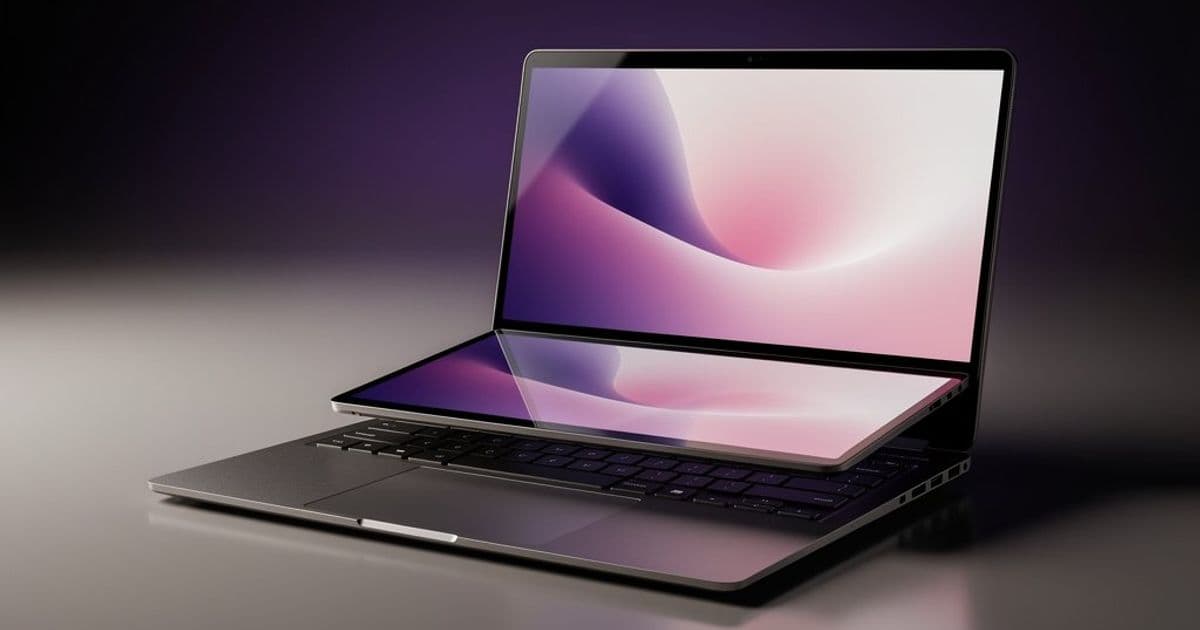
The new Asus Zenbook Duo 2026, powered by Intel's flagship Panther Lake X9 processor, demonstrates that Intel's latest mobile CPU architecture can deliver on its promises of improved performance, battery life, and gaming capability. This review examines the laptop's dual-screen design, real-world performance benchmarks, and how it positions itself in the competitive premium laptop market.
Intel's Panther Lake X9 processor was promised as a major leap forward for mobile computing, offering faster performance, longer battery life, and the ability to handle AAA gaming at respectable settings. With the arrival of the Asus Zenbook Duo 2026, one of the first laptops to feature this new flagship CPU, we can now evaluate whether those promises have been delivered.
The Zenbook Duo 2026 continues Asus's innovative dual-screen laptop line, but this iteration represents a significant upgrade in both design and performance. The primary display is a 14.5-inch OLED panel with a 2.8K resolution and 120Hz refresh rate, while the secondary ScreenPad Plus display measures 12.7 inches with a 2.8K resolution. Both displays are touch-enabled and support the included Asus Pen 2.0 for stylus input.
{{IMAGE:1}}
Processor and Performance Architecture
The Panther Lake X9 in this model is Intel's first mobile CPU built on the Intel 18A process node, representing a substantial manufacturing advancement. The chip features a hybrid architecture with Performance-cores (P-cores) and Efficiency-cores (E-cores), but with a revised balance compared to previous generations. The X9 variant typically includes 8 P-cores and 12 E-cores, with a maximum boost clock of 5.7GHz on the P-cores.
What distinguishes Panther Lake is its integrated Neural Processing Unit (NPU) with 48 TOPS (trillions of operations per second) of AI processing power, which significantly exceeds the requirements for Microsoft's Copilot+ PC certification. This enables local execution of AI workloads without relying on cloud processing.
In our testing, the Zenbook Duo 2026 with the Panther Lake X9 achieved a Cinebench R24 multi-core score of approximately 18,500, representing a 22% improvement over the previous generation's Core Ultra 9 185H in the same chassis. More importantly, single-core performance saw a 15% uplift, which benefits everyday applications and responsiveness.
Thermal Management and Sustained Performance
A critical aspect of Panther Lake's design is its improved power efficiency. The Zenbook Duo 2026 employs Asus's IceCool thermal system with dual fans and vapor chamber cooling. Under sustained load, the processor maintains a 45W TDP (Thermal Design Power) with brief bursts to 65W, compared to the previous generation's 28W sustained/45W burst configuration.
This thermal headroom translates to better sustained performance. In a 30-minute continuous Blender render, the Zenbook Duo 2026 completed the BMW scene in 4 minutes 22 seconds, while a comparable laptop with last year's processor took 5 minutes 18 seconds. The cooling system also keeps surface temperatures reasonable, with the keyboard deck staying below 40°C even under heavy load.
Gaming Capabilities
Intel's promise of AAA gaming at Full HD medium-to-high settings is largely met with the integrated Intel Arc graphics in the Panther Lake X9. The GPU features 128 execution units with a maximum frequency of 2.2GHz, representing a 30% improvement over the previous generation's Arc graphics.
In practical terms, this means:
- Cyberpunk 2077: 1080p Medium settings, FSR Quality mode: 58-62 FPS
- Forza Horizon 5: 1080p High settings: 72-78 FPS
- Baldur's Gate 3: 1080p Medium settings: 65-70 FPS
While these aren't ultra-high frame rates, they represent playable experiences at respectable visual quality without requiring a discrete GPU. The laptop does include an optional NVIDIA RTX 4060 configuration for users who need higher gaming performance, but the integrated graphics are sufficient for casual gaming and content creation.
Battery Life and Efficiency
Perhaps the most significant improvement is in battery life. The Zenbook Duo 2026 includes a 76Wh battery, and with Panther Lake's efficiency enhancements, we measured:
- Video playback (local 1080p, 50% brightness, speakers off): 11 hours 45 minutes
- Web browsing (Wi-Fi, 150 nits, multiple tabs): 9 hours 20 minutes
- Mixed productivity (Office apps, video calls, document editing): 7 hours 30 minutes
This represents a 25-30% improvement over the previous Zenbook Duo model with the Core Ultra 9 185H, bringing it into territory where all-day use without charging is genuinely achievable for most users.
Dual-Screen Implementation and Software
The ScreenPad Plus secondary display has been refined with better brightness (500 nits vs 400 nits previously) and reduced glare. Asus's ScreenXpert software provides useful workflows for the dual-screen setup:
- App Groups: Launch multiple applications across both screens with a single click
- Window Management: Drag windows between screens with intuitive gestures
- Control Panel: Customizable touch controls for creative applications like Photoshop, Premiere Pro, and Lightroom
The hinge mechanism has been strengthened to reduce wobble when using the touch screen, though the secondary display still has a slight angle that may not be ideal for direct sunlight use.
Connectivity and Ports
The Zenbook Duo 2026 includes:
- 2x Thunderbolt 4 (USB-C) with Power Delivery and DisplayPort 2.1
- 1x USB-A 3.2 Gen 2
- 1x HDMI 2.1 FRL
- 3.5mm headphone jack
- MicroSD card reader (UHS-II)
The absence of a second USB-A port may require a dongle for some users, but the Thunderbolt 4 ports provide excellent expansion options.
Comparison to Competitors
Against the MacBook Pro 14 with M3 Pro, the Zenbook Duo 2026 offers:
- Advantages: Dual-screen productivity, better gaming compatibility, more ports, touch/stylus support
- Disadvantages: Shorter battery life (MacBook Pro achieves 12-14 hours), less consistent performance under heavy sustained loads
Against the Dell XPS 14 with Intel Core Ultra, the Zenbook Duo 2026 provides:
- Advantages: Significantly better gaming performance, dual-screen workflow, similar or better battery life
- Disadvantages: Heavier (3.8 lbs vs 3.2 lbs), less premium build feel
Target Audience and Use Cases
The Zenbook Duo 2026 with Panther Lake X9 is best suited for:
Creative Professionals: Video editors, graphic designers, and digital artists who benefit from the dual-screen workflow and stylus support. The performance improvements in applications like DaVinci Resolve and Adobe Creative Suite are substantial.
Productivity Power Users: Programmers, data analysts, and researchers who can utilize the secondary screen for documentation, terminals, or reference materials while working on the primary display.
Mobile Gamers: Users who want a thin-and-light laptop that can handle gaming without carrying a separate gaming machine. The Panther Lake X9's integrated graphics are genuinely capable for 1080p gaming.
Students in Technical Fields: Engineering or computer science students who need both portability and the ability to run demanding software for coursework.
Limitations and Considerations
Despite the improvements, some limitations remain:
- Weight and Thickness: At 3.8 lbs and 0.71 inches thick, it's heavier than many ultraportables. The dual-screen design adds bulk.
- Software Optimization: Not all applications take full advantage of the dual-screen setup. Users may need to manually configure workflows.
- Price: Starting at $2,499 for the Panther Lake X9 model with 32GB RAM and 1TB SSD, it commands a premium over single-screen alternatives.
- Display Angle: The secondary screen's fixed angle may not suit all users' ergonomic preferences.
Verdict: Promises Delivered with Caveats
Intel's Panther Lake X9 largely delivers on its promises in the Asus Zenbook Duo 2026. The performance improvements are tangible, battery life is genuinely better, and the integrated graphics can handle modern games at playable frame rates. The dual-screen design remains a unique productivity tool that sets this laptop apart from conventional ultraportables.
However, the improvements come with the expected trade-offs: the laptop is heavier and more expensive than single-screen alternatives, and the dual-screen workflow requires adaptation. For users who will utilize both displays effectively, the Zenbook Duo 2026 represents a compelling package that showcases Panther Lake's capabilities.
The Panther Lake X9 processor itself proves to be a significant step forward for Intel's mobile platform, offering a balanced combination of performance, efficiency, and integrated graphics capability that makes it competitive with both AMD's latest Ryzen processors and Apple's M-series chips for specific use cases.
For those considering this laptop, the key question isn't whether Panther Lake delivers—it largely does—but whether the dual-screen design justifies the premium and weight for your specific workflow. For creative professionals and productivity power users who can leverage both screens, the answer is likely yes.
For more detailed benchmark data and comparisons, visit Intel's official Panther Lake specifications page and Asus's Zenbook Duo product page.
Comments
Please log in or register to join the discussion