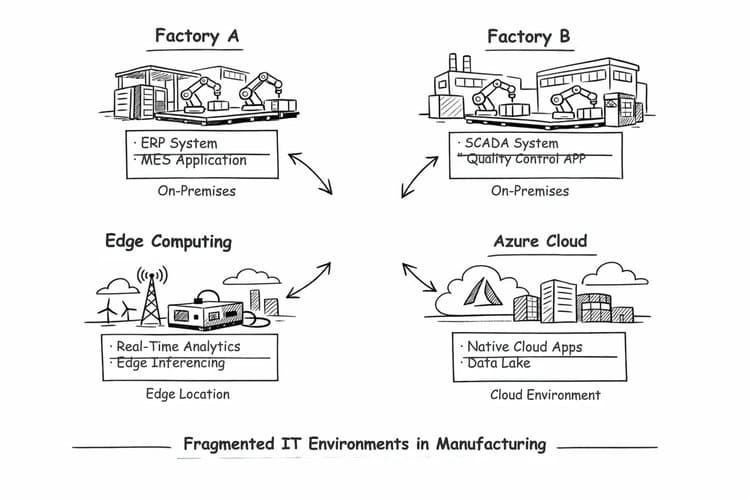
Azure Arc offers three architectural patterns to address the persistent challenge of operational fragmentation in manufacturing's hybrid environments, providing centralized control while maintaining local execution requirements.
Manufacturing companies face a unique cloud challenge: hybrid architectures aren't transitional—they're persistent. Most large manufacturers operate across remote plants, branch sites, private datacenters, and Azure. The primary challenge isn't adopting cloud services; it's preventing long-term operational fragmentation as the estate grows. Multiple teams, multiple tools, inconsistent security controls, and uneven governance create operational complexity that scales poorly.
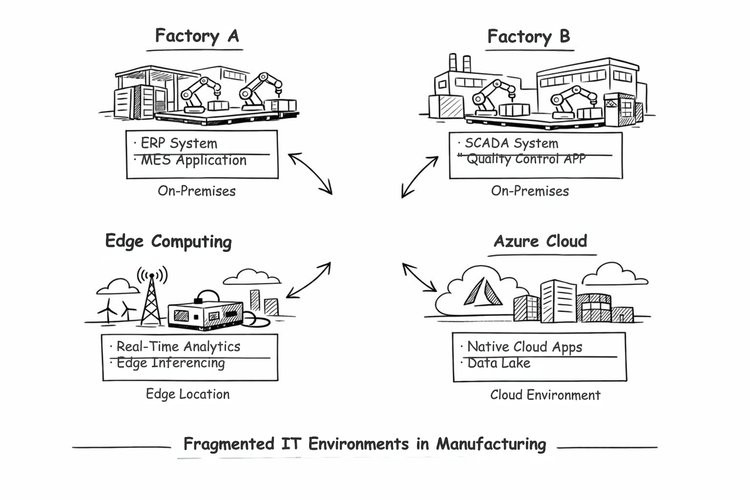
When manufacturing IT grows organically, systems end up scattered across factories, edge locations, and cloud environments, creating fragmentation instead of operational flow. Azure Arc addresses this through an architectural control-plane pattern, extending Azure management to infrastructure and Kubernetes outside Azure by projecting them into Azure Resource Manager (ARM).
This projection enables governance using Azure-native primitives such as policy, RBAC, and monitoring, creating unity across hybrid environments. In manufacturing scenarios, the estate typically includes:
- Latency & determinism requirements: plant-floor systems often require local execution
- Distributed footprint: dozens or hundreds of sites with varying maturity levels
- Connectivity variability: some sites are intermittently connected
- Regulatory & data constraints: some workloads must remain on premises
- Cloud-native applications including AI-based research and SAP systems
The failure mode isn't performance—it's inconsistent operations: different patching methods, varying monitoring stacks, and uneven security baselines across the enterprise.
Architectural Foundation: Control Plane and Data Plane Separation
A helpful way to conceptualize Azure Arc in manufacturing scenarios is to separate the control plane and data plane:
Control Plane (Centralized):
- Azure Resource Manager (resource inventory, tags, RBAC, Policy)
- Security posture & compliance (Defender for Cloud, policy initiatives)
- Observability and operations workflows (Azure Monitor, Update Manager, etc.)
Data Plane (Distributed):
- Workload execution remains at plants, private DCs, or edge sites
- Kubernetes API endpoints, runtime traffic, OT systems remain local
This separation is an architectural lever allowing organizations to standardize governance without forcing workload relocation, addressing the core challenge of maintaining consistent operations across distributed environments.
{{IMAGE:2}}
Pattern Selection Matrix
The appropriate Azure Arc pattern depends on specific constraints:
| Constraint | Recommended Starting Pattern | Why |
|---|---|---|
| Many sites + inconsistent tooling | Arc as distributed control plane | Standardizes governance and inventory via ARM projection |
| Plant workloads require local platform | Azure Local + Arc | Uses Azure Local baseline + Arc integration for operations |
| Connectivity cannot be assumed | Disconnected/intermittent design | Forces control-plane boundary design + local autonomy |
Pattern 1: Azure Arc as the Distributed Control Plane
When this pattern fits:
- You need consistent governance across plants, datacenters, and multicloud environments
- You can maintain at least periodic connectivity for control-plane synchronization
- You want Azure policy/security/monitoring to apply uniformly
Architecture Intent: Azure Arc projects existing bare metal, VM, and Kubernetes infrastructure resources into Azure to handle operations with Azure management and security tools. This approach simplifies governance and management by delivering a consistent multicloud and on-premises management platform experience for Azure services.
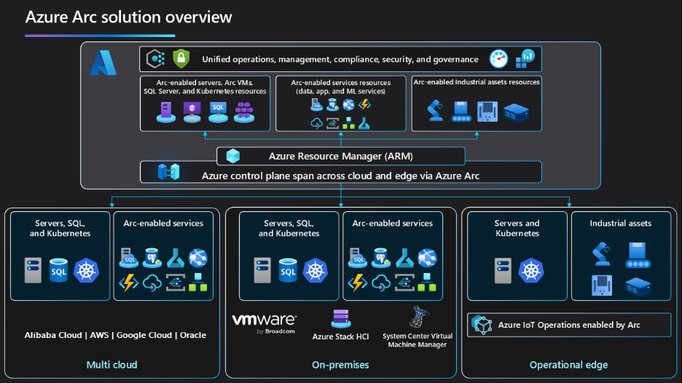
Once projected, organizations can operate hybrid resources using Azure-native constructs (inventory, compliance reporting, policy scope) and apply standardized guardrails. From an architectural standpoint, Azure Arc establishes a centralized control plane in Azure (ARM, RBAC, Policy, Resource Graph) while maintaining a decentralized data plane at plants, datacenters, or edge sites.
This separation enables organizations to apply management-group–scoped policies, standardized tagging, and Defender for Cloud controls consistently across environments while preserving local execution and latency characteristics required by manufacturing workloads.
Business Impact:
- Moves organizations from managing individual sites to governing the entire estate as one
- Minimizes operational drift as environments expand across plants and edge locations
- Centralized control simplifies enforcement of standards without slowing local operations
- Creates predictability at scale in highly distributed environments
- Establishes a stable foundation for future modernization initiatives
Pattern 2: Azure Local + Azure Arc
When this pattern fits:
- Workloads must run on premises for latency, sovereignty, or operational control
- You want cloud-consistent operations without creating a separate tooling island
- You need a standardized platform for virtualized + containerized workloads at sites
- You need local AI inferencing where data must be processed at the source/plant site
Architecture Intent: Azure Local is Microsoft's distributed infrastructure solution that extends Azure capabilities to customer-owned environments. It facilitates local deployment of both modern and legacy applications across distributed or sovereign locations.
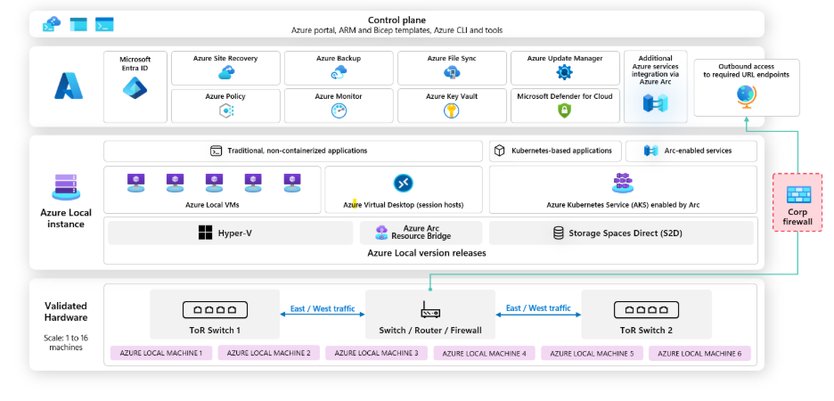
Azure Local accelerates cloud and AI innovation by seamlessly delivering new applications, workloads, and services from cloud to edge, using Azure Arc as the unifying control plane. Architecturally, Azure Local serves as the local data plane for applications—supporting general-purpose virtual machines, managed Kubernetes (AKS), and selected Azure services—while Azure Arc extends the Azure control plane to that environment for inventory, policy, monitoring, and security integration.
This separation allows workloads to run close to manufacturing systems without creating a parallel or disconnected operational model. Azure Local supports a broad spectrum of workload types on the same platform foundation:
- Traditional line-of-business applications on virtual machines
- Modern containerized workloads using AKS on Azure Local
- Azure-consistent platform services that can be deployed locally, such as Azure Virtual Desktop and SQL Managed Instance
- GPU-accelerated workloads for AI inferencing and computer vision scenarios
Business Impact:
- Prevents on-premises manufacturing workloads from evolving into bespoke environments with inconsistent security, monitoring, and lifecycle management
- Enables standardization across distributed locations while accommodating local requirements
- Simplifies skills development by using familiar Azure management patterns
- Reduces the operational burden of maintaining separate toolsets for different environments
- Provides a clear path for modernization while respecting operational constraints
Pattern 3: Disconnected Edge Workloads
When this pattern fits:
- Sites cannot assume continuous connectivity
- Local autonomy is required for safety or production continuity
- You still want centralized governance when connectivity is available
Architecture Intent: In manufacturing and edge scenarios, some environments must operate without continuous internet connectivity due to regulatory constraints, physical isolation, or operational risk tolerance. These architectures must assume cloud control-plane access is intermittent or unavailable while local execution continues without disruption.
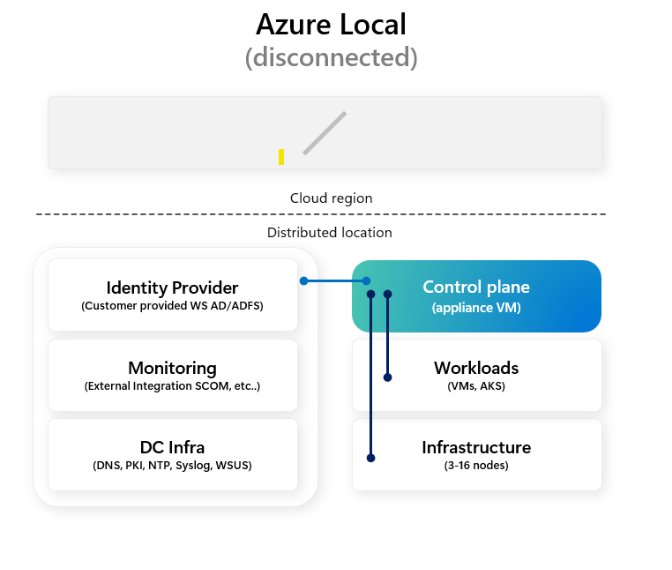
Disconnected architectures shift the primary design concern from availability of services to autonomy of execution. This pattern applies to environments that are fully offline, intermittently connected, or explicitly restricted from sending data to public cloud endpoints.
Azure supports this model through Disconnected-containers, where containerized services are deployed and operated fully offline. Once provisioned, these containers run entirely on local infrastructure with no runtime dependency on Azure endpoints, enabling uninterrupted execution even during extended disconnection periods.
Disconnected containers are offered through commitment tier pricing, each offering a discounted rate compared to the Standard pricing model. Learn more about pricing here.
Before attempting to run a Docker container in an offline environment, organizations should understand:
- Host computer requirements and recommendations
- The Docker pull command needed to download the container
- How to validate that a container is running
- How to send queries to the container's endpoint once it's running
Business Impact:
- Enables critical workloads to operate independently at the edge while remaining aligned to central governance when connectivity is available
- Prioritizes local autonomy without sacrificing architectural discipline
- Reduces operational risk in constrained or disconnected sites
- Ensures resilience and continuity in environments where connectivity cannot be assumed
- Simplifies compliance for regulated manufacturing environments
Strategic Implementation Considerations
Successful Azure Arc implementation in manufacturing environments requires attention to several factors:
Migration Pathways:
- Start with governance and policy definition before extending to operational tools
- Begin with consistent tagging and inventory across environments
- Implement monitoring incrementally, focusing on critical systems first
- Gradually extend security controls as trust is established
Provider Comparison: Azure Arc competes with several hybrid management solutions:
- AWS Outposts: Provides similar edge capabilities but lacks the same level of integration with on-premises Kubernetes and SQL Server
- Google Anthos: Offers strong multi-cloud capabilities but has less manufacturing-specific integration
- VMware Tanzu: Strong on-premises container management but limited Azure integration
Azure Arc's differentiator is its deep integration with Azure services while extending to non-Azure environments, making it particularly suitable for organizations heavily invested in Azure but maintaining diverse infrastructure estates.
Pricing Considerations: Azure Arc pricing follows a consumption-based model:
- Azure Arc-enabled servers are billed per connected server per month
- Azure Arc-enabled Kubernetes is billed per connected cluster per month
- Azure Arc data services are billed per instance per month
- Pricing varies by region and service tier
For disconnected environments, commitment tiers offer significant discounts compared to standard pricing, making it cost-effective for manufacturing deployments with predictable usage patterns.
Conclusion
Manufacturing IT will remain distributed by design. The risk isn't hybrid complexity—it's fragmented operations. By centralizing the control plane while keeping execution local, Azure Arc enables consistent security, compliance, and operations across cloud, datacenter, and edge environments.
The three architectural patterns—distributed control plane, plant-adjacent platform, and disconnected edge—provide flexibility to address diverse operational requirements while maintaining governance consistency. Organizations should evaluate their specific constraints and connectivity profiles to determine the appropriate pattern or combination of patterns for their environment.
As manufacturing continues its digital transformation journey, Azure Arc offers a practical approach to bridging the gap between traditional operational requirements and modern cloud capabilities, enabling organizations to innovate without compromising on security, compliance, or operational continuity.
Comments
Please log in or register to join the discussion