
Microsoft's Azure Arc product group outlined key updates for hybrid server management, including the commencement of Windows Server Hot Patch billing, a preview of TPM-based onboarding, and recaps of major SQL Server announcements from 2025.
Microsoft's Azure Arc Server Forum for January 2026 provided a strategic update on the evolving capabilities for managing on-premises and multi-cloud servers through Azure. The session, led by the Azure Arc product group, focused on several critical areas: essential machine management within Azure Compute Hub, the roadmap and billing commencement for Windows Server Hot Patch, a preview of new TPM-based onboarding, and a recap of significant SQL Server announcements from 2025.
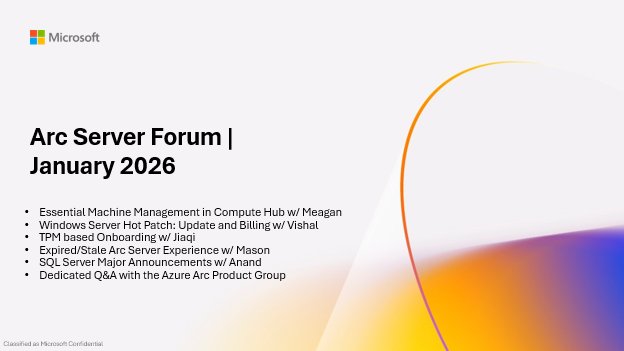
What Changed: Core Updates from the Forum
The forum highlighted several key developments in the Azure Arc ecosystem, each addressing specific operational and financial considerations for organizations managing hybrid infrastructure.
Essential Machine Management in Azure Compute Hub
The product group emphasized the integration of essential machine management capabilities directly within the Azure Compute Hub. This represents a consolidation of management interfaces, allowing administrators to oversee Azure Arc-enabled servers alongside native Azure virtual machines from a single pane of glass. The focus is on providing core operational tasks—such as inventory, monitoring, and basic configuration—without requiring navigation to separate portals. This move aligns with Microsoft's broader strategy to simplify hybrid management by reducing tool sprawl and centralizing control planes.
Windows Server Hot Patch: Billing Commencement and Roadmap
A significant update concerns the Windows Server Hot Patch feature. The forum confirmed that billing for this service will commence, marking a transition from a preview or free period to a generally available, paid model. Hot Patch allows for the installation of security updates on Windows Server 2022 and Windows Server 2019 Datacenter Edition Azure Edition virtual machines without requiring a reboot, thereby reducing downtime. The billing model is expected to be based on the number of virtual machines utilizing the service. The roadmap discussion likely covered future enhancements, such as broader OS version support or integration with other update management tools. Organizations must now factor this cost into their operational budgets, weighing the value of reduced downtime against the new subscription fee.
Preview: New TPM-Based Onboarding to Azure Arc
The forum offered a preview of a new onboarding method for Azure Arc that leverages Trusted Platform Module (TPM) technology. This approach aims to enhance security during the server onboarding process by using hardware-backed identity. Instead of relying solely on traditional authentication methods, TPM-based onboarding can provide a more secure, hardware-rooted trust relationship between the on-premises server and Azure. This is particularly relevant for environments with stringent security requirements, as it reduces the attack surface associated with credential management. While still in preview, this capability signals Microsoft's investment in hardware-based security for hybrid scenarios.
Recap of SQL Server Major Announcements from 2025
The session also revisited major SQL Server announcements made in 2025, providing context for how these integrate with Azure Arc. Key announcements likely included advancements in SQL Server 2025, such as enhanced AI integration, performance improvements, and new security features. For Azure Arc customers, the recap would have highlighted how these SQL Server capabilities can be managed and extended through Azure Arc, enabling consistent governance and monitoring across on-premises and cloud environments. This reinforces the value of Azure Arc as a unified platform for managing data services beyond just compute.
Provider Comparison: Azure Arc in the Hybrid Management Landscape
When evaluating Azure Arc for hybrid server management, it's essential to compare it with other major cloud providers' offerings. Azure Arc's unique value proposition lies in its agent-based model, which extends Azure's control plane to any infrastructure, including on-premises, edge, and multi-cloud environments.
AWS Outposts and VMware Cloud on AWS: AWS provides a more integrated but vendor-specific approach. Outposts is a fully managed service that extends AWS infrastructure to on-premises data centers, but it requires specific AWS hardware and is deeply tied to the AWS ecosystem. VMware Cloud on AWS offers a managed VMware environment on AWS, but management is primarily through VMware tools, not natively through the AWS console for all server-level operations. Azure Arc, by contrast, is more flexible, allowing management of servers running on any hypervisor or bare metal, and it integrates with existing VMware and Hyper-V investments.
Google Cloud Anthos: Anthos focuses on containerized applications and Kubernetes, offering strong multi-cloud and on-premises management for container workloads. While it can manage VMs, its primary strength is in modern, cloud-native applications. Azure Arc provides broader server management capabilities, including traditional VM and physical server management, making it more suitable for organizations with legacy workloads alongside modern applications.
VMware vSphere with Tanzu: For organizations heavily invested in VMware, vSphere with Tanzu offers a path to modernization within their existing environment. However, it lacks the native cloud integration and unified governance that Azure Arc provides across multiple clouds. Azure Arc can coexist with VMware environments, offering an additional layer of cloud-based management without requiring a full migration.
Pricing Considerations: Azure Arc's pricing model is primarily based on the number of servers (or virtual machines) under management, with additional costs for specific services like Azure Monitor, Azure Security Center, and now, Windows Server Hot Patch. This can be more predictable than models based on data transfer or compute usage, but organizations must account for the cumulative cost of all integrated services. In comparison, AWS Outposts has a minimum hardware commitment and operational costs, while Anthos has a subscription-based pricing model. The choice often depends on the existing vendor relationships, workload types, and the desired level of cloud integration.
Business Impact: Strategic Implications for Organizations
The updates from the Azure Arc Server Forum have direct implications for IT strategy and operations.
Cost Management and Budgeting: The commencement of Windows Server Hot Patch billing requires a cost-benefit analysis. Organizations must evaluate the financial impact of potential downtime reduction against the new subscription cost. For businesses with critical, always-on applications, the savings from avoided reboots and associated labor costs may justify the expense. However, for less critical systems, the cost may be harder to justify, leading to a potential reassessment of update strategies.
Security Posture Enhancement: The preview of TPM-based onboarding represents a proactive step toward stronger security in hybrid environments. Organizations with compliance requirements (e.g., GDPR, HIPAA) or those in high-risk industries should monitor this feature's development. Early adoption could provide a competitive advantage in security posture, reducing reliance on software-based credentials that are more vulnerable to theft.
Migration and Modernization Considerations: The recap of SQL Server 2025 announcements, coupled with Azure Arc's management capabilities, provides a clear path for modernizing data infrastructure. Organizations can run the latest SQL Server versions on-premises while leveraging Azure's cloud services for backup, disaster recovery, and monitoring. This hybrid approach can be a strategic middle ground, allowing businesses to modernize at their own pace without a full, disruptive migration to the cloud.
Operational Efficiency: The integration of essential machine management into Azure Compute Hub simplifies daily operations. IT teams can reduce context switching between tools, leading to faster incident response and more consistent policy enforcement. This is particularly valuable for organizations managing diverse environments, as it reduces the training overhead for multiple management consoles.
Staying Engaged and Future Outlook
To remain current with Azure Arc developments, the forum organizers recommend several actions:
- Provide Feedback: Microsoft is actively seeking input on the Arc Server experience, especially regarding expired or stale features. Direct feedback can influence the product roadmap.
- Stay Updated: Ensuring the Azure Arc agent is on the latest version is critical for receiving security patches and quality improvements. The agent is the bridge between on-premises servers and Azure, and its health is paramount.
- Engage with the Community: Registering for the Azure Arc Server Forum and newsletter (via https://aka.ms/arcserverforumsignup/) provides direct access to the product group and early insights into upcoming features. The next session is scheduled for February 19, 2026, at 9:30 AM PST.
- Explore SQL Server Future: For database professionals, registering for SQL Con 2026 at sqlcon.us offers deeper insights into SQL Server's trajectory, which is increasingly intertwined with Azure Arc for hybrid deployments.
The January 2026 forum underscores Microsoft's commitment to refining Azure Arc as a central pillar of its hybrid cloud strategy. By addressing practical concerns like cost, security, and management complexity, Azure Arc continues to evolve as a compelling option for organizations navigating the multi-cloud reality.
For those who missed the live session, a recording is available on the Azure Arc YouTube channel (search for "Arc Server Forum January 2026").
Comments
Please log in or register to join the discussion