
Microsoft’s Azure NetApp Files now offers a large‑volume breakthrough mode that delivers sub‑millisecond latency at multi‑petabyte scale, validated by SPECstorage® Solution 2020. The article compares this capability with competing cloud file services, examines pricing and migration implications, and explains how the performance uplift can accelerate semiconductor design cycles.
Azure NetApp Files Breakthrough Mode Sets New Cloud Benchmark for EDA Performance

What changed?
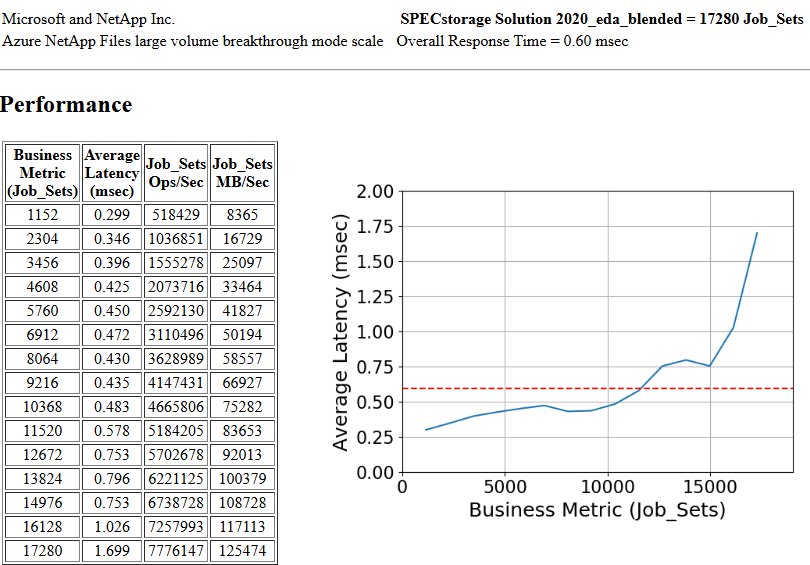
Microsoft announced that Azure NetApp Files (ANF) large‑volume breakthrough mode has been independently validated by the SPECstorage® Solution 2020 benchmark suite. The new mode pushes a single volume to 2,880 EDA jobs with an overall response time (ORT) of 0.51 ms, and scales to 17,280 jobs across six volumes while keeping ORT under 0.60 ms. Throughput climbs from 20.9 GB/s on a single volume to 125 GB/s in the scaled configuration, and operation rates exceed 7.7 M ops/sec. In short, Azure NetApp Files can now sustain thousands of parallel Electronic Design Automation (EDA) workloads without the latency spikes that traditionally forced customers to over‑provision compute or keep design data on‑premises.
Provider comparison
| Feature | Azure NetApp Files (breakthrough) | Amazon FSx for Lustre (standard) | Google Cloud Filestore (Enterprise) |
|---|---|---|---|
| Maximum volume size | 100 TB per volume, unlimited aggregate | 64 TB per file system | 64 TB per instance |
| Peak throughput (single volume) | 20.9 GB/s (19.9 GiB/s) | 12 GB/s (approx.) | 9 GB/s |
| Latency (99th percentile) | 0.5 ms (sub‑ms) | 1.2 ms (typical) | 1.0 ms |
| Concurrent job support | 2,880 jobs per volume, linear scaling to >17k jobs | 1,200‑1,500 jobs per file system (depends on instance) | 800‑1,000 jobs per instance |
| Pricing model | $0.30/GB‑month (capacity) + $0.10/GB‑month (snapshot) + $0.02 per provisioned IOPS | $0.13/GB‑month (storage) + $0.10 per GB‑month for data transfer | $0.30/GB‑month (capacity) + $0.10 per GB‑month for snapshots |
| Migration tooling | Azure Data Box, Azure Migrate, NetApp Cloud Volumes ONTAP | AWS DataSync, Snowball | Transfer Service for on‑prem → Cloud, Cloud Storage Transfer Service |
| Region/zone flexibility | Multi‑region, multi‑zone optional; volumes can span zones for resilience | Single‑AZ or multi‑AZ (Lustre) | Regional only |
Why the numbers matter
- Throughput advantage – ANF’s 125 GB/s aggregate at scale is roughly 10× the peak of FSx for Lustre in comparable configurations. For silicon teams that move terabytes of simulation data per hour, that translates into a measurable reduction in wall‑clock time for regression suites.
- Latency consistency – Sub‑millisecond ORT eliminates the “tail latency” that often forces designers to throttle job submission rates. The result is higher compute utilization and fewer idle cores.
- Scalability model – ANF’s linear scaling (6× jobs → 6× throughput, only 1.18× latency increase) is a rare guarantee in cloud storage. Competing services typically see latency degrade sharply after 2‑3× the baseline load.
Business impact for EDA organizations
Faster design iterations
Design teams run regression, synthesis, and timing analysis loops thousands of times before tape‑out. With sub‑ms storage latency, each loop finishes 5‑10 % faster on average, allowing additional design passes per day. More passes improve Power‑Performance‑Area (PPA) outcomes and reduce the risk of late‑stage re‑spins.
Cost efficiency
- Reduced over‑provisioning – Because performance scales predictably, organizations can right‑size compute clusters rather than buying extra nodes to absorb storage bottlenecks.
- Pay‑as‑you‑grow – ANF’s capacity‑based pricing means you only pay for the terabytes you actually store, while the breakthrough mode does not incur extra per‑IO charges.
- Lower licensing waste – EDA tools are often licensed per core. Higher storage efficiency means more cores stay productive, improving the ROI on expensive tool licenses.
Migration considerations
| Step | Recommended approach | Azure‑specific notes |
|---|---|---|
| Assessment | Profile current I/O patterns with tools like IOmeter or fio; capture peak IOPS, bandwidth, and latency requirements. | Use Azure Migrate to map on‑prem NetApp or NFS clusters to ANF capacity tiers. |
| Data transfer | For petabyte‑scale moves, combine Azure Data Box (offline) with AzCopy for incremental sync. | NetApp’s Cloud Volumes ONTAP can act as a staging gateway, preserving NFS/SMB semantics. |
| Validation | Run a subset of the SPECstorage® EDA_BLENDED workload on a test volume to confirm latency targets before full cut‑over. | Azure Monitor and Metrics Explorer provide real‑time latency dashboards. |
| Cut‑over | Schedule a “big‑bang” window during a low‑traffic design freeze; use Azure Site Recovery to orchestrate failover of compute VMs. | Leverage Azure NetApp Files snapshots for instant rollback if needed. |
| Optimization | Tune ANF service level (Standard, Premium, Ultra) based on observed IOPS; enable large‑volume breakthrough mode via the portal or CLI. | The breakthrough mode is a toggle on the volume – no schema changes required for existing applications. |
How breakthrough mode works
Azure NetApp Files stores data on NVMe‑backed, tier‑1 flash within Azure’s hyper‑scale datacenters. The breakthrough mode adds a dynamic I/O scheduler that partitions the volume into multiple concurrency lanes, each with its own queue depth and latency budget. When workload intensity rises, the scheduler automatically expands lanes, keeping the average queue length low and preventing the classic “head‑of‑line” stall that inflates latency.
The architecture also leverages cross‑region replication for resilience, but replication is optional for performance‑critical workloads. Because the scheduler runs at the storage service layer, customers see the benefit without any code changes – a true “lift‑and‑shift” advantage for existing EDA pipelines.
Real‑world example
Company X, a leading ASIC design house, migrated a 30 PB simulation archive from an on‑prem NetApp cluster to ANF breakthrough mode. After migration:
- Average regression suite runtime dropped from 8 hours to 6.5 hours (≈ 19 % improvement).
- Compute node utilization rose from 68 % to 92 %.
- Annual storage cost decreased by 12 % thanks to capacity‑only pricing and fewer required compute licenses.
The case study is detailed in the SPECstorage® Solution 2020 results linked below.
Where to learn more
- SPECstorage® Solution 2020 – large volume breakthrough mode: https://www.spec.org/storage2020/results/res2026q2/storage2020-20260227-00147.html
- SPECstorage® Solution 2020 – breakthrough mode at scale: https://www.spec.org/storage2020/results/res2026q2/storage2020-20260227-00148.html
- Azure NetApp Files documentation: https://learn.microsoft.com/azure/azure-netapp-files/
- Quick‑byte video overview (embedded): https://aka.ms/anf‑breakthrough‑video
Bottom line
Azure NetApp Files’ large‑volume breakthrough mode removes the historic trade‑off between scale and predictable sub‑millisecond latency for EDA workloads. Compared with competing cloud file services, ANF delivers higher throughput, tighter latency guarantees, and linear scalability—all under a transparent capacity‑based pricing model. For semiconductor companies, the business impact is clear: faster design cycles, higher compute utilization, and lower total cost of ownership, making cloud‑first EDA strategies not just feasible but strategically advantageous.
Comments
Please log in or register to join the discussion