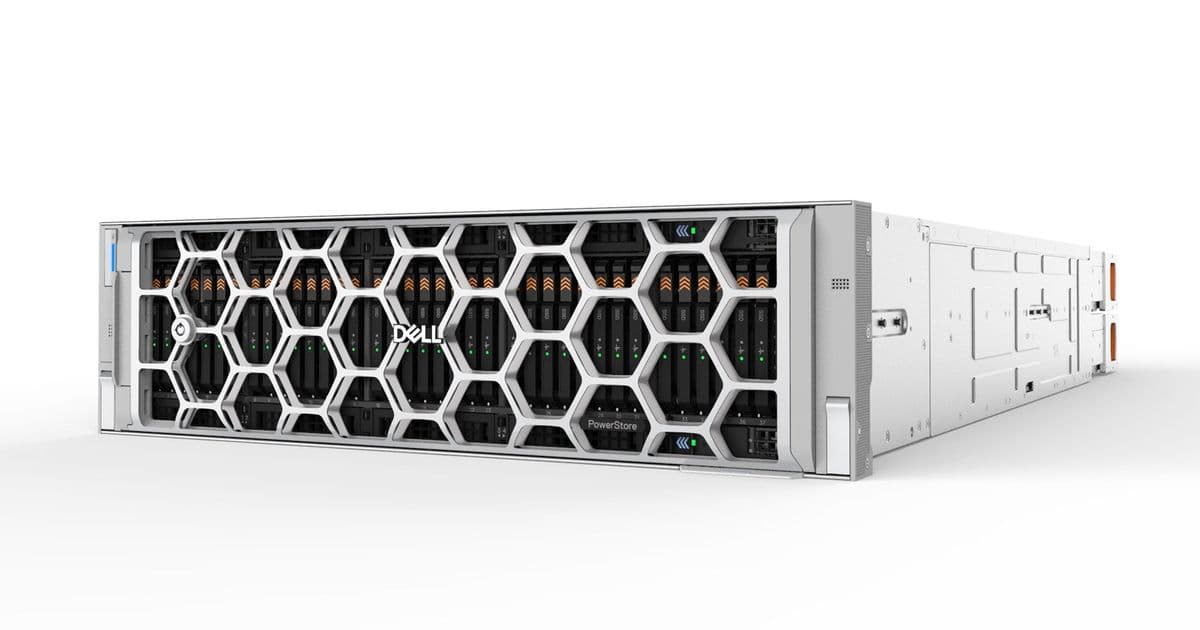
Dell announced its first servers built on AMD’s 6th‑gen EPYC “Venice” CPUs, including the liquid‑cooled M9825 and a family of 1U/2U/3U rack units, plus a single‑socket Intel Xeon “Diamond Rapids” model. In parallel, the company introduced the PowerStore Elite storage appliance, a 3U chassis that can hold up to 40 E3‑form SSDs for a raw capacity of 5.8 PB and delivers up to 3× the performance of the previous generation through PCIe Gen5, DDR5, and modular hardware design.
Dell Unveils EPYC Venice‑Based PowerEdge Lineup and 5.8 PB PowerStore Elite
Dell Technologies World’s second day shifted focus from AI‑centric GPUs to the broader Modern Data Center portfolio. The announcements covered two major hardware families: a next‑generation PowerEdge server line built around AMD’s 6th‑generation EPYC "Venice" silicon, and the PowerStore Elite storage appliance that pushes raw capacity past 5 PB while moving to PCIe Gen5 and DDR5.
1. PowerEdge Gen 18 – First Systems with EPYC Venice
1.1 Processor background
- AMD EPYC Venice – 6th‑gen Zen 4+ cores, fabricated on TSMC’s N2 node.
- Core counts up to 256 cores / 512 threads per socket.
- Up to 4 TB of DDR5‑5600 memory per socket, with 12 memory channels.
- PCIe Gen5 x16 per socket, delivering 64 GT/s per lane.
Dell’s Gen 18 roadmap positions Venice as the baseline for every new PowerEdge SKU announced today. The company claims up to 70 % performance uplift versus the current Gen 17 (based on EPYC Milan) when measured on mixed AI‑training and database workloads.
1.2 Flagship liquid‑cooled M9825
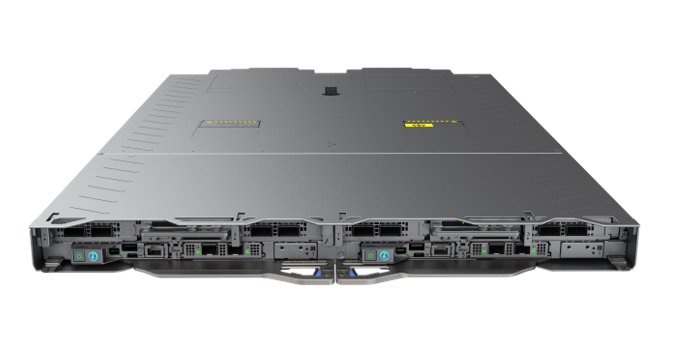
- Form factor: 2U, designed for Dell’s IR7000 rack infrastructure (up to 480 kW per rack).
- Cooling: Direct‑to‑chip liquid cooling loop with redundant pumps and heat exchangers.
- Configuration: Dual‑socket, up to 512 cores / 1024 threads, 8 TB DDR5 per socket, 40 PCIe Gen5 slots.
- Target workloads: Large language model (LLM) inference, high‑throughput HPC, and dense AI training clusters where power density is the limiting factor.
1.3 Traditional density‑optimized rack units
| Model | Size | Sockets | Max cores | Memory | Typical use |
|---|---|---|---|---|---|
| R9815 | 2U | 1 | 256 | 4 TB DDR5 | General purpose, virtualization |
| R9825 | 3U | 2 | 512 | 8 TB DDR5 | Database, analytics, AI inference |
| R6815 | 1U | 1 | 128 | 2 TB DDR5 | Edge, micro‑datacenter |
| R8815 | 1U | 2 | 256 | 4 TB DDR5 | High‑density web serving |
All models expose the full PCIe Gen5 bandwidth, enabling future accelerator cards (e.g., NVIDIA H100, AMD Instinct) without additional riser cards.
1.4 Accelerated compute variants – XE5845 / XE7845
- Form factor: 2U, air‑cooled.
- CPU: Single‑socket EPYC Venice.
- GPU: Up to four NVIDIA Rubin‑based accelerators via NVLink bridges.
- Use case: Mixed‑precision AI training pipelines that need x86 control plane alongside GPU compute.
1.5 Storage‑focused EPYC models – R7815 / R7815xd / R7825
- R7815 – 1U, single socket, 256‑core, 12 PCIe Gen5 slots, optimized for NVMe‑over‑Fabric.
- R7815xd – 2U, same CPU but with an expanded backplane for up to 24 NVMe drives.
- R7825 – 2U, dual socket, 512‑core, 24 PCIe Gen5 slots, targeting hyper‑converged workloads.
All EPYC‑based servers are slated for H2 2024 silicon shipment, with the remainder of the Gen 18 family arriving in 2027.
2. Intel‑based PowerEdge R9810 – Diamond Rapids
Dell also announced a single‑socket R9810 built on Intel’s upcoming Xeon 7 Diamond Rapids silicon. Key specs:
- Up to 64 cores, 128 threads.
- DDR5‑5600 memory, 8 TB per socket.
- PCIe Gen5 x16, double the memory bandwidth of Granite Rapids.
- 2U, air‑cooled, targeting workloads that favor Intel’s AVX‑512 extensions and software ecosystems tied to Intel optimizations.
The R9810 is scheduled for 2027 release, providing Dell a balanced portfolio across AMD and Intel high‑core‑count platforms.
3. PowerStore Elite – 3U, 5.8 PB of raw SSD capacity
3.1 Mechanical redesign
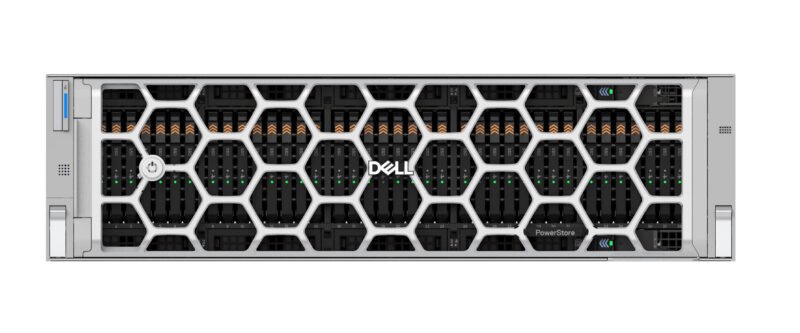
- Chassis: 3U, supports 40 vertically‑mounted E3‑form factor SSDs (7.5 mm thick).
- Drive mix: Up to 40 × 128 GB QLC or 40 × 2 TB TLC modules, yielding 5.8 PB raw.
- Modular midplane and controller backplane enable future upgrades without full chassis replacement.
3.2 Compute and I/O
- CPUs: Intel Xeon Scalable (4th Gen) – 1‑socket (1500) or 2‑socket (5500/9500) configurations.
- PCIe: Gen5 for all SSDs, delivering up to 128 GB/s aggregate bandwidth per drive.
- Networking: Base models ship with 32 × FC, 16 × 100 GbE, 40 × 25 GbE; optional 200 GbE/400 GbE modules are planned.
- Internal cross‑node fabric: 200 GbE RDMA, a 20× increase over the previous 10 GbE link.
3.3 Data reduction and software stack
- 6:1 effective data reduction (up from 5:1) via unaligned deduplication and advanced compression.
- Autonomous Data Path (ADP) uses machine‑learning models to prioritize I/O scheduling per operation, mitigating QLC latency.
- Log‑structured metadata reduces write amplification on QLC drives, extending endurance to > 5 PBW (petabyte‑writes).
- OS layer is container‑based, allowing Dell to push updates to the storage stack without firmware flashes.
3.4 Performance claims
| Metric | PowerStore Gen 2 | PowerStore Elite |
|---|---|---|
| IOPS (mixed) | ~2 M | ~6 M |
| Throughput (sequential) | ~12 GB/s | ~36 GB/s |
| Density (PB per rack) | 1.9 PB | 5.7 PB |
Dell attributes the three‑fold gains to the combined effect of PCIe Gen5, DDR5, and the modular hardware design.
4. Deployment considerations
4.1 Power and cooling
- The M9825 and IR7000 rack require high‑density cooling loops; facilities must provision chilled water loops with redundancy.
- Traditional air‑cooled EPYC servers (R9815/R9825) fit within standard 30 kW per rack limits, simplifying integration into existing data halls.
- PowerStore Elite’s 3U chassis draws ≈12 kW at full drive load; Dell recommends dual‑circuit power feeds and hot‑aisle containment for optimal thermal performance.
4.2 Network topology
- For AI clusters, connect the M9825 to a 200 GbE spine using DPDK‑accelerated RoCE v2 to minimize latency.
- Storage‑centric deployments should leverage the Elite’s 100 GbE or 200 GbE ports with NVMe‑over‑Fabric to saturate the PCIe Gen5 backplane.
4.3 Upgrade path
- Both the PowerEdge and PowerStore families use modular backplanes; Dell ships spare midplane kits that allow retrofitting of newer CPUs or SSD controllers without chassis replacement.
- The container‑based OS on PowerStore Elite means software upgrades (e.g., new compression algorithms) can be rolled out in minutes, reducing maintenance windows.
5. Real‑world impact
- AI training clusters can now achieve > 1 PFLOP of mixed‑precision compute per rack by pairing M9825 nodes with NVIDIA H100 GPUs, thanks to the high‑core‑count EPYC CPUs and liquid‑cooling density.
- Enterprise storage can consolidate three generations of legacy arrays into a single Elite chassis, reducing footprint and power consumption while maintaining ≥ 6:1 data reduction.
- The modular approach extends the useful life of both compute and storage platforms, aligning with typical 5‑year refresh cycles and protecting CAPEX.
6. Availability
- PowerEdge M9825, R9815, R9825 – shipping H2 2024 (first wave of EPYC Venice).
- Remaining EPYC‑based models – slated for 2027.
- PowerEdge R9810 (Diamond Rapids) – expected 2027.
- PowerStore Elite – begins order intake July 2024, with first units shipping Q4 2024.
Dell’s announcements signal a shift toward higher core density, PCIe Gen5 I/O, and modular hardware that can evolve with future silicon. Organizations that plan for liquid‑cooling or dense NVMe storage now have a clear upgrade path that leverages both AMD and Intel’s latest silicon while keeping the software stack flexible through containerization.
Comments
Please log in or register to join the discussion