
A detailed cost comparison of four Azure networking architectures reveals Virtual WAN as the most cost-effective solution for environments with 3,000+ VNets across multiple regions, though traffic patterns significantly impact pricing outcomes.
When designing large-scale Azure networks spanning thousands of virtual networks (VNets) across multiple regions, architects face fundamental cost questions. A recent analysis comparing four Azure networking architectures demonstrates that Azure Virtual WAN consistently delivers superior cost efficiency for common enterprise scenarios, though traffic patterns dramatically influence outcomes.
The Four Contenders
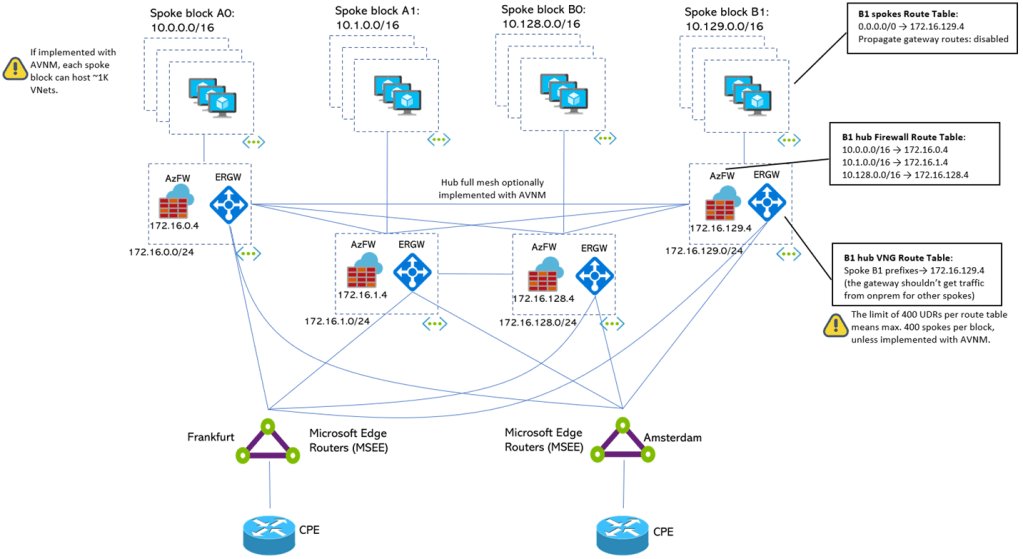
Four architectures were evaluated for a scenario with 3,000 VNets across two regions using Azure Firewall and ExpressRoute:
Traditional Hub-and-Spoke (HnS)
- Full mesh peering between regional hubs
- Maximum 400 spokes per hub due to GatewaySubnet route table limits
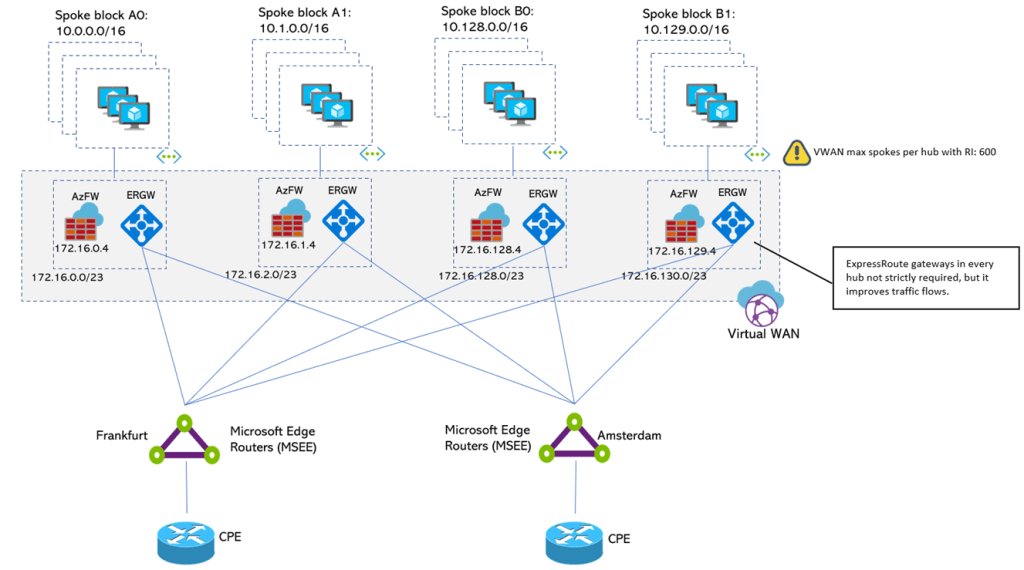
Virtual WAN (VWAN)
- Managed service with simplified topology
- Supports 600 spokes per virtual hub
Indirect Spoke Design (HnS+VWAN)
- Hybrid approach combining traditional hubs with Virtual WAN core
- Centralizes ExpressRoute gateways
Azure Virtual Network Manager (AVNM)
- Full mesh connectivity within spoke blocks
- Supports 1,000 VNets per managed group
Cost Breakdown: The Devil in the Details
Using baseline traffic assumptions (100MB/month between spokes, 1GB/month spoke-to-onprem, 10GB/month onprem-to-spoke), the analysis revealed:
1. VNet Peering Costs
- Traditional HnS: $18,654
- VWAN: $9,327 (50% savings)
- AVNM: $18,654
VWAN's advantage stems from eliminating peering costs at the hub level.
2. Firewall Expenses
- Traditional HnS: $34,828
- VWAN: $31,539
- AVNM: $23,474 (benefits from intra-block traffic avoidance)
3. Inter-Block Transfer Costs
- Traditional HnS: $7,875
- VWAN: $9,000
- Indirect Spoke: $40,920 (prohibitive due to Virtual WAN processing fees)
4. Virtual Hub Costs
- VWAN: $1,533
- Indirect Spoke: $511
5. ExpressRoute Gateways
- Traditional HnS: $2,108
- VWAN: $2,277
- Indirect Spoke: $759 (most efficient gateway deployment)
6. AVNM Premium
- Fixed $43,858 management cost
The Verdict
 For the 3,000-VNet scenario:
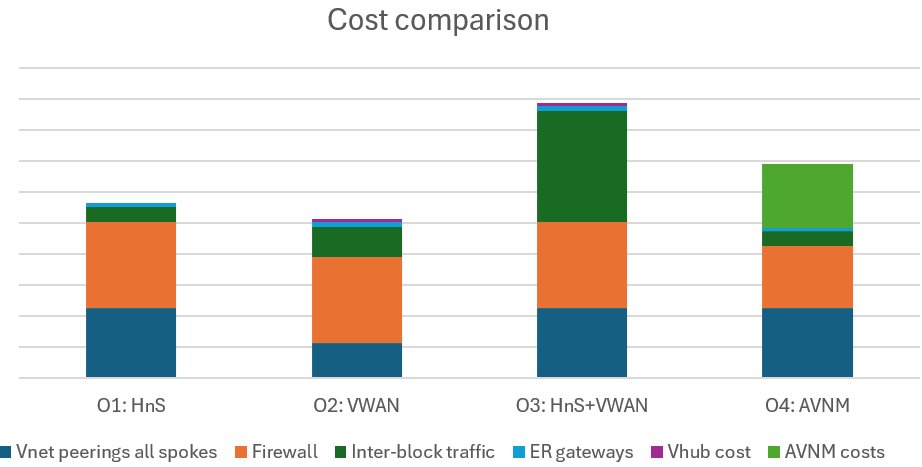
- Virtual WAN - Most cost-effective at $44,678
- Traditional HnS - $63,465
- AVNM - $106,460
- Indirect Spoke - $100,364
VWAN's cost advantage stems primarily from reduced peering expenses and efficient traffic processing. The indirect spoke model became uneconomical due to Virtual WAN transfer fees, while AVNM's fixed management cost proved prohibitive.
Scenario Sensitivity
Results vary significantly with traffic patterns:
- No VNet-to-VNet Traffic: All options converge near $30,000-$40,000
- 6 Regions: VWAN maintains ~20% cost advantage
- High On-Prem Traffic (10x increase): All models scale similarly with VWAN remaining cheapest
- Heavy Spoke-to-Spoke Traffic (10GB/pair): AVNM becomes competitive ($58,482 vs VWAN's $62,939) by avoiding firewall hops
Strategic Implications
- Traffic Analysis is Non-Negotiable: Cost outcomes depend entirely on specific traffic flows
- Operational Costs Matter: While VWAN won on price, AVNM reduces management overhead
- Scale Changes Everything: Designs viable at 100 VNets become inefficient at 3,000
- Hybrid Models Carry Risk: Indirect spoke architectures introduced unexpected cost penalties
The analysis confirms that for most large-scale implementations with typical enterprise traffic patterns, Azure Virtual WAN delivers the optimal balance of cost efficiency and operational simplicity. However, organizations with extreme spoke-to-spoke traffic should evaluate AVNM, while those prioritizing gateway efficiency might consider hybrid approaches.
Methodology Note: Calculations assumed 20% headroom under published limits (e.g., 590 spokes/VWAN hub vs 600 maximum). Real-world pricing may vary based on actual usage and regional pricing differences.
Comments
Please log in or register to join the discussion