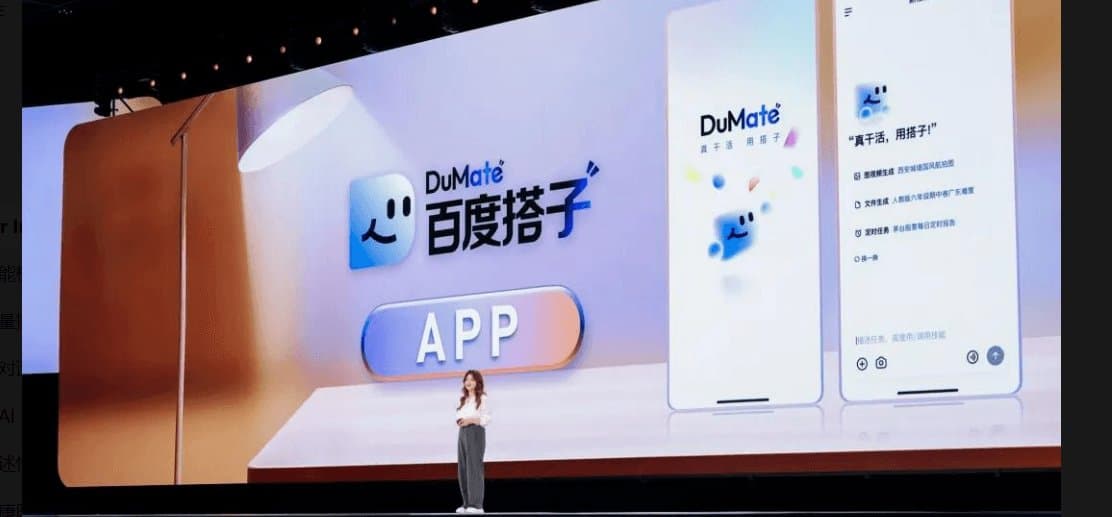
At Create 2026, Baidu introduced DuMate, claiming it can execute three distinct tasks simultaneously from a single voice command. We examine the technical reality behind these claims and assess where this fits in the current AI agent landscape.
At Baidu's Create 2026 conference, the company unveiled DuMate, a general-purpose AI agent touted to execute three completely different tasks simultaneously from a single voice command. This bold claim positions DuMate as potentially redefining AI productivity, but a closer examination reveals both the technical possibilities and practical limitations of such an approach.
The Claims vs. Technical Reality
Baidu's demonstration showed a user providing an informal command that triggered three specialized AI agents—handling customer service, operations, and marketing concurrently. While visually impressive, the actual implementation likely involves more nuance than simultaneous execution.
Technical experts familiar with distributed AI systems note that true parallel processing of three distinct tasks would require:
- Sophisticated task parsing algorithms
- Resource allocation mechanisms
- Coordination between specialized models
- Significant computational resources
The reality is likely a hybrid approach where tasks are initiated nearly simultaneously but may not execute in perfect lockstep. This distinction matters for practical applications where timing precision is crucial.
Technical Architecture
While Baidu hasn't published detailed technical documentation, we can infer several key components based on similar systems:
Intent Recognition Layer: Processes natural language input to identify multiple intents within a single command.
Task Orchestrator: Dispatches tasks to appropriate specialized models or services.
Parallel Execution Engine: Manages concurrent processing, potentially using techniques like async processing or microservices architecture.
Result Synthesizer: Combines outputs from different tasks into a coherent response.
The official DuMate announcement lacks these technical details, making independent verification difficult.
Practical Applications vs. Marketing
The article correctly identifies a real pain point: the fragmentation of AI tools. However, the solution proposed—multi-task parallel execution—may not be the most efficient approach for all scenarios.
Consider the overhead:
- Context switching between tasks
- Increased computational requirements
- Potential conflicts between concurrent operations
- Latency in result aggregation
For many use cases, sequential processing with optimized state management might be more efficient than parallel execution. The key advantage of DuMate appears to be reducing the cognitive load of switching between tools rather than true parallelism.
Limitations and Trade-offs
Several important limitations aren't addressed in Baidu's marketing:
Resource Intensity: True parallel processing requires significant computational resources, potentially limiting accessibility.
Task Interdependence: When tasks depend on each other, parallel execution can introduce race conditions or inconsistencies.
Quality Control: Monitoring multiple concurrent AI outputs for quality and accuracy is non-trivial.
Integration Complexity: The demonstrated integration with PC and mobile environments likely involves substantial backend infrastructure.
Competitive Landscape
DuMate enters a crowded field of AI agent platforms:
- Microsoft's Copilot focuses on integration with existing productivity tools
- Google's Gemini Advanced emphasizes contextual understanding across tasks
- OpenAI's Custom GPTs allow for specialized task-specific agents
What potentially sets DuMate apart is its emphasis on multi-intent processing, though this remains to be proven in real-world applications beyond staged demonstrations.
Conclusion
While DuMate represents an interesting approach to AI agent orchestration, the claims of simultaneous execution of three distinct tasks require careful scrutiny. The technology likely offers near-parallel processing rather than true concurrency, with practical limitations that Baidu hasn't fully addressed.
The real value proposition appears to be reducing tool-switching friction rather than revolutionary parallelism. As with many AI advancements, the gap between marketing claims and technical reality remains significant. For a more thorough technical analysis, we'll need to wait for Baidu to publish detailed documentation and allow independent testing of the system.
For developers interested in exploring similar approaches, research papers on multi-agent systems and task orchestration provide more grounded insights than vendor demonstrations. The field of AI agent coordination continues to evolve, with DuMate representing one approach rather than a definitive solution.
Comments
Please log in or register to join the discussion