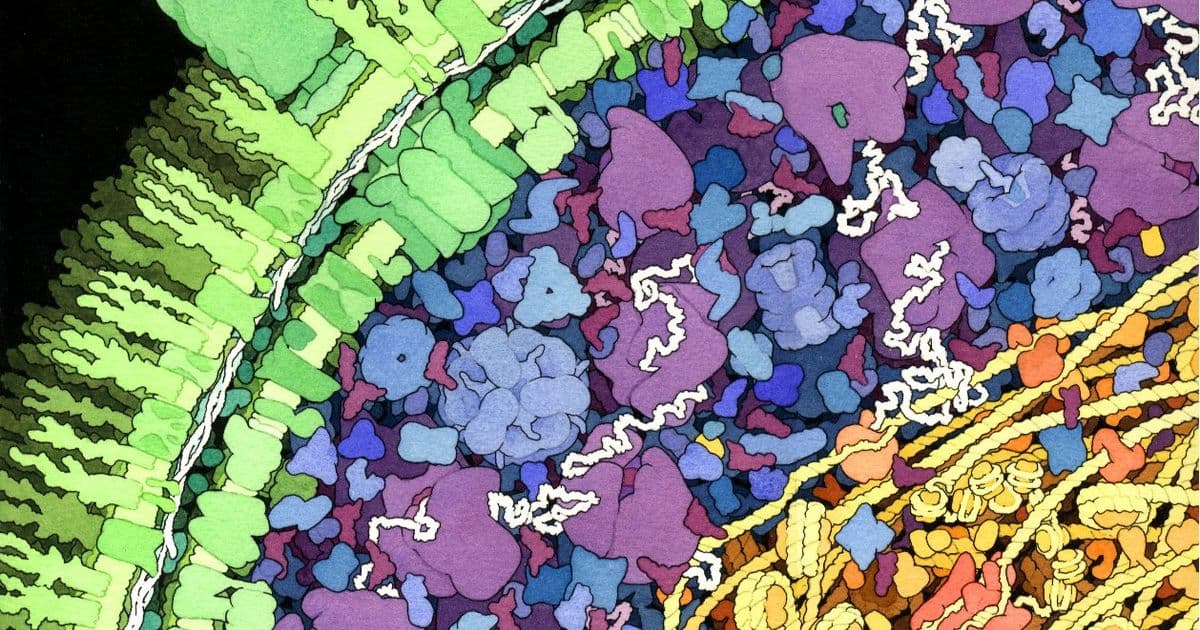
New quantitative approaches are transforming our understanding of cellular biology, revealing that cells are not the orderly spaces depicted in textbooks but incredibly crowded environments where biological processes happen with astonishing speed and efficiency.
The microscopic world of cells has long been depicted in textbooks as orderly, spacious places where molecules float in "secluded harmony." But as biologists like Michael Elowitz at Caltech point out, "a cell looks more like a burrito" – all the biochemicals are pushed together, bumping into each other in an environment so crowded it's a wonder anything gets done at all.
This fundamental shift in perspective – from viewing cells as orderly spaces to understanding them as incredibly crowded environments – is transforming how researchers approach biological problems. And at the heart of this transformation is mathematics.
For years, biology was often taught as a discipline that could be mastered through memorization of facts and processes. But as the author discovered during their Ph.D. in Bioengineering at Caltech, "biology is naked" without mathematics. Without numbers, we can only comprehend cells at arm's length. But with mathematical modeling, living cells come alive in ways that words and static images never could.
Consider the sheer scale of the problem: a typical E. coli cell measures just one micrometer across – about 100 million times smaller than a grain of sand. Yet inside this tiny vessel, the genome, stretched end-to-end, is nearly 1,000 times longer than the cell itself. If you placed one E. coli into a gallon-sized jug with nutrients, the genomes of its descendants would reach to the moon and back several times.
How do biological processes work in such an environment? The answer lies in understanding the numbers of biology.
Take transcription, for example. A typical E. coli has 4,400 genes, and at any given moment, about 25% of these are being copied into RNA by RNA polymerase. Each polymerase moves at breakneck speed, converting about 40 bases of DNA into RNA each second – if scaled up to human size, it would move twice as fast as Usain Bolt's record-setting pace. Yet it makes only one mistake every 100,000 bases.
Ribosomes work with similar efficiency, translating RNA into proteins in just 24 seconds on average. A single ribosome could translate the first Harry Potter book in two-and-a-half hours while making just three dozen typos.
The challenge is understanding how these processes work in a space where molecules are constantly jostling against each other. Small molecules like water can diffuse quickly, traveling about one centimeter per second – the length of ten thousand bacterial cells in a single second. But large proteins move much more slowly, taking 20 days to travel the same distance.
This is where mathematical modeling becomes essential. By calculating diffusion rates, reaction speeds, and molecular concentrations, researchers can begin to understand how biological processes work in these crowded environments. As the author discovered, "when I did these calculations, I felt an intense appreciation for biology."
This quantitative approach is revealing that cells are not just crowded spaces, but optimized environments where biological processes happen with incredible efficiency. The error rates of transcription and translation are shockingly low given the speed at which they occur. Enzymes find their substrates despite their sparse concentrations in the cellular milieu.
The implications of this approach extend beyond basic research. Understanding how cells function at the molecular level could lead to new approaches for drug development, synthetic biology, and biotechnology. If we can understand and model the crowded reality of cells, we may be able to design better therapeutic interventions and biological systems.
As we continue to develop new methods for studying living cells – methods that don't require killing or freezing them before observation – mathematical modeling will become even more essential for understanding the "active chaos" of life at the smallest scales.
The burrito problem – how so much can fit and function in such a small, crowded space – is not just a biological curiosity. It's a fundamental challenge that may hold the key to understanding life itself.
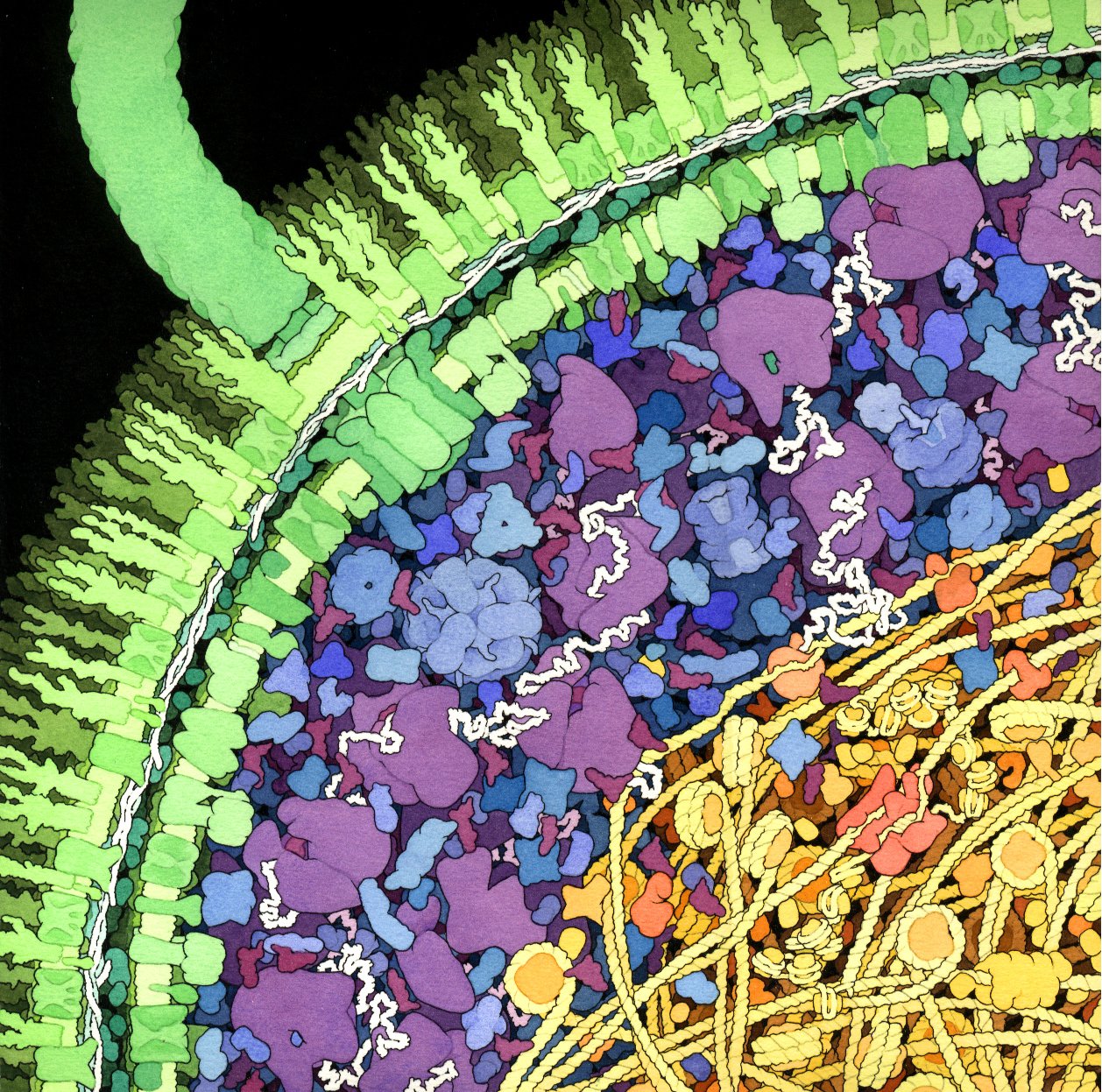
David Goodsell's watercolor cross-section of E. coli beautifully illustrates this crowded reality. The green band is the cell membrane; purple and blue shapes are proteins; the yellow tangle is DNA. While these paintings are beautiful and informative, they are snapshots of cells at a single moment in time. They can hint at complexity but can't convey the intense dynamics of a living cell.
That's where mathematics comes in. By developing a "numerical intuition for biology," as Rob Phillips has done, researchers can begin to understand how cells function in real time. They can ask questions like "How many ribosomes does a typical E. coli cell have?" and figure out the answer from scratch using little more than scribbled equations.
This approach is democratizing biology. No longer is it necessary to have access to expensive equipment or complex experiments to understand biological processes. With a pencil and paper, anyone can begin to grasp the "numbers of biology" and develop a deeper appreciation for the beauty and weirdness of life at the smallest scales.
As the author notes, "Biology is infinitely weird, and if we ever plan to master it, we will need new scientific methods to measure protein dynamics and interaction strengths." But with mathematical modeling leading the way, we're making progress in understanding this strange and wonderful microscopic world.
The burrito problem may seem like an esoteric biological curiosity, but it's actually a window into one of the most fundamental questions of science: how does life work at the molecular level? And with mathematical modeling providing new insights, we're beginning to find answers.
This quantitative approach to biology is not just changing how we understand cells; it's changing how we teach and learn biology. By encouraging students to think as mathematicians – to carefully quantify biology, to think in absolute units, and to develop a feeling for the organism – we're creating a new generation of researchers who can tackle the most challenging problems in biology.
As we continue to explore the microscopic world, one thing is clear: the more we understand about the crowded reality of cells, the more we appreciate the incredible efficiency and resilience of life itself.
The burrito problem is far from solved, but with mathematical modeling leading the way, we're making progress in understanding one of nature's most remarkable achievements: the living cell.
Comments
Please log in or register to join the discussion