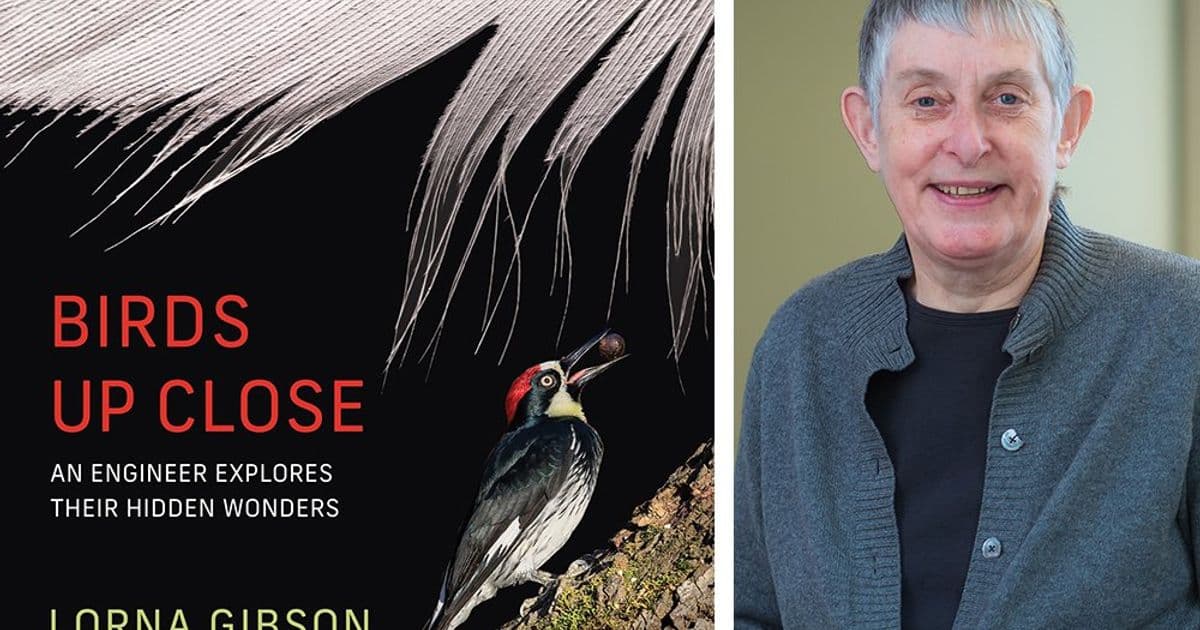
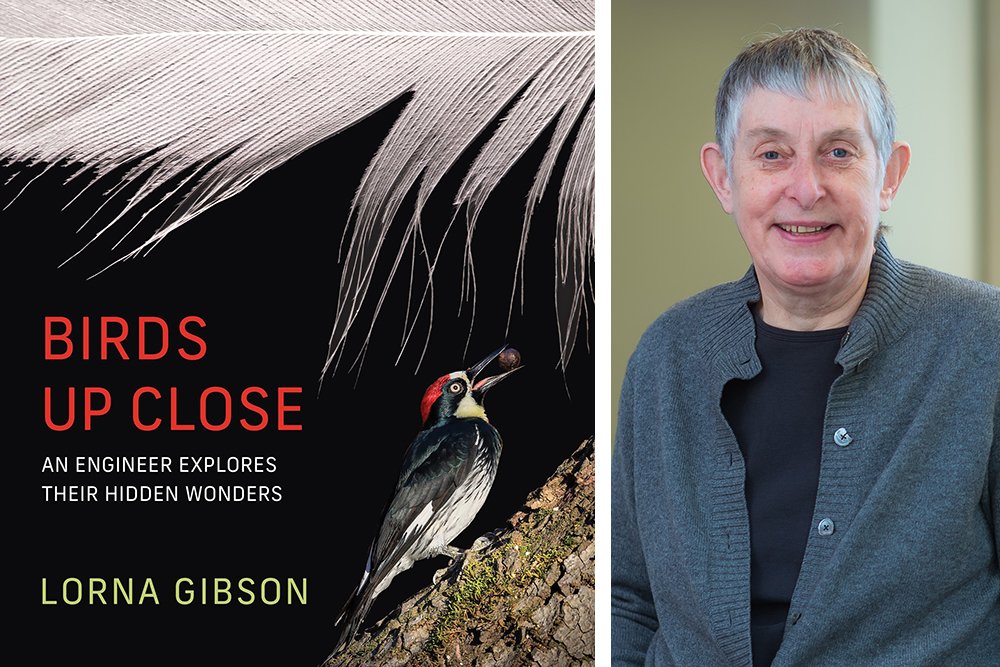
MIT materials engineer Lorna Gibson applies her expertise in mechanical behavior to avian biology in her new book 'Birds Up Close,' offering a unique engineering perspective on feathers, bones, bills, eggs, and flight mechanics that bridges scientific research with accessible natural history.
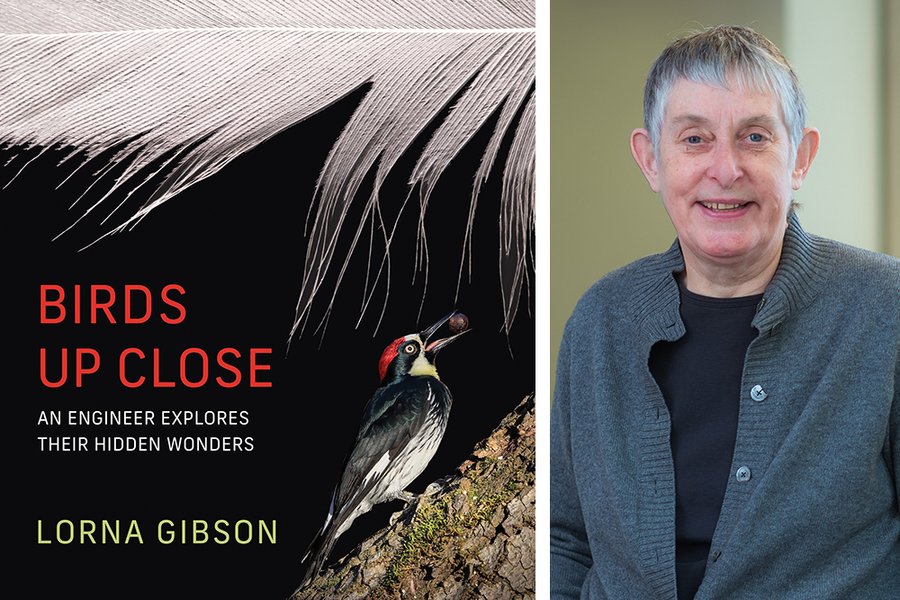
In the world of materials science, few researchers possess both the technical depth of MIT's Professor Lorna J. Gibson and the observational intimacy of a lifelong birder. Her new book, "Birds Up Close," represents a remarkable synthesis of these two worlds, applying four decades of expertise in mechanical behavior to unravel the engineering marvels that enable birds' extraordinary capabilities.
The book, published by MIT Press, takes readers on a microscopic journey through the structural adaptations that make birds such remarkable creatures. Gibson, a post-tenure professor specializing in cellular materials like engineered honeycombs and natural ones like wood and bamboo, brings her unique perspective to understanding how birds function at the intersection of biology and engineering.
Engineering Meets Ornithology
Gibson's approach to bird biology represents a valuable cross-disciplinary methodology. "I wasn't writing it for engineers; I was writing it for birders — people who are curious about natural history," she explains. The book's accessibility stems from this deliberate choice to present complex engineering concepts through the lens of observable bird behaviors and characteristics.
The book's structure follows a logical progression, with chapters dedicated to specific avian features:
- Two comprehensive chapters on feathers ("Fantastic Feathers")
- Bones and their structural adaptations
- Bills and specialized feeding mechanisms
- Eggs and their remarkable engineering properties
- Flight mechanics and aerodynamics
Each chapter can be read independently, allowing readers to explore topics of particular interest without needing to follow the book sequentially. This modular approach reflects Gibson's understanding of her audience's likely interests while maintaining scientific rigor.
Technical Deep Dive: The Engineering of Feathers
The most technically rich sections of the book explore the remarkable properties of feathers. Gibson demonstrates how these complex structures serve multiple functions beyond simple flight:
Color production mechanisms receive particular attention. She explains how birds achieve their dazzling colors through both pigments and structural coloration. The blue jay's vibrant blue, for example, results not from pigments but from microscopic structures within the feathers that interact with light. This structural coloration represents a sophisticated example of natural nanotechnology.
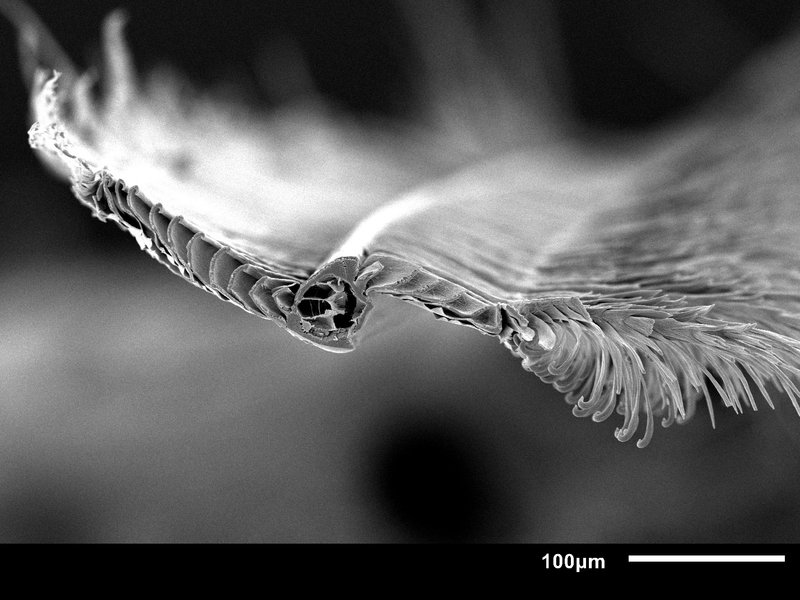
The book includes stunning scanning electron microscope images revealing the intricate architecture of feathers. These images show contour feathers as branched structures with connecting barbs and parallel barbules, including the foamy core of feather shafts invisible to the naked eye. These visual elements help readers understand how feather structure enables functions like water repellency in ducks and sound dampening in owls.
Gibson also explains specialized adaptations like the comb-like serrations on barn owl feathers that break up airflow and reduce noise, enabling stealthy flight. Similarly, she details how male hummingbirds produce high-pitched buzzing sounds during courtship dives through the fluttering edges of their outermost tail feathers—a phenomenon analogous to blowing across a blade of grass.
Real-World Applications and Broader Implications
The significance of Gibson's work extends beyond ornithology into practical engineering applications. Her analysis of natural cellular materials like bird bones and feathers offers valuable insights for biomimetic design—the practice of creating synthetic systems based on biological models.
For example, the honeycomb-like structure of feather shafts has inspired lightweight, strong materials for aerospace applications. Similarly, the water-repellent properties of duck feathers inform the design of water-resistant fabrics and coatings. The book implicitly demonstrates how studying biological systems can lead to innovative engineering solutions, a field known as biomimetics that has grown significantly in recent years.
The book also addresses questions of evolutionary significance. Yale ornithologist Richard Prum, who contributed images to the book, notes that Gibson's engineering perspective helps explain not just how birds survive, but how their unique features evolve and function. This approach bridges the gap between descriptive natural history and mechanistic understanding.
Personal Journey and Scientific Integrity
What makes "Birds Up Close" particularly compelling is the integration of personal narrative with scientific rigor. Gibson recounts her childhood experiences observing birds along the Niagara River and in England's Farne Islands, establishing her lifelong connection to ornithology.
More profoundly, she reflects on writing the book while her wife faced terminal illness during the pandemic. These difficult moments led to a deeper appreciation for birds' ability to bring wonder and solace. "On difficult days, 'I would be out on a walk, spot something... and stop in awe and think: Oh, wow, I love seeing that. And for that moment, the grief would disappear,'" she writes.
This personal journey influenced the book's final form. Initially more textbook-like, Gibson worked with colleagues and editors to transform it into something more engaging while maintaining scientific accuracy. Harvard's Scott Edwards praises this approach: "That's what science is... Science is done by humans. It's not like we can morph into some ultra-objective person when we're being a scientist. We bring to science our whole selves."
Technical Challenges and Limitations
While the book successfully bridges engineering and ornithology, it acknowledges certain limitations. The flight mechanics chapters, Gibson notes, are more technical than others, focusing on forces like lift and drag. She presents these concepts clearly but acknowledges they require more concentrated effort from readers.
Additionally, while the book draws on extensive published research, Gibson maintains an accessible tone that necessarily simplifies some complex mechanical concepts. The sidebars include calculations for readers who want more detail, but the main text avoids overwhelming non-engineering readers with mathematical formulations.
Conclusion: A New Perspective on Birds
"Birds Up Close" represents a valuable contribution to both ornithology and materials science. By applying engineering principles to biological systems, Gibson offers a fresh perspective on birds that complements traditional natural history approaches. The book demonstrates how technical understanding can enhance appreciation rather than diminish wonder.
As Gibson reflects, "Part of it was my own sense of awe and wonder. I couldn't believe the things that I found out about birds." This sense of discovery permeates the book, making it accessible to the growing community of birders—currently numbering 96 million Americans according to the U.S. Fish and Wildlife Service—while offering technical depth that satisfies engineering curiosity.
The book arrives at a time when birding has surged in popularity in the United States; 96 million people — about one in three Americans — consider themselves birders, according to the U.S. Fish and Wildlife Service. Those readers will find no shortage of memorable facts about how birds function at the mechanical level.
The book goes on sale May 5, 2026, with Gibson scheduled to discuss the work at the MIT Museum on May 6. For those interested in exploring the intersection of engineering and natural history, "Birds Up Close" offers a compelling journey into the remarkable mechanical adaptations that make birds such extraordinary creatures.
Comments
Please log in or register to join the discussion