Researchers pinpoint alpha wave patterns in the parietal cortex as the neural mechanism defining body ownership, with implications for schizophrenia treatment and prosthetic development.
At what point does your physical self end and the external world begin? While this philosophical question might seem abstract, neuroscientists have discovered concrete neural mechanisms that actively define these boundaries. New research reveals that specific patterns of alpha brain waves in the parietal cortex create our fundamental sense of embodiment – findings that could reshape treatments for schizophrenia and revolutionize prosthetic design.
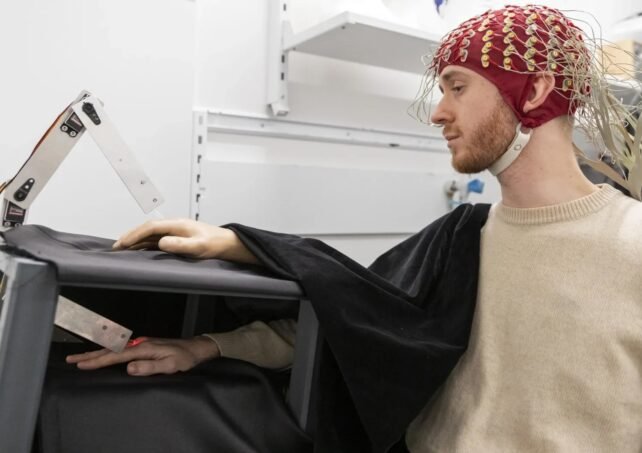
In a series of experiments with 106 participants, researchers from Sweden's Karolinska Institute and France's Lyon Neuroscience Research Center employed the classic rubber hand illusion. This paradigm hides a participant's real hand while displaying a rubber hand in their field of view. When both hands receive synchronized tactile stimuli, the brain temporarily accepts the artificial limb as part of the body – creating a measurable disconnect between physical reality and subjective experience.
EEG monitoring during these trials revealed a critical pattern: The frequency of alpha waves (8-12 Hz) in the parietal cortex – a region integrating sensory input and constructing body maps – directly correlated with participants' sensitivity to bodily boundaries. Individuals with faster alpha rhythms detected even 50-millisecond discrepancies between real and fake hand stimuli, maintaining strong self-other differentiation. Those with slower alpha waves experienced ownership of the rubber hand even with longer temporal mismatches.
The team then demonstrated causality using transcranial alternating current stimulation. By artificially accelerating alpha wave frequency, participants became more resistant to the illusion, precisely detecting subtle timing differences. Slowing alpha waves produced the opposite effect: participants more readily accepted the rubber hand as their own, effectively blurring their body boundary perception.
Lead researcher Mariano D'Angelo explains: "We've identified a core biological process that continuously generates our sense of embodiment. This isn't just philosophical – it's a measurable electrical rhythm that defines where 'you' stop and the world begins."
The implications extend beyond basic neuroscience. These findings offer new mechanistic insights into psychiatric conditions like schizophrenia, where disrupted alpha rhythms could explain distorted self-perception and ego boundary confusion. Clinically, modulating parietal alpha waves might alleviate symptoms in patients experiencing out-of-body sensations or loss of agency.
Equally significant are applications in neurotechnology. Prosthetic limbs could become more naturally integrated by mimicking the alpha wave patterns that signal body ownership. Virtual reality systems might leverage these rhythms to create more immersive experiences while preventing disorientation. As co-author Henrik Ehrsson notes: "Understanding how the brain constructs bodily self-consciousness lets us develop technologies that harmonize with our neural architecture."
The research, published in Nature Communications, establishes alpha oscillations as a fundamental building block of human self-awareness – a discovery poised to advance both clinical psychiatry and next-generation human-machine interfaces.
Comments
Please log in or register to join the discussion