
A developer's transition from Windows with WSL to a complete Linux setup reveals the evolving state of Linux hardware support and the satisfaction of unified development environments.
For most of my computing life, Windows has been my go-to operating system. But last year, the growing divide between Windows proper and the Windows Subsystem for Linux (WSL) became increasingly frustrating. The constant context switching, the friction of moving between environments, and the feeling of being stuck in a hybrid world that wasn't quite satisfying led me to consider a more radical solution: going all-in on Linux.
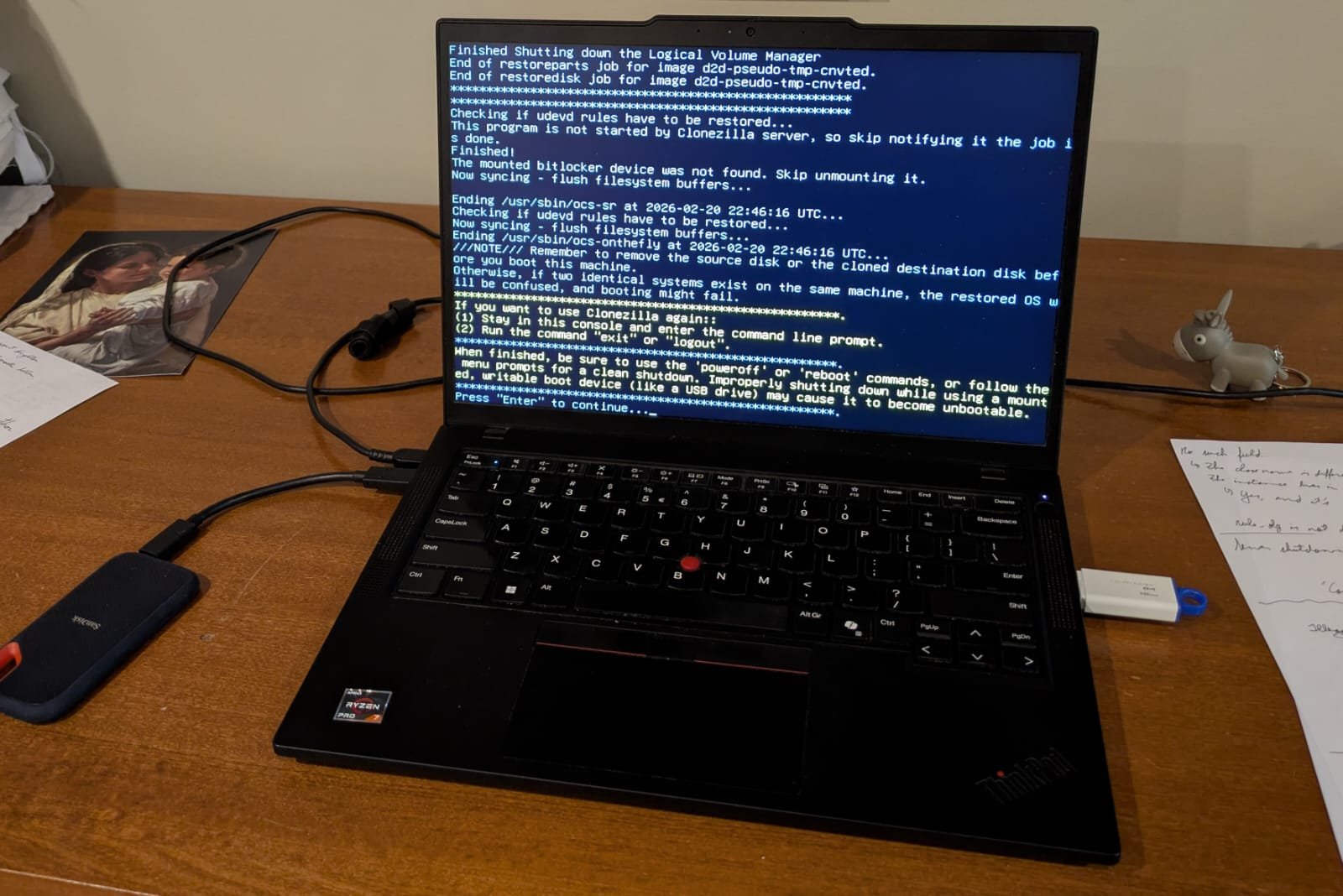
The challenge was clear: could I make the switch without disrupting my workflow or risking my existing system? The answer came in the form of an external SSD sitting in my drawer. With a fast drive and high-throughput USB-C cable at hand, I realized I could install Linux on this external device and boot from it—a perfect test environment that would leave my Windows installation untouched.
My search for an opinionated, programmer-focused Linux distribution naturally led me to Omarchy Linux. The installation process was refreshingly straightforward, and within minutes I had a fully functional system. To my relief, everything worked immediately: I could mount my encrypted Windows drive to access files, my laptop's fingerprint reader functioned flawlessly, and even my webcam—which had mysteriously stopped working months earlier while I was still on Windows—spontaneously revived.

The first month was spent settling into the new environment. I removed some pre-installed software that didn't fit my workflow, adapted to the tiling window manager (a significant departure from Windows' traditional desktop paradigm), and tweaked a few settings that felt off. This period gave me a profound appreciation for Linux's configurability—suddenly, every aspect of my user experience was within my control. While I chose to make minimal changes, I now understand the appeal of endless system customization that draws so many Linux enthusiasts into deep configuration rabbit holes.
After a month of successful daily use booting from the external drive, I felt confident enough to make the permanent switch. The process involved backing up any remaining files from my Windows installation and carefully mirroring the external SSD to my laptop's internal drive. This step required particular caution—the last thing I wanted was to accidentally mirror in the wrong direction and lose everything.
Everything went smoothly. By the end of the operation, Windows was gone, and Linux had taken its rightful place as my primary operating system.
For those considering a similar transition, several insights emerged from my experience. The difficulty level varies significantly based on your background. My previous experience with WSL and managing a homelab server undoubtedly smoothed the process. The choice of distribution matters enormously—while Omarchy suited my needs perfectly, something like Ubuntu Desktop or Fedora KDE Plasma Desktop might require less tinkering for newcomers.
Large language models proved invaluable throughout the process, serving as sophisticated search tools for finding the right configuration commands and troubleshooting issues. While they're not infallible, they dramatically accelerated the learning curve. Hardware support in 2026 has reached a point where it's arguably superior to Windows—at least in my case. My ThinkPad P14s (Gen 5, AMD-based) worked flawlessly, though whether this reflects broad Linux compatibility or simply good fortune with my specific hardware remains unclear.
There are still some rough edges. I encountered issues with copy-pasting between my browser and VSCode's integrated terminal—a minor annoyance that proved surprisingly stubborn even with LLM assistance. However, these papercuts haven't outweighed the benefits of a unified, cohesive development environment.
The transition from a Windows-WSL hybrid to full Linux commitment represents more than just a change of operating systems—it's a philosophical shift toward owning every layer of your computing experience. For developers who value control, consistency, and the satisfaction of a system that works exactly as you intend, the effort of making the switch can be deeply rewarding. The Linux desktop has matured to the point where it can genuinely replace Windows for most users, especially those already comfortable in Unix-like environments through WSL or development work.
The journey from WSL to bare-metal Linux isn't just about escaping the split between Windows and Linux—it's about embracing a computing experience where the tools you use daily are fully under your control, configurable to your exact preferences, and free from the friction of operating system boundaries. In 2026, that dream is more achievable than ever.
Comments
Please log in or register to join the discussion