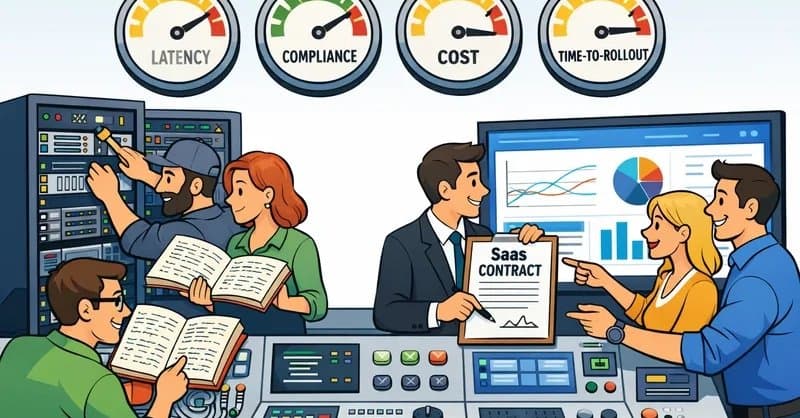
A pragmatic guide that weighs the technical, operational, and cost trade‑offs of building a home‑grown feature‑flag service against buying an enterprise SaaS platform. Includes scalability considerations, consistency models, API patterns, a TCO framework, and a step‑by‑step proof‑of‑concept checklist.
Build vs. Buy: How to Choose a Feature‑Flag Platform for Your Organization
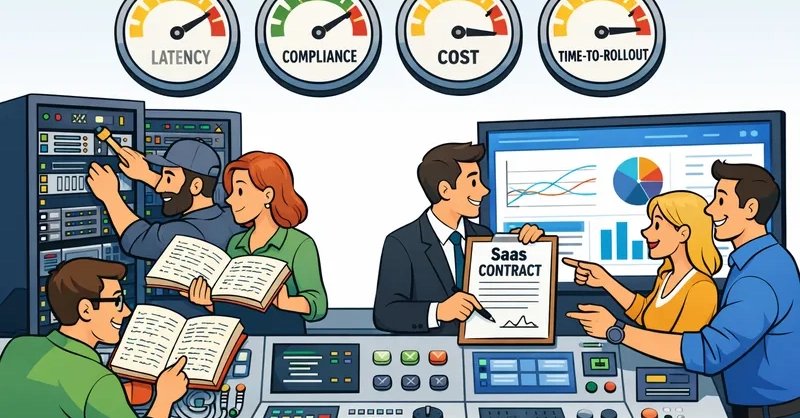
Feature flags are not a nice‑to‑have UI widget; they are a production control plane that touches every request path, every rollout, and every compliance audit. Selecting the wrong implementation can cripple speed, resilience, and regulatory posture while silently inflating technical debt.
1. The Problem – Why the Decision matters now
- Latency spikes – services in different regions see flag evaluation delays of several seconds.
- Orphaned flags – a growing list of unowned toggles sits in code, increasing the risk of accidental exposure.
- Compliance blocks – legal teams reject SaaS vendors that cannot guarantee data‑residency or FedRAMP compliance.
- Reliability backlog – the platform team spends weeks each sprint fixing flag‑related incidents instead of delivering product value.
All of these symptoms trace back to a single strategic choice: build a custom flag service or buy an enterprise platform.
2. When Build Wins – Scenarios that Favor a Home‑Grown Service
| Reason | What it looks like in practice |
|---|---|
| Data‑residency or air‑gap requirements | A defense contractor must keep all control‑plane traffic inside a private‑cloud VPC. Open‑source projects such as Unleash, Flagsmith, Flipt, or FeatureHub provide on‑prem deployment options that satisfy these constraints. |
| Domain‑specific evaluation semantics | Your product needs flag rules that depend on cryptographic attestations or a proprietary billing state. Extending an open‑source core gives you full control over the rule engine and data model. |
| Existing low‑latency config cache | Your platform already runs a Redis‑based configuration layer with CDN edge caches. Adding flag evaluation to that stack avoids a new external dependency. |
| Extreme scale where unit economics favor internal ops | A hyperscale retailer runs 10 k services, each with 100 k flag evaluations per second. With a dedicated SRE team, the marginal cost of operating a self‑hosted flag plane can be lower than a per‑MAU SaaS bill—if you account for all ongoing engineering effort. |
| Need for custom audit trails or experimental behaviours | The organization wants a bespoke audit log that records every flag change with a signed hash. Building in‑house sidesteps vendor roadmap constraints. |
Caution: Early engineering estimates are easy; the hidden cost is the continuous effort required for reliability, SDK parity, and lifecycle cleanup. Most home‑grown systems start strong and decay after six to eighteen months.
3. When Buy Wins – What Enterprise Platforms Actually Deliver
| Capability | Typical SaaS offering (e.g., LaunchDarkly, Optimizely) |
|---|---|
| Global low‑latency delivery | A streaming delivery network pushes rule sets to SDKs in milliseconds. Local in‑memory evaluation keeps P99 latency in the low‑single‑digit millisecond range. |
| Compliance artifacts | SOC 2, ISO 27001, and FedRAMP evidence are provided on demand, simplifying audit preparation. |
| Self‑service UI & governance | Non‑engineers can create segments, schedule rollouts, and approve changes via a built‑in approval workflow. RBAC and audit logs are baked in. |
| Multi‑language SDK maintenance | Vendors ship and test SDKs for Java, Go, Node, Python, iOS, Android, and edge runtimes. Consistent evaluation logic across platforms is guaranteed. |
| SLA‑backed availability | Contracts include uptime guarantees and vendor‑run runbooks, reducing on‑call load for your SREs. |
Counterpoint: SaaS pricing is often based on MAU or service‑connection counts, which can become unpredictable as usage grows. Model those dimensions early.
4. Operational Realities – Scaling, Latency, and Consistency at Production Scale
4.1 Local evaluation vs. remote checks
The most important performance rule is evaluate flags locally. Remote per‑request calls add network latency and create a single point of failure. Both SaaS and self‑hosted solutions achieve this by streaming a ruleset to each SDK instance.
4.2 Update distribution patterns
- Streaming (SSE / long‑lived connections) – Provides sub‑second propagation but requires outbound connectivity. Most SaaS SDKs default to this mode.
- Polling – Simpler for fire‑walled environments; adds a configurable delay (usually 30‑60 s).
- Relay/Proxy – A thin edge service (e.g., LaunchDarkly Relay Proxy, Unleash Proxy) aggregates connections and reduces the number of outbound sockets for backend services.
4.3 Cold‑start and edge evaluation
Client‑side and mobile apps must start quickly. Embedding the flag daemon flagd at the edge or using OpenFeature providers lets you ship a pre‑populated rule set, cutting start‑up time dramatically.
4.4 Consistency and testability
Martin Fowler’s toggle taxonomy (release, experiment, ops, permission) reminds us that each toggle type has a different lifecycle. You need:
- Automated tests for both ON and OFF paths.
- Guardrails that enforce TTLs and ownership metadata.
- A clear fail‑open or fail‑closed default for network partitions.
4.5 Observability
Flags become actionable only when you can see:
- Impression counts per flag and variant.
- Error rates when SDKs fall back to defaults.
- Business metrics linked to flag exposure (conversion, latency, error budget).
SaaS platforms often ship built‑in dashboards; self‑hosted setups require you to pipe events into your own analytics pipeline (e.g., Kafka → Prometheus → Grafana).
5. Cost and Staff Economics – Modeling TCO
5.1 Cost buckets
| Bucket | Build (self‑hosted) | Buy (SaaS) |
|---|---|---|
| Licensing / SaaS fees | $0 (open source) | Per‑MAU / service‑connection fees |
| Infrastructure | Servers, DB, CDN, egress | Minimal (network egress only) |
| Platform engineering & SRE | 0.5‑1 FTE build + 1 FTE ops | 0.1‑0.3 FTE integration & triage |
| Compliance & audit | Internal audit, pen‑tests | Vendor‑provided SOC/ISO reports |
| Migration & integration | SDK rollout, data pipelines | Onboarding, training |
| Opportunity cost | Engineers spend time on flag platform | Engineers focus on product features |
5.2 A reproducible TCO worksheet
- Define demand metrics – number of services, SDK instances, client‑side MAU, expected evaluation rate (ops/sec).
- Map to vendor billing – e.g., LaunchDarkly charges per MAU and per service connection.
- Estimate staff cost – multiply FTE count by average fully‑loaded salary (e.g., $180k/yr).
- Add compliance overhead – annual audit fees, any extra hosting premiums for data residency.
- Run a 3‑year NPV – sum all yearly costs and compare.
Sample calculation (illustrative only)
| Category | Build (3 yr) | Buy (3 yr) |
|---|---|---|
| Engineering (build) | $750 k | $120 k (onboarding) |
| Infra & hosting | $180 k | $30 k (egress) |
| SaaS licensing | $0 | $360 k |
| Compliance/audit | $120 k | $90 k |
| Total | $1.05 M | $600 k |
Tip: Replace the numbers with your telemetry‑derived values. The pattern works for any vendor that publishes its billing primitives.
6. Practical Application – POC Checklist and Migration Protocol
6.1 Four‑week POC design
| Week | Goal |
|---|---|
| 0 | Define SLOs (P99 eval latency < 5 ms, rollout propagation < 2 s) and business KPIs (time‑to‑rollback, compliance sign‑off). |
| 1 | Integrate SDKs into two critical services and one client app. Verify local evaluation, fallback defaults, and memory footprint. |
| 2 | Run failure‑mode tests: network partition, SDK crash, and synthetic load to validate proxy scaling. |
| 3 | Gather security artifacts, draft incident runbooks for kill‑switch activation, and perform a tabletop drill. |
| 4 | Pilot 1 % traffic in production, monitor metrics, execute a rollback, then produce a decision memo. |
6.2 Quick checklist
- Metrics – P99 eval latency, init latency, update propagation.
- Observability – flag impressions, linked business metrics, error guards.
- Governance – RBAC, audit logs, approval workflow.
- Compliance – data‑residency proof, SOC/ISO artifacts.
- SDK parity – coverage for all languages in the stack.
- Failure modes – default behavior, circuit‑breaker, on‑call playbook.
- Lifecycle controls – owner tag, TTL, automated cleanup.
6.3 Migration patterns
- Lift‑and‑shift (hybrid) – Deploy a Relay Proxy to route a subset of services to the SaaS platform while keeping the rest on the internal plane.
- Dual‑write & sync – Mirror flags to a vendor via the OpenFeature API for non‑sensitive traffic, letting product teams use the SaaS UI without exposing PII.
- Feature‑by‑feature – Migrate a high‑traffic, well‑instrumented flag first; validate rollback, monitoring, and cost assumptions before expanding.
7. Vendor vs. OSS Evaluation Short‑list
| Question | Buy (SaaS) | Build (OSS) |
|---|---|---|
| SDK coverage | Does the vendor support every language you use? | Can you fill any gaps with community SDKs or a custom provider? |
| Billing mapping | Can you translate your MAU/service‑connection forecast into the vendor’s pricing model? | What are the fixed and variable infrastructure costs at your projected scale? |
| Compliance | Are SOC 2/ISO reports available? Does the vendor support your required data‑residency region? | Can you run the control plane inside your approved VPC and produce the same audit artifacts? |
| SRE load | How many on‑call incidents are covered by the SLA? | How many FTEs are needed for 24×7 ops, upgrades, and incident response? |
8. Sources
- LaunchDarkly Architecture – official docs on local evaluation and streaming delivery.
- LaunchDarkly Billing – pricing guide describing MAU and service‑connection dimensions.
- Unleash – How it works – description of proxy patterns and self‑hosted deployment.
- OpenFeature – flagd – CNCF incubating project providing a vendor‑agnostic evaluation daemon.
- Martin Fowler – Feature Toggles – taxonomy and lifecycle warnings.
- DORA – State of DevOps 2024 – data on the impact of progressive delivery on lead time and MTTR.
9. Bottom Line
Choosing a feature‑flag platform is a classic build‑or‑buy decision, but the stakes are higher than a typical infra component because flags sit at the intersection of performance, compliance, and product velocity. Use the scalability and latency analysis, the TCO model, and the four‑week POC checklist to turn gut feeling into data‑driven evidence. Once you have concrete numbers and a validated prototype, the final recommendation—whether to invest in a self‑hosted control plane or to contract a SaaS vendor—will be defensible, repeatable, and aligned with your organization’s risk tolerance.
Comments
Please log in or register to join the discussion