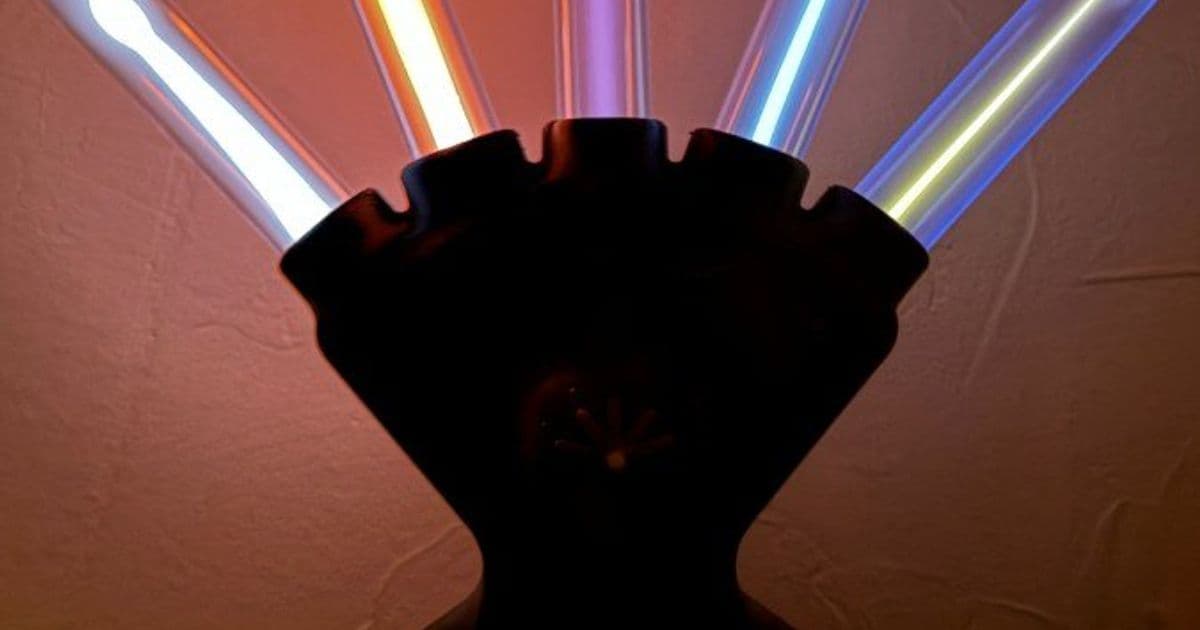
A spacecraft propulsion engineer creates a desktop display using noble gas tubes, combining plasma ball technology with custom 3D-printed mounts to visualize the gases used in ion thrusters.
When you work with spacecraft propulsion systems, your relationship with the fuel can feel oddly distant. For me, that fuel is Xenon - a heavy noble gas that gets accelerated to incredible speeds in ion thrusters to move satellites through space. But in my day job, Xenon lives inside metal cylinders, hidden behind valves and pressure gauges, only making an appearance during vacuum chamber tests that aren't exactly hands-on experiences.
So I decided to build something that would let me interact with these noble gases directly - a desktop display that would serve as both a beautiful desk toy and a practical tool for understanding ionized gas behavior.
The Gas Tubes
Amazon sells noble gas tubes, though not specifically Xenon-only options. I found a 5-pack containing all the noble gases - Helium, Neon, Argon, Krypton, and Xenon. Perfect for what I had in mind.
The Power Challenge
The first hurdle was finding a safe way to ionize these gases. I needed a high-voltage RF source, and after some research, I settled on repurposing the base of a plasma ball toy. This turned out to be the cheapest, easiest, and most importantly safest approach.
According to Wikipedia, plasma lamps typically output 35 kHz currents at 2-5 kV. With a 5W power supply, that's about 2.5 mA maximum current - well within the safe zone for human exposure to AC currents. Still, I wasn't taking any chances. I bought a high-voltage probe for my oscilloscope to measure the output directly before getting anywhere near the bare wire.
The measurements showed mid-20s kHz frequency with peak-to-peak voltage around 1.5kV. Plenty safe, but enough to give you a pucker factor when touching that wire for the first time.
The Electrical Coupling
Here's where things got interesting. Simply touching the wire to the tubes did nothing. Instead of direct connection, I needed capacitive coupling through the glass to transfer the electrical energy to the gas.
In a plasma ball, there's a hollow post filled with crumpled metal mesh that acts as an antenna, radiating energy to the surrounding gas. I inverted this setup by placing metal antennas around the tubes instead of inside them.
My solution? Little tinfoil hats for each tube. I wired these to a dial switch so I could select which gas to light up, since I wasn't sure if the system had enough power to ionize all five tubes simultaneously.
The Structure
The structural design was straightforward CAD work - measure the plasma ball base, gas tubes, and switch, then iterate until everything fit together nicely. The 3D-printed holders needed to accommodate the tubes with their tinfoil caps and rubber gaskets, while also looking good enough for a desk display.
Lighting the Crown
The finished display is mesmerizing, especially in a dark room. Each gas produces its own characteristic color - Neon glows bright orange, Argon shows a soft purple, and Xenon creates a stunning yellow core that fades to blue at the edges.
However, the system is an RF beehive. The heavier gases, especially Xenon, don't always ionize reliably when you turn the switch. Sometimes I have to touch the tube or grab the base to encourage it to light up. My theory is that my hand provides better capacitive grounding than air, allowing more voltage drop in the gas tube.
Neon often "steals" the signal from neighboring tubes, ionizing instead of Helium or Argon. This crosstalk is thanks to the RF coupling in the wires - definitely not something an RF engineer would approve of, but it works.
Safety Considerations
Plasma balls can throw off enough RF energy to interfere with nearby electronics. You also need to keep ionized gas away from metal objects that might capacitively couple and cause arcing. There are plenty of videos online of people burning their fingernails by wrapping plasma balls in tinfoil - not something you want to replicate.
The Result
I'm thrilled with how it turned out. The Xenon tube is particularly beautiful, and touching the tubes to make the beams bend and dance never gets old. It's become a fun desk toy that also serves a practical purpose - building hands-on intuition about ionized noble gases that I work with professionally.
Plus, now I can play with my propellant as much as I want without needing a vacuum chamber or worrying about high-pressure tanks. Sometimes the best engineering projects are the ones that bridge the gap between professional work and personal curiosity.
Comments
Please log in or register to join the discussion