What began as a New Year’s Day 2025 joke in a transit enthusiast Discord server evolved into Transit Tracker, an open-source DIY public transit arrivals display that has drawn global interest, spawned community build events across the U.S., and inspired countless custom adaptations for homes, campuses, and public spaces.
Thesis
The Transit Tracker project’s unexpected success stems not from technical novelty alone, but from its deliberate design as an open, customizable platform that centers community collaboration, public transit advocacy, and accessible DIY hardware. This approach proves that small-scale hobby projects can generate meaningful social impact when they prioritize user agency and shared purpose over proprietary polish, bridging digital communities with physical local action.
Key Arguments
Origins and Rapid Prototyping
The spark for Transit Tracker came on January 1, 2025, when a member of the Eastside Urbanism Discord server shared a post from the West Seattle Bike Blog detailing a similar display in a New York City cafe showing subway arrivals. Several other members immediately chimed in with interest, including Lara G, whose message captured the group’s collective enthusiasm: 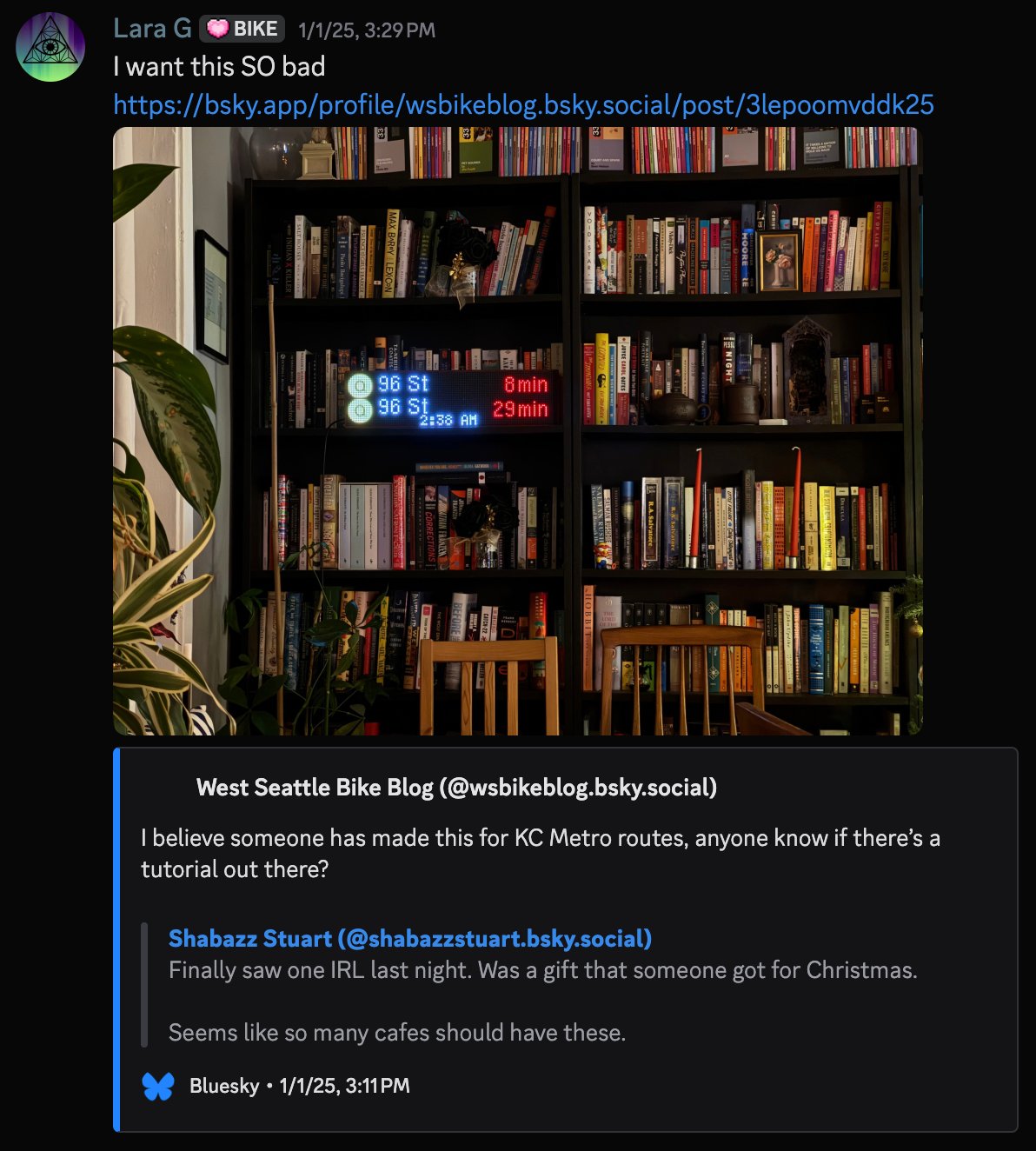
We each began researching whether ready-made solutions existed that could work with our local Puget Sound transit agencies. We evaluated several commercial options, including proprietary displays sold by transit agencies and third-party hardware targeted at hobbyists, but none met our core requirements: support for local agencies, customizable enclosures to match home decor, and open configurability to add new routes or agencies as needed. Most closed-source options locked users into specific data providers or required monthly subscriptions, which ran counter to our goal of building an accessible, community-owned tool.
With my background in software, recent experience with hardware tinkering, and amateur CAD skills, I joked that the project would not be overly difficult to execute, and suggested we could even host a group assembly event, later dubbed a build party. 
Development moved quickly. Over the next five days, I researched hardware components, built the backend service to fetch schedule data from transit APIs, and developed a custom component for ESPHome, a framework for configuring ESP32-based devices, to handle firmware. 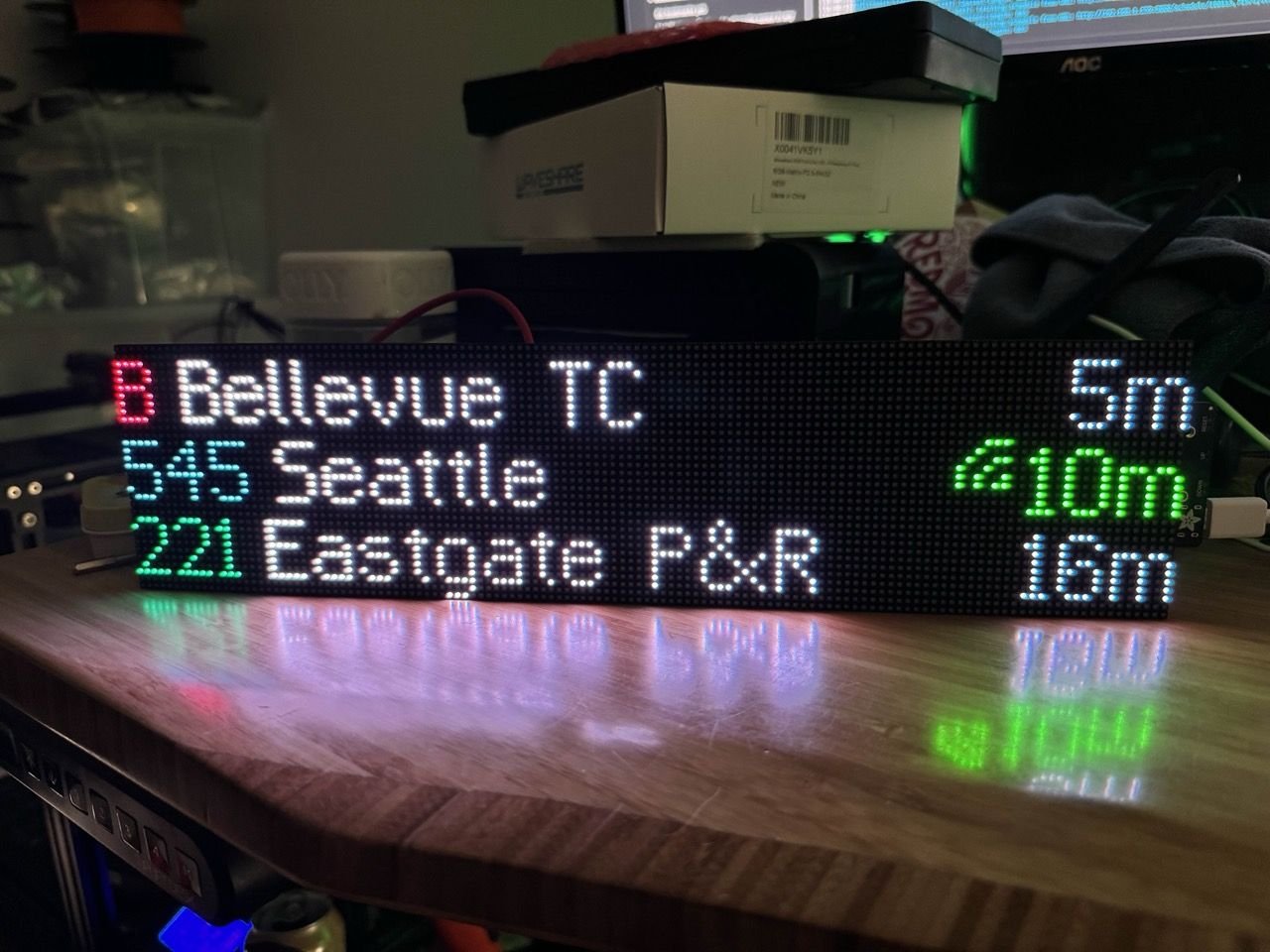 The prototype sat on my desk, wires tangled among components, displaying arrivals for three local routes: the B to Bellevue TC, the 545 to Seattle, and the 221 to Eastgate P&R.
With the prototype functional, the next priority was a permanent enclosure. I opened Fusion 360, referenced the display manufacturer’s technical drawings, and sketched a frame that would hold the LED matrix panels securely. 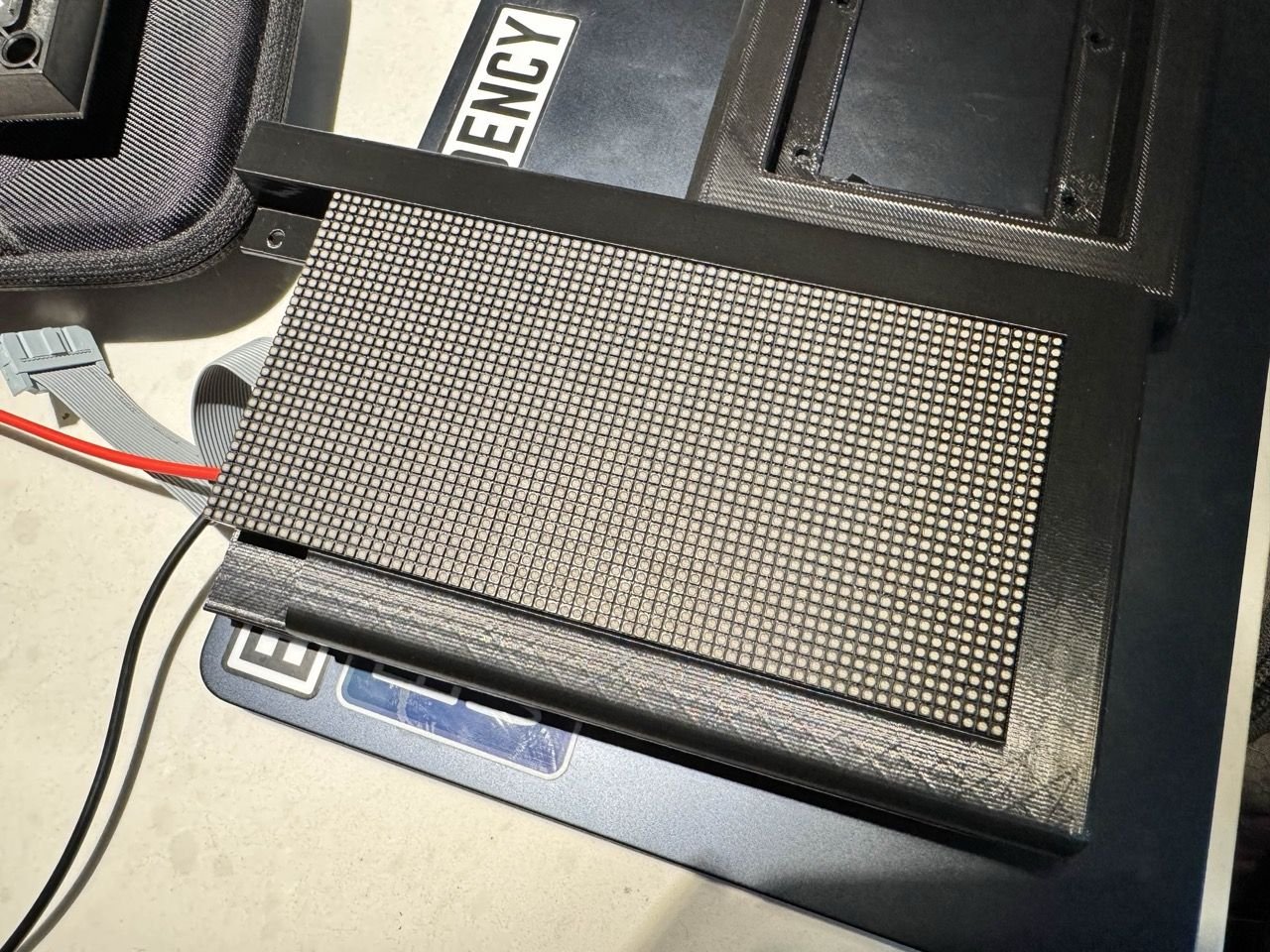 The first draft fit the displays almost perfectly, requiring only minor adjustments before moving to print the initial batch of frames. The first full Transit Tracker unit was assembled shortly after, and we began iterating on the design, firmware, and a web-based configurator tool to simplify setup for non-technical users.
Community Build Events
To gauge interest ahead of a public release, we shared a form on social media asking if community members would want to attend a group build event. Roughly 50 people committed to participating, which introduced a host of logistical challenges: where to hold the event, how to 3D print 50 custom frames, how to collect funds for parts, what materials attendees needed to bring, and whether new tariffs on parts imported from China would delay shipments.
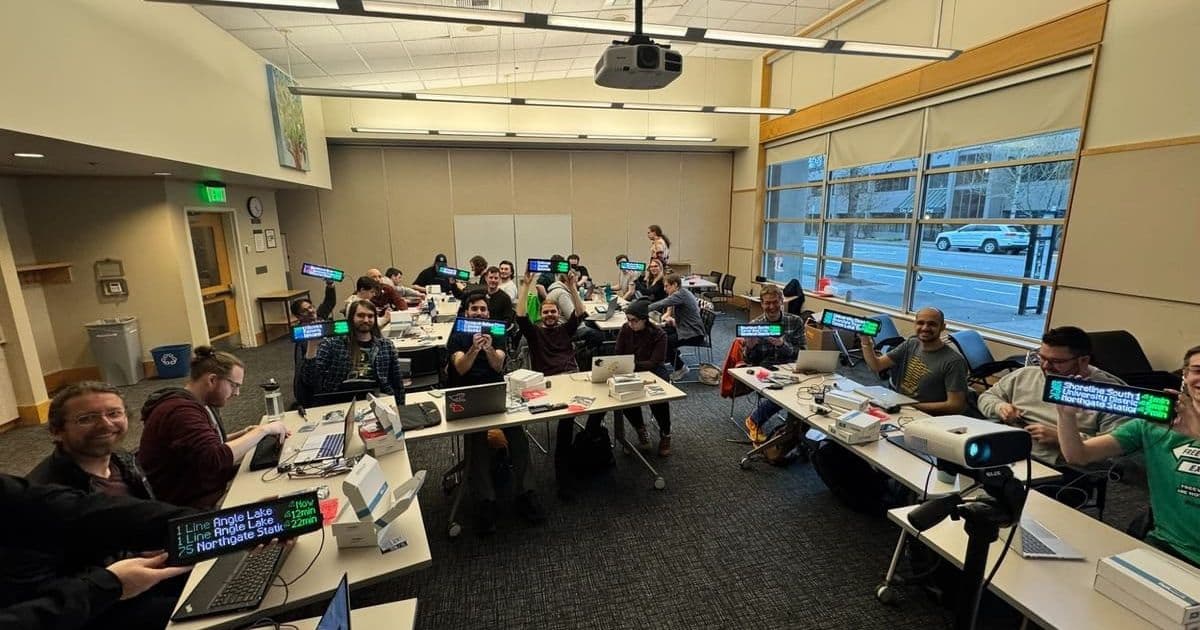
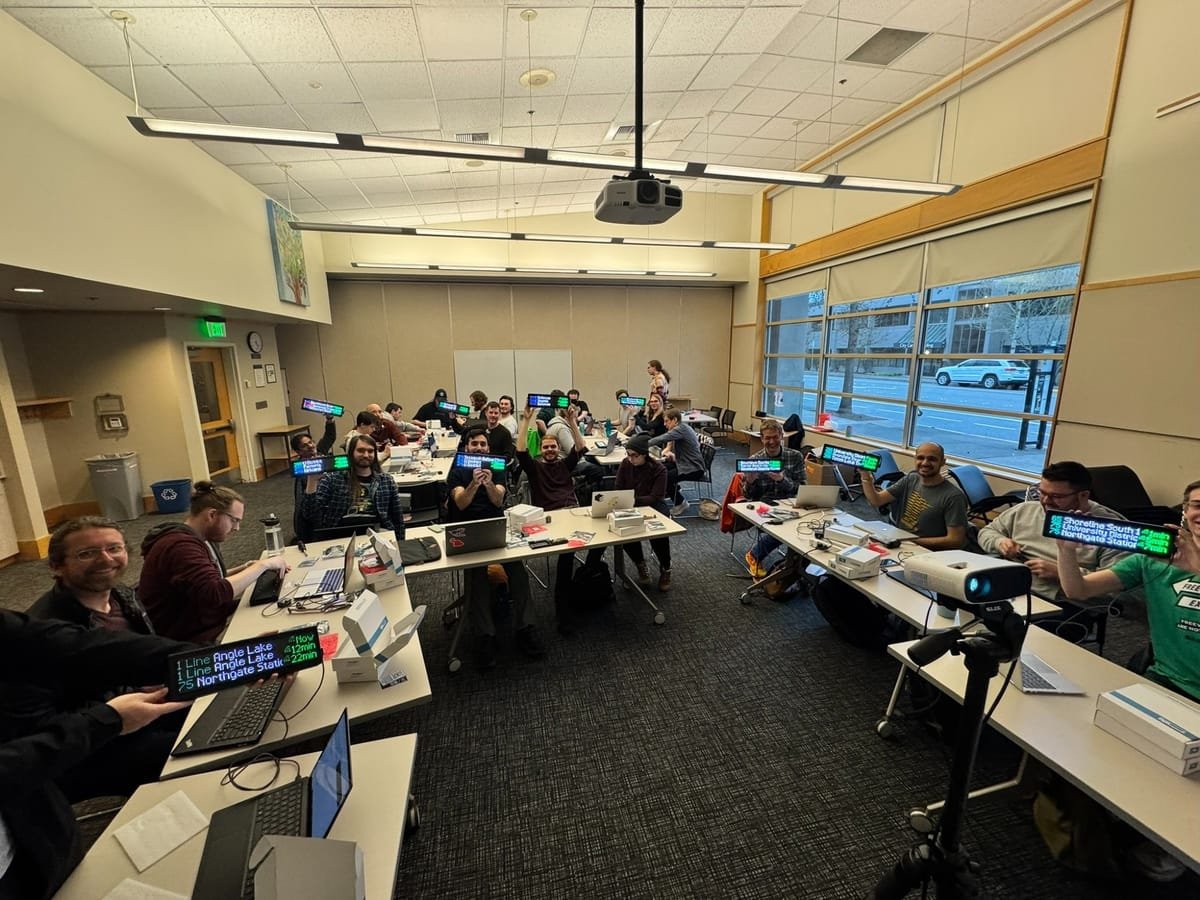
The value of community became immediately apparent as members stepped forward to handle logistics. We collaborated on solutions to print frames faster without compromising quality, evaluated local venues, and used multiple Google Forms to settle on a date, time, and location. When the day of the build party arrived, minor bumps aside, the event went smoothly. Attendees poured in, picked up pre-assembled parts kits, and worked together to build their displays, with those finishing early walking around to assist others. By the end of the event, participants left with fully functional Transit Trackers and new friendships forged over a shared interest in transit and DIY hardware.
The energy from the first build party inspired Walk and Roll Bellingham, a local active transportation advocacy group, to host their own event using the same format. I took Amtrak Cascades up to Bellingham to assist with troubleshooting, and the second event replicated the first’s success, with attendees of all skill levels coming together to build displays for their homes and community spaces.
Open Source and Custom Adaptations
Shortly after the first build party, we released all project files, firmware, and documentation under an MIT open source license, making the Transit Tracker GitHub repository publicly available. This decision was rooted in a long-held personal philosophy: projects that improve public life should be open for anyone to learn from, modify, or redistribute. Open sourcing enabled rapid global adoption, with contributors adding support for 43 transit agencies across five countries in the months following release. Users have added language support, improved error handling for transit APIs, and built quality-of-life features like automatic brightness adjustment based on ambient light.
The open source model also inspired countless custom adaptations tailored to specific needs. A user in Spain modified the frame design to use a thin front panel that diffuses LED light, printing the enclosure in white resin to match their light-colored home decor. Nick from the Sustainability Office at Bellevue College built several displays to place near bus stops on campus, customizing the firmware to cycle between route arrivals and stop names, and creating flyers to explain the tool to students. Walk and Roll Bellingham donated a Transit Tracker to Lighthouse Mission, a local shelter, where it sits at the front desk displaying arrivals for nearby routes. The Bellevue Downtown Association installed a display in their lobby showing train and bus departures, with customized text alignment to show two upcoming arrivals instead of one. Other users applied woodworking skills to build custom wooden frames, while Paul Cutler shared on Bluesky that he repurposed the hardware to display his currently playing music instead of transit arrivals.
Personal Motivation
I have been writing software since the age of 12, and my work has always been motivated by a desire to improve lives, both my own and those of others. Seeing attendees at build parties hold up finished Transit Trackers with big grins, or hearing from users who have customized the project to fit their own needs, is a tangible reminder of that impact. Open sourcing the project extends its reach further, allowing it to serve as a platform for others to build on, rather than a static tool controlled by a single creator. This aligns with my belief that the best technology is not that which is most advanced, but that which empowers the most people.
Implications
Transit Tracker offers several broader lessons for DIY hardware projects, transit advocacy, and community building. For the maker movement, it demonstrates that open, customizable platforms lower barriers to entry, allowing local projects to scale globally via community contributions rather than corporate marketing. The project’s reliance on viral social media posts, a tweet that spread quickly on X and a subsequent post on Reddit’s r/transit community, shows how digital platforms can amplify small projects, but the success of in-person build parties highlights the irreplaceable value of physical gathering spaces for solidifying community bonds.
For transit advocacy, Transit Tracker proves that small, visible tools can normalize public transit use and provide critical real-time information in spaces where it is often lacking. Displays in cafes, shelters, and college campuses make transit arrivals accessible to people who may not have smartphones or reliable data connections, while home displays keep transit top of mind for users, potentially shifting travel behavior away from private vehicles. The project also illustrates how hobbyist communities can fill gaps left by underfunded public agencies, which often lack the resources to build custom displays for local spaces.
More broadly, the project challenges the notion that impactful technology must be built by large teams or well-funded startups. Transit Tracker was built by a small group of volunteers in their spare time, using off-the-shelf components and free open source tools, yet it has reached hundreds of users worldwide. This aligns with a growing trend of community-led technology development, where local groups build tools tailored to their specific needs rather than relying on one-size-fits-all corporate solutions.
Counter-Perspectives
The project has not been without challenges or criticism. Supply chain issues, including tariffs on parts imported from China, delayed the first build party by several weeks, and ongoing component shortages have made it difficult to maintain a steady supply of parts for users building their own displays. The work of documenting the project, building a configurator tool for non-technical users, and providing support to a growing user base has also created a maintenance burden, blurring the line between hobby project and second job.
Some transit agencies have pushed back against unauthorized use of their real-time data APIs, citing terms of service that prohibit display on third-party hardware. We have worked with several agencies to formalize data sharing agreements, but this remains an ongoing challenge as the project scales to new regions. Technical critiques have also emerged: some users note that the ESP32-based controller and LED matrix panels consume more power than necessary for an always-on display, or that the 3D printed enclosure is less durable than injection-molded alternatives. These are valid trade-offs, as lowering costs and using accessible manufacturing methods, consumer 3D printers, were priorities for the project, but they illustrate the tensions inherent in building low-cost DIY tools.
There is also a tension between keeping the project simple for beginners and adding features for power users. As more contributors request support for new transit agencies, custom display layouts, and advanced features, the firmware and configurator have grown more complex, potentially alienating users with less technical experience. Balancing these competing needs requires ongoing community input, and we have established a contributor guidelines document to help prioritize changes that align with the project’s core mission of accessibility.
Conclusion
Transit Tracker has grown far beyond what I imagined when we started tinkering with the idea on New Year’s Day 2025. What began as a nerd snipe in a Discord server has become a tool used by hundreds of people across the globe, a platform for community building, and a catalyst for countless custom projects. It has reminded me that the most meaningful work is not that which generates the most social clout or financial return, but that which makes a positive difference in people’s daily lives. As the project continues to grow, with new transit agencies added every week and new build parties planned in cities across the U.S., I am grateful to the community of transit enthusiasts, makers, and advocates who have made it all possible.
Comments
Please log in or register to join the discussion