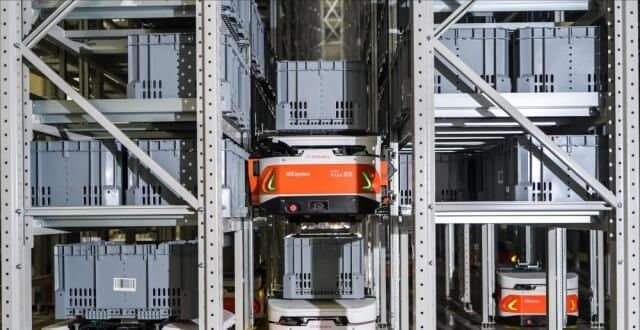
Cainiao's new climbing robot promises 100% efficiency gains in warehouse operations, but a closer examination reveals both significant innovations and limitations in this warehouse automation approach.
Cainiao, the logistics arm of Alibaba, has announced the deployment of its ZeeBot climbing robots in a Dongguan warehouse, claiming a remarkable 100% improvement in human efficiency. This development represents an interesting approach to warehouse automation, but requires closer examination beyond the marketing claims.
The core innovation of ZeeBot appears to be its ability to transition between ground-level transportation and vertical climbing operations. Traditional automated warehouses typically separate these functions: autonomous ground vehicles transport goods while specialized vertical systems handle storage and retrieval. ZeeBot attempts to consolidate these capabilities into a single platform.
According to Cainiao, the ZeeBot features a "flexible structure" designed specifically for warehouse environments. This design allows the robot to operate efficiently in both horizontal and vertical dimensions, potentially reducing the need for multiple specialized systems. The company claims this integration has resulted in a doubling of human efficiency in their Dongguan facility.
However, the claim of 100% efficiency improvement warrants scrutiny. In warehouse automation, efficiency metrics can be measured in various ways: items picked per hour, storage density, labor costs, or order throughput. Without specific details on how Cainiao quantifies this improvement, the figure remains ambiguous. It's possible that the metric reflects labor efficiency (items handled per worker) rather than overall system throughput.
From a technological perspective, climbing robots in warehouse settings are not entirely novel. Companies like Boston Dynamics have demonstrated climbing robots in various environments, and specialized warehouse systems have incorporated vertical movement for years. What appears potentially new is the integration of climbing capability with traditional material handling functions in a single, cost-effective system designed for large-scale deployment.
The practical advantages of such a system could be significant. By eliminating the need for separate horizontal and vertical transport systems, Cainiao might reduce capital expenditures, simplify maintenance, and potentially increase flexibility in warehouse layout. The ability to dynamically reconfigure storage without being constrained by fixed conveyor systems or AS/RS (Automated Storage and Retrieval Systems) could be particularly valuable in e-commerce fulfillment centers where product variety and demand patterns change frequently.
However, several challenges likely remain. Climbing robots would need to navigate complex, dynamic warehouse environments with obstacles, varying shelf configurations, and human workers. Safety considerations become paramount when robots operate at height in close proximity to personnel. Additionally, the energy requirements for vertical movement may offset some efficiency gains, particularly if the robots are frequently climbing and descending.
The scalability of this technology is another question. While Cainiao reports successful deployment in one facility, the transition from pilot to global implementation presents numerous challenges. Each warehouse has unique characteristics in terms of layout, inventory profiles, and operational requirements. The adaptability of ZeeBot to these varied environments will determine its long-term viability.
Cainiao's announcement that ZeeBot is "entering global delivery phase" suggests confidence in the technology's readiness for widespread deployment. The company plans to expand to additional warehouses worldwide, indicating they see this as a strategic component of their automation efforts. This aligns with broader industry trends toward increasingly sophisticated warehouse automation as e-commerce continues to grow.
From a competitive standpoint, this move positions Cainiao alongside other logistics companies investing heavily in automation. Amazon's Kiva robots (now Amazon Robotics) have demonstrated the value of floor-based automation, while companies like Ocado have developed highly automated warehouse systems. ZeeBot's climbing capability could represent a different approach to solving similar challenges of efficiency and scalability.
Looking at the broader context, warehouse automation has become increasingly important as e-commerce continues to grow. The pressure to reduce delivery times while managing labor costs has driven innovation in this sector. Technologies like robotics, AI-driven inventory management, and automated sorting have become commonplace, with the frontier moving toward increasingly integrated and adaptable systems.
The success of ZeeBot will likely depend on several factors beyond the initial efficiency claims. Long-term reliability, adaptability to different warehouse configurations, total cost of ownership compared to traditional systems, and the ability to integrate with existing warehouse management systems will all play crucial roles in determining its industry impact.
As with many technological innovations, the reality may fall short of the initial hype. While ZeeBot appears to offer an interesting approach to warehouse automation, the claimed 100% efficiency improvement should be viewed with appropriate skepticism until more detailed performance data becomes available. Nevertheless, the development represents a noteworthy attempt to rethink traditional approaches to warehouse automation, potentially offering new solutions to persistent challenges in the logistics sector.
For those interested in following this technology, Cainiao's future announcements about deployment metrics, operational challenges, and expansion plans will provide valuable insights into the practical viability of their climbing robot approach.
Comments
Please log in or register to join the discussion