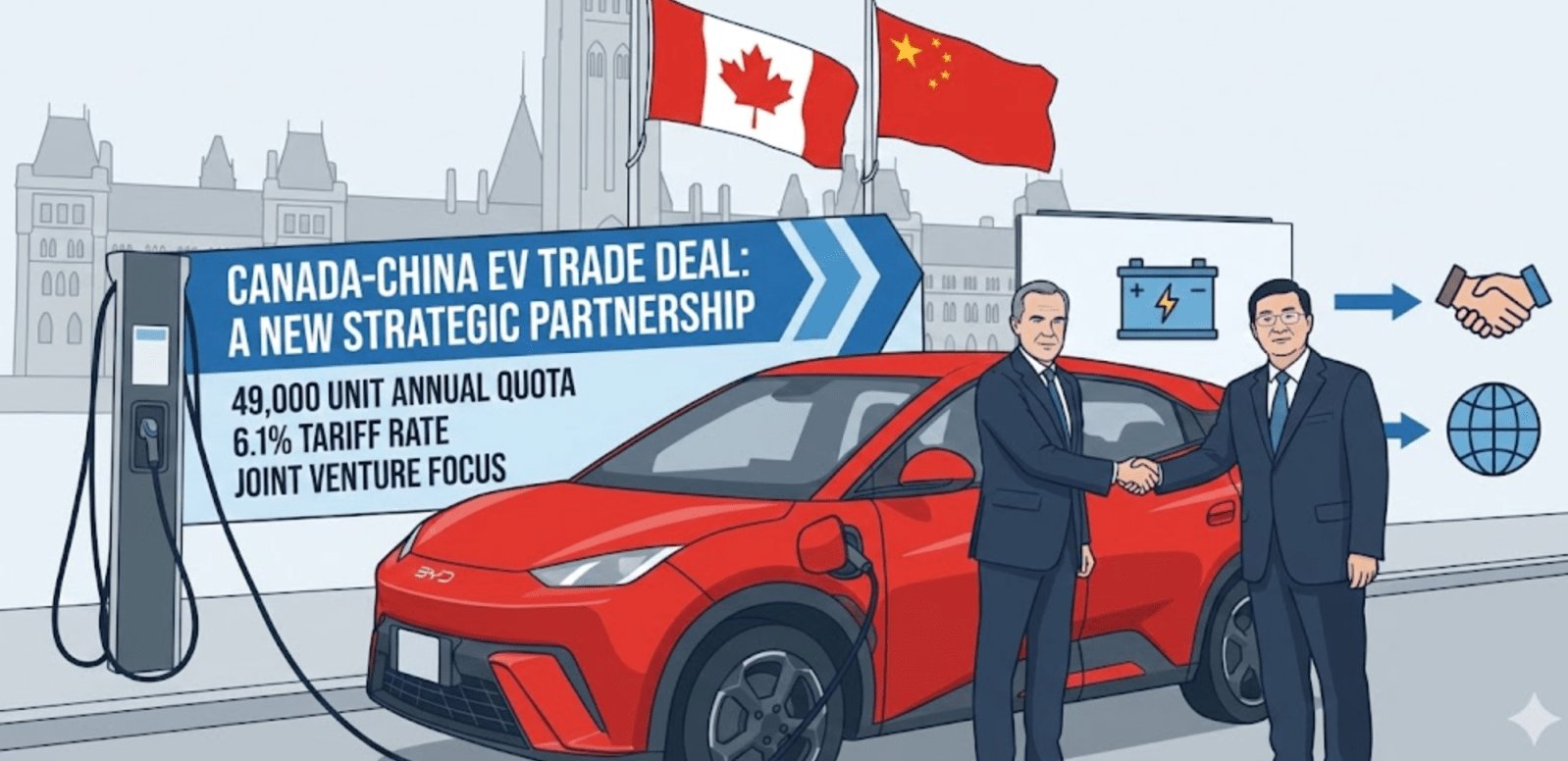
In a decisive break from US protectionism, Prime Minister Mark Carney has negotiated a new trade deal with China that reduces tariffs on Chinese electric vehicles from 100% to just 6.1% for an annual quota of 49,000 units, prioritizing affordable climate solutions and domestic supply chain investment over complete alignment with Washington's industrial strategy.
In a move that fundamentally reshapes North American trade dynamics, Canada has executed a sharp pivot from its longstanding alignment with US policy on Chinese electric vehicles. Prime Minister Mark Carney announced a new "strategic partnership" with Beijing that slashes tariffs on Chinese EVs from the punitive 100% rate to just 6.1% for an annual quota of 49,000 vehicles. This decision represents a calculated trade-off, exchanging market access for Chinese agricultural concessions and, potentially, significant domestic investment in EV manufacturing.
The context for this shift is critical. For the past two years, Canada has mirrored the United States' aggressive protectionist stance against Chinese EVs. Following the Biden administration's 100% tariff implementation, Canadian policy effectively froze out major Chinese automakers like BYD, Nio, and Zeekr. This alignment was part of a broader "Fortress North America" strategy aimed at shielding legacy automakers and domestic supply chains from Chinese competition. The new agreement dismantles that wall, at least partially, by creating a controlled opening.
The mechanics of the deal are specific and targeted. The 49,000-vehicle quota represents less than 3% of Canada's total new vehicle market, a deliberate limitation that prevents a flood of imports while still creating a meaningful market entry point. The government's focus is explicitly on the affordable segment, with projections that over half of these imports will be vehicles with import prices below $35,000. This directly addresses a gap in the North American market, where affordable EV options remain scarce despite growing consumer demand for accessible electric transportation.
The trade concessions Canada secured in return are substantial. China has agreed to reduce tariffs on Canadian canola seed from approximately 85% to 15% and lift restrictions on Canadian lobster and crab exports. These agricultural sectors represent significant economic interests for Canada, particularly in provinces like Saskatchewan and the Maritimes. The deal effectively prioritizes these export markets alongside consumer access to affordable EVs, creating a multi-faceted economic rationale that extends beyond automotive policy alone.
Perhaps the most strategically interesting element is the agreement's language regarding joint ventures. The text explicitly states the deal is expected to "drive considerable new Chinese joint-venture investment in Canada" to build out the domestic EV supply chain. This suggests Carney is employing a sophisticated strategy: using limited market access as leverage to attract Chinese manufacturing expertise and capital to Canadian soil. Rather than simply importing finished vehicles, the goal appears to be fostering technology transfer and domestic capability building.
This approach mirrors tactics China itself has used for decades, requiring foreign automakers to establish joint ventures with local companies as a condition of market access. By inverting this dynamic, Canada seeks to transform a potential threat into a development opportunity. Companies like BYD or CATL might establish Canadian operations not just to serve the local market, but to leverage Canadian manufacturing capabilities for broader North American distribution.
The implications for the broader North American EV market are significant. While 49,000 vehicles is a modest volume, it establishes a precedent and creates competitive pressure. Canadian consumers will gain access to vehicles like the BYD Seagull and other affordable models that have been absent from the market. This availability could accelerate EV adoption rates in Canada, particularly among price-sensitive buyers who have been priced out of the current market dominated by premium and mid-range offerings.
For Canadian automakers and suppliers, the impact will be complex. Short-term protection from the full force of Chinese competition has been reduced, potentially pressuring domestic manufacturers to accelerate innovation and cost reduction efforts. However, the potential for joint-venture investment could strengthen the domestic supply chain, particularly in battery technology and electric drivetrain components. The success of this strategy will depend heavily on whether Chinese companies see sufficient value in Canadian manufacturing to establish meaningful operations.
The political ramifications with the United States are unavoidable. Washington has pursued a coordinated North American strategy against Chinese EVs, viewing market access as a national security issue. Canada's unilateral move to create a significant exception will likely strain diplomatic and trade relations. The US may respond with its own trade measures, potentially targeting other Canadian exports or pressuring for a reversal of the policy. However, Canada's decision also reflects a pragmatic assessment of its own economic interests and consumer needs.
The timing of this agreement is noteworthy. The global EV market is experiencing rapid evolution, with Chinese manufacturers leading in both technology and cost efficiency. BYD, for instance, has surpassed Tesla in quarterly deliveries and offers compelling products across multiple price points. By maintaining complete isolation, Canada risked falling behind in EV adoption rates and potentially missing opportunities for domestic industry development. The 6% tariff rate represents a middle ground—maintaining some protective barrier while allowing competitive pressure to drive innovation.
For consumers, the immediate benefit is clear: more choice at lower price points. The $35,000 threshold mentioned in the agreement is particularly significant, as it targets the segment where most Canadian drivers make purchasing decisions. Current Canadian EV offerings above this price point have limited the market's growth potential. Affordable Chinese models could catalyze broader adoption, especially in provinces with less developed charging infrastructure where range anxiety remains a concern.
The environmental implications are equally important. Accelerating EV adoption directly supports Canada's climate goals, particularly in the transportation sector, which accounts for a significant portion of national emissions. By prioritizing affordable climate solutions, the government is making a calculated bet that market access for cost-effective EVs will drive faster decarbonization than protectionist policies aimed at preserving legacy manufacturing jobs.
The success of this strategy will unfold over the coming years. The five-year timeline mentioned in the agreement suggests this is viewed as a long-term experiment rather than a quick fix. Key metrics to watch will include the actual volume of Chinese EV imports, the level of joint-venture investment secured, and the impact on Canadian EV adoption rates and domestic manufacturing capabilities.
This trade agreement represents a significant departure from the protectionist consensus that has dominated North American industrial policy in recent years. By choosing targeted market access over complete isolation, Canada is testing whether strategic engagement can achieve better outcomes for consumers, climate goals, and domestic industry development than outright prohibition. The results will be closely watched by policymakers in Washington and other capitals considering similar trade decisions.
The move also highlights a growing divergence in how different countries approach the Chinese EV challenge. While the US has chosen confrontation, Canada's approach reflects a more nuanced calculation that balances multiple competing interests. Whether this proves to be a masterstroke of economic diplomacy or a concession that weakens North American industrial resilience remains to be seen. What is certain is that the Canadian EV market will look markedly different in the years ahead, with new players, new models, and new dynamics reshaping the landscape.
Comments
Please log in or register to join the discussion