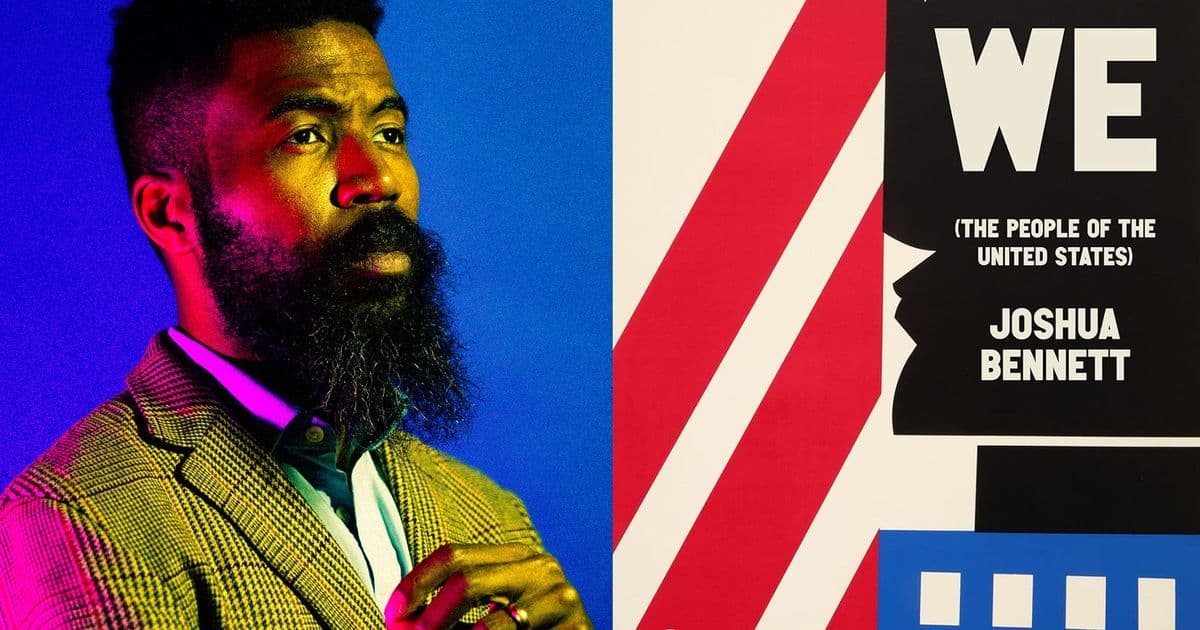
Joshua Bennett's new book-length poem 'We (The People of the United States)' commemorates the nation's 250th anniversary by highlighting one remarkable person or invention from each state, exploring the complex beauty of American innovation and creativity.
For the 250th anniversary of the United States, MIT Professor Joshua Bennett has crafted an ambitious literary tribute that celebrates the nation's spirit of innovation through verse. His new book-length poem, "We (The People of the United States)," published today by Penguin Books, features one remarkable person or invention from each of the 50 states, weaving together a tapestry of American creativity and resilience.
Bennett, who serves as the Distinguished Chair of the Humanities at MIT, draws inspiration from classical poetry while grounding his work in the lived experiences of Americans who have shaped the nation's cultural fabric. The collection opens with deeply personal reflections on his own family background and becoming a father in Massachusetts, before expanding outward to encompass the breadth of American innovation.
Among the figures celebrated in the collection are Zora Neale Hurston, the celebrated Florida author; Charles Henry Turner, the Ohio-based entomologist who became the first Black person to receive a PhD from the University of Chicago in 1907; and Brian Wilson, the Beach Boys founder from California. Each entry illuminates not just the achievement itself, but the complex circumstances and personal journeys that led to these moments of breakthrough.
What makes Bennett's approach distinctive is his willingness to engage with the full complexity of American history. His choice for North Carolina is George Moses Horton, an enslaved man who learned to read and write in the early 1800s—when such education was legal—and went on to publish poetry in the 1820s, even as North Carolina later made it illegal for enslaved persons to learn these skills. Bennett writes of Horton's public performances as "an ancient art revived in the flesh of a prodigy in chains."
Some entries celebrate widely recognized figures, while others rescue inventors and innovators from obscurity. From Oregon comes the Phillips-head screwdriver, inspired by Bennett's memories of his father fixing things around their home in Yonkers, New York. The trampoline, invented by Iowa gymnast George Nissen in the 1930s, appears as a "magical device" that brings to life "the scene in your mind of the leap/and of the leap itself, where you are airborne, illuminated/quickly immortal."
Bennett's work is informed by his academic background and literary influences. He encountered Virgil's "Georgics" while a PhD student at Princeton, where his professor Susan Stewart introduced him to these pastoral poems. The concept of covering Virgil's territory in an American context appealed to him, especially given that one of his favorite poets, Gwendolyn Brooks, had reimagined Virgil's "Aeneid" in her Pulitzer Prize-winning work "Annie Allen."
The collection's structure emerged organically as Bennett began writing poems about American agriculture before expanding to a broader meditation on invention and creativity. He adopted a disciplined writing schedule, producing at least one new poem per week until the project was complete.
Throughout the work, Bennett maintains an unflinching regard for historical reality while celebrating the beauty and possibility inherent in American life. "It's about feeling that you have a life in this country which is undeniably complex, but also has this remarkable beauty to it," he explains. "A beauty you helped to create, and that no one can take away from you."
The poet draws particular inspiration from moments of surprise and revelation in art, whether in the unexpected turns of a poem or the musical innovations of figures like Brian Wilson. These moments of creative breakthrough—whether achieved through rigorous academic exploration or mass-market appeal—form the connective tissue of the collection.
At its core, "We (The People of the United States)" is about honoring those who have helped make the present possible through their engagement with the substance of their lives. Bennett sees his work as part of a larger responsibility to tell the truth about the world as we know it, while working toward a future worthy of the most vulnerable among us. As he puts it, quoting Toni Morrison: "We can 'dream the world as it ought to be.' And then make it real. That's my vision."
The book arrives at a moment when Americans are grappling with questions about national identity and shared purpose. Through its celebration of diverse innovators and inventions, Bennett's epic poem offers a reminder that the story of America is still unfolding—a story built by people from all walks of life who dared to imagine something new.
Comments
Please log in or register to join the discussion