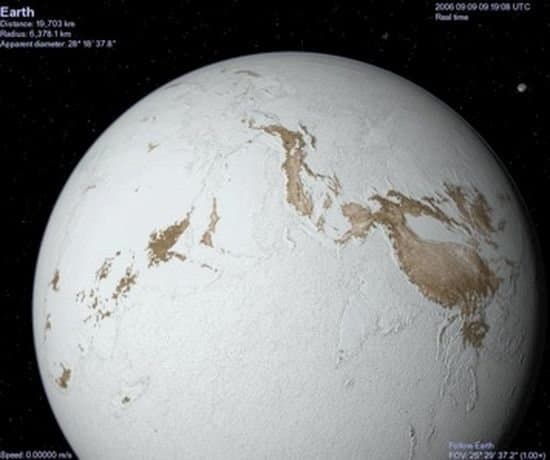
New research challenges traditional Snowball Earth theories, suggesting repeated glaciation cycles rather than continuous ice cover during Earth's distant past.
The scientific understanding of Earth's ancient climate faces a significant revision as new research published in the Proceedings of the National Academy Sciences challenges long-held theories about the Sturtian glacial period during the Neoproterozoic Era. 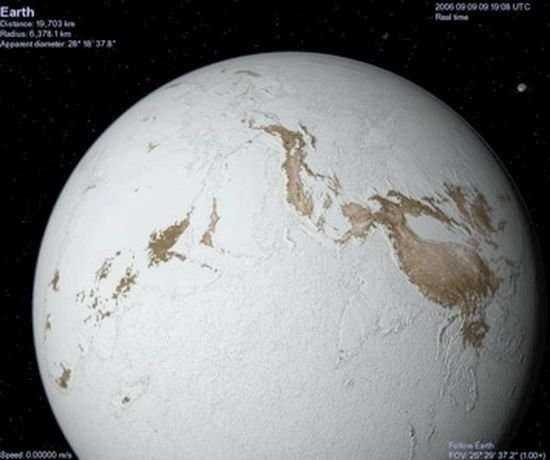
For decades, scientists have debated whether Earth experienced complete "Snowball" glaciation or a "Slushball" scenario with some open water during this period approximately 717 million years ago. Traditional models suggested either a completely ice-covered planet for around 56 million years or a version with patchy tropical ice, but both faced significant inconsistencies with geological and biological evidence.
"These mismatches between the predicted pCO2 evolution and observed glacial duration, and between the predicted pO2 evolution and observed isotopic and biological records, motivate alternative solutions to the Neoproterozoic glaciation problem," the study authors write.
The key contradiction lies in timescales and biological persistence. Carbon cycle models suggest that silicate weathering, which acts as a carbon sink, significantly slows during glaciation. Volcanic CO2 would then accumulate until reaching a threshold that triggers melting. This natural cycle typically takes around 4 million years—consistent with the later Marinoan glacial period but far shorter than the 56-million-year Sturtian period.
Furthermore, oxygen becomes depleted during prolonged glaciation, with models suggesting complete depletion long before 56 million years of global ice cover. Yet, geological evidence shows that various forms of life persisted throughout the Sturtian period, indicating oxygen levels remained sufficient for survival.
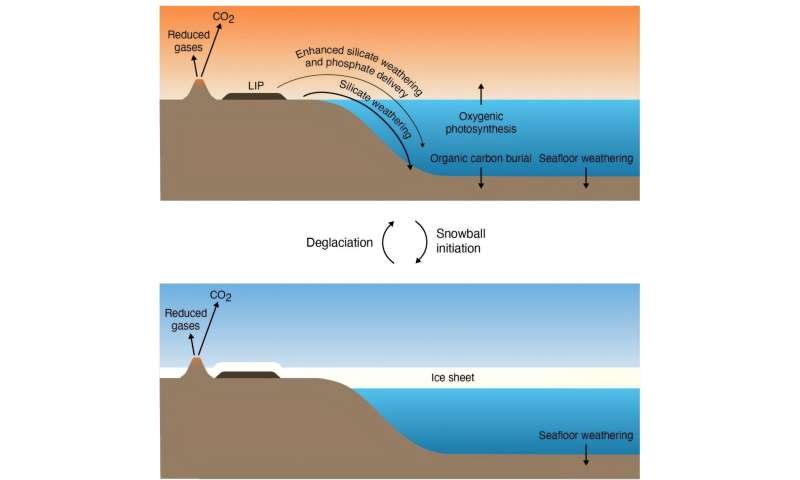
To resolve these discrepancies, researchers developed a new model focusing on the Franklin Large Igneous Province (LIP), a massive volcanic rock formation in the Canadian Arctic that emerged approximately 717 million years ago—essentially coinciding with the onset of the Sturtian glaciation.
"Enhanced weathering by LIPs has long been acknowledged as an important climate driver across geologic time. The Franklin LIP was emplaced at ∼717 Ma, essentially coincident (within 1 to 2 Myr) with the onset of the Sturtian, and could have provided a sufficiently large quantity of fresh basalt to draw down CO2 and trigger a global glaciation," the authors explain.
The team's coupled box model simulating Earth's climate, carbon, and oxygen cycles revealed a compelling alternative scenario: repeated glaciation cycles driven by the weathering of the Franklin LIP. Instead of continuous ice cover, the model suggests that only portions of the LIP weathered during initial glaciation. When glaciers melted, the remaining basalt would continue weathering during the warm interglacial period, gradually drawing down CO2 until another glaciation was triggered.
"If only a portion of the Franklin LIP was weathered away during the initial Snowball onset, the remaining volume of basalt would still be available for weathering upon deglaciation, reinitiating CO2 drawdown during the interglacial hothouse climate until another Snowball was triggered and the cycle repeated," the researchers write. "This cycling, back and forth between climate extremes, would continue until Franklin's weathering power (i.e. unweathered basalt) was exhausted."
This "limit cycle" model elegantly explains both the extended duration of the Sturtian period and the persistence of life through alternating glaciation and warming periods. Each cycle would have lasted several million years, creating a pattern of extreme climate swings rather than a single, prolonged ice age.
While simplified and not capturing all possible biogeochemical processes, the new model offers a more consistent explanation for geological observations from this distant period. The research also has broader implications beyond Earth's ancient climate, potentially helping scientists understand similar climate dynamics on Earth-like exoplanets.
The study represents a significant shift in understanding our planet's climatic past, demonstrating how large-scale geological processes can create complex, repetitive climate patterns that challenge our assumptions about planetary stability.
Comments
Please log in or register to join the discussion