
Developer Cam Pedersen draws parallels between pottery and programming, suggesting AI's automation of boilerplate code mirrors industrialization's effect on ceramics—freeing creators to focus on innovative work.

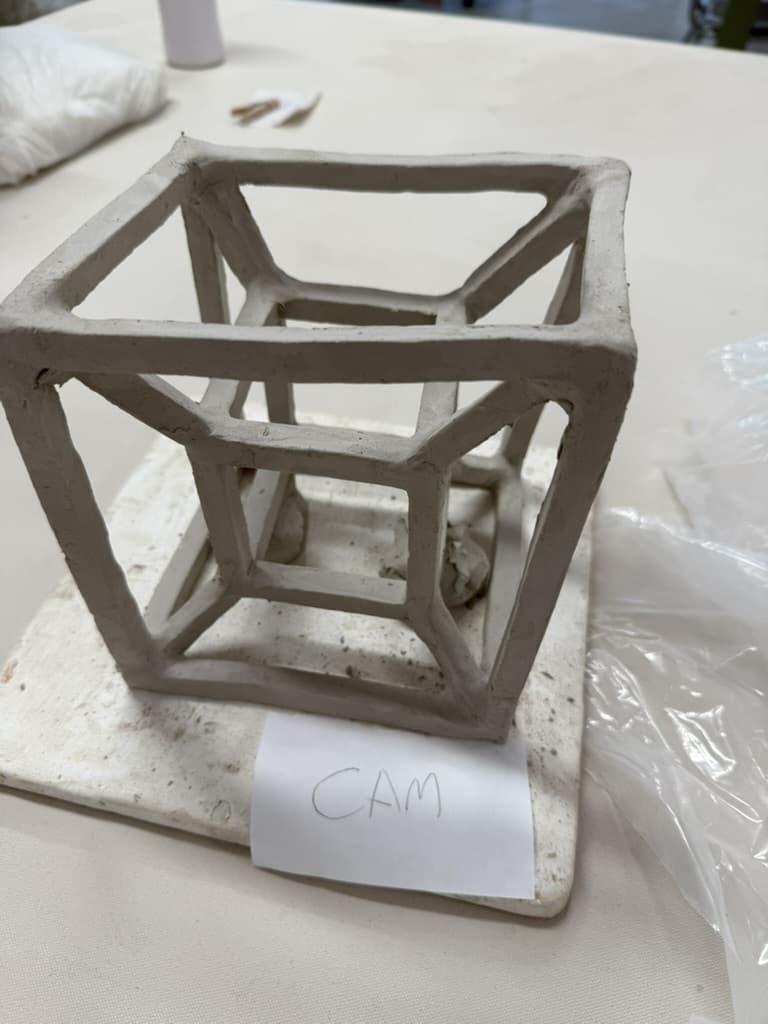
When Cam Pedersen enrolled in a ceramics class expecting to make functional mugs, his instructor didn't anticipate he'd emerge with a glazed ceramic hypercube instead. This unconventional creation—an iridescent blue geometric form that plays with light—became the catalyst for Pedersen's meditation on the parallels between shaping clay and writing code. Both, he argues, are fundamentally malleable mediums where ideas take physical or digital form.
"When centering clay, it's constantly responding—push too hard and everything wobbles off-center," Pedersen observes. "Code behaves similarly. You refactor one component and introduce three new bugs. Neither medium is static or ever truly 'finished.'" This inherent instability extends to fragility: cracked kiln pieces and dropped sculptures mirror corrupted databases and failed deployments. Yet Pedersen emphasizes this impermanence liberates creators: "Clay doesn't care if it breaks. It's just material waiting for the next idea. Code is the same—we get too precious about lines of text that should be rewritten or deleted."
Pedersen's core thesis emerges from this tactile philosophy: AI is triggering programming's industrial revolution, mirroring pottery's mechanization. Pre-industrial artisans painstakingly crafted every cup and plate; developers historically hand-coded every function. Industrialization made ceramics cheap and abundant—yet pottery studios thrive today precisely because handcrafted work gained new meaning when mass production emerged.
"LLMs now generate boilerplate code at factory speed," Pedersen notes. "Commodity software becomes disposable. But like pottery, the craft isn't disappearing—it's evolving. When you don't need to make something manually, choosing to do so imbues it with intention." He envisions developers shifting from typing repetitive patterns to pursuing conceptual "hypercubes": experimental architectures, unconventional interfaces, or systems solving uniquely human problems.
This transition excites Pedersen: "I programmed to build, not to copy-paste boilerplate forever. If AI handles the mugs, I focus on hypercubes." His ceramic tesseract—visually documented in striking detail—embodies this ethos. The medium's future, he contends, grows richer when automation handles the mundane: "The clay isn't vanishing. It's just getting more interesting."
Pedersen's analogy arrives as developers grapple with AI's role. His perspective reframes automation not as a threat but as a liberator—elevating code from utility to artistry when the tedious is automated. The ceramic hypercube, flawed yet ambitious, stands as physical proof: even in an age of machines, human creativity finds its most potent expression in the spaces between efficiency and imagination.
Comments
Please log in or register to join the discussion