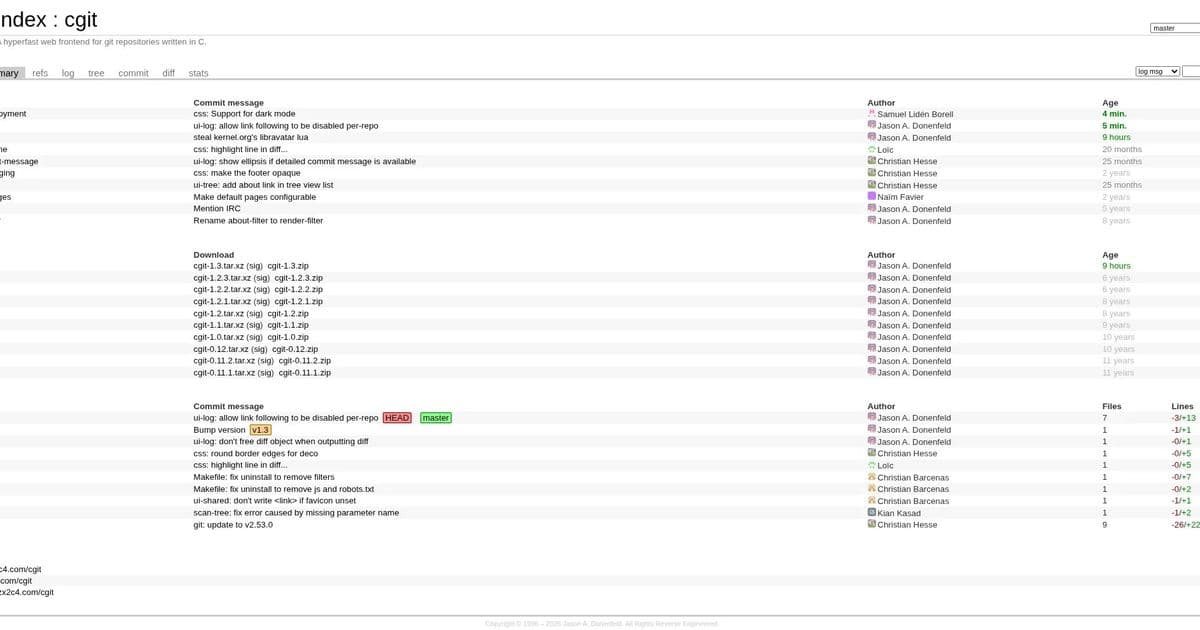
After a six-year hiatus, CGIT 1.3 brings modern Git compatibility, CSS updates, and its first-ever optional JavaScript feature while maintaining its lightweight, JavaScript-free core.
After a six-year hiatus, CGIT 1.3 has arrived as a significant update to the lightweight web interface for Git repositories. Jason Donenfeld, known for his work on WireGuard and Linux cryptography, has taken time from those projects to breathe new life into this essential tool that powers git.kernel.org and similar high-traffic Git hosting environments.
For those unfamiliar with CGIT, it occupies a unique niche in the Git web interface ecosystem. Unlike feature-rich platforms like GitLab or GitHub Enterprise that handle pull requests, issue tracking, and continuous integration, CGIT focuses purely on providing an efficient, readable web interface for Git repositories. This minimalist approach has made it the preferred choice for projects that need simple repository browsing without the overhead of a full-featured Git management platform.
What's New in CGIT 1.3
The six-year gap between versions has resulted in a substantial update that addresses both modern Git compatibility and user experience improvements. The most significant technical change is the update to support Git 2.53 functionality, ensuring compatibility with the latest Git features and security improvements.
Beyond the version bump, CGIT 1.3 introduces several user-facing enhancements. The CSS styling has been refreshed, bringing a more modern appearance to the interface while maintaining its characteristic simplicity. This update is particularly noticeable in the repository browsing experience, where improved visual hierarchy makes navigation more intuitive.
The most notable addition in this release is CGIT's very first optional JavaScript feature. The JavaScript implementation is specifically for a "dynamic aging" feature that updates the display of commit ages and similar time-based information on the client side. This means timestamps like "2 hours ago" or "3 days ago" will update automatically without requiring a page refresh.
This JavaScript addition is worth highlighting because it represents a careful evolution of CGIT's philosophy. The core functionality remains completely functional without JavaScript, and users who block JavaScript in their browsers won't experience any loss of essential features. The dynamic aging is purely a convenience enhancement that doesn't compromise the tool's accessibility or performance characteristics.
Why CGIT Matters
In an era where web applications seem to grow increasingly complex and resource-intensive, CGIT stands out for its efficiency. Written in C, it delivers exceptional performance even under heavy load, making it ideal for hosting large, public Git repositories like those found in the Linux kernel ecosystem.
The tool's lack of dependency on JavaScript for core functionality also makes it uniquely accessible. It works perfectly in any web browser, including text-based browsers and environments with JavaScript disabled for security or performance reasons. This design philosophy ensures that CGIT remains usable in the widest possible range of scenarios, from modern desktop browsers to embedded systems and command-line interfaces.
Getting CGIT 1.3
The release announcement provides detailed information about the changes and installation instructions. As with previous versions, CGIT 1.3 can be compiled from source, and the process remains straightforward for those familiar with building C applications.
For projects that need a simple, fast, and reliable way to provide web access to Git repositories without the complexity of full-featured Git management platforms, CGIT 1.3 represents a welcome update that modernizes the tool while preserving its core strengths. The six-year development cycle has resulted in a release that balances necessary modernization with the conservative approach that has made CGIT a trusted tool in the open-source community for over a decade.
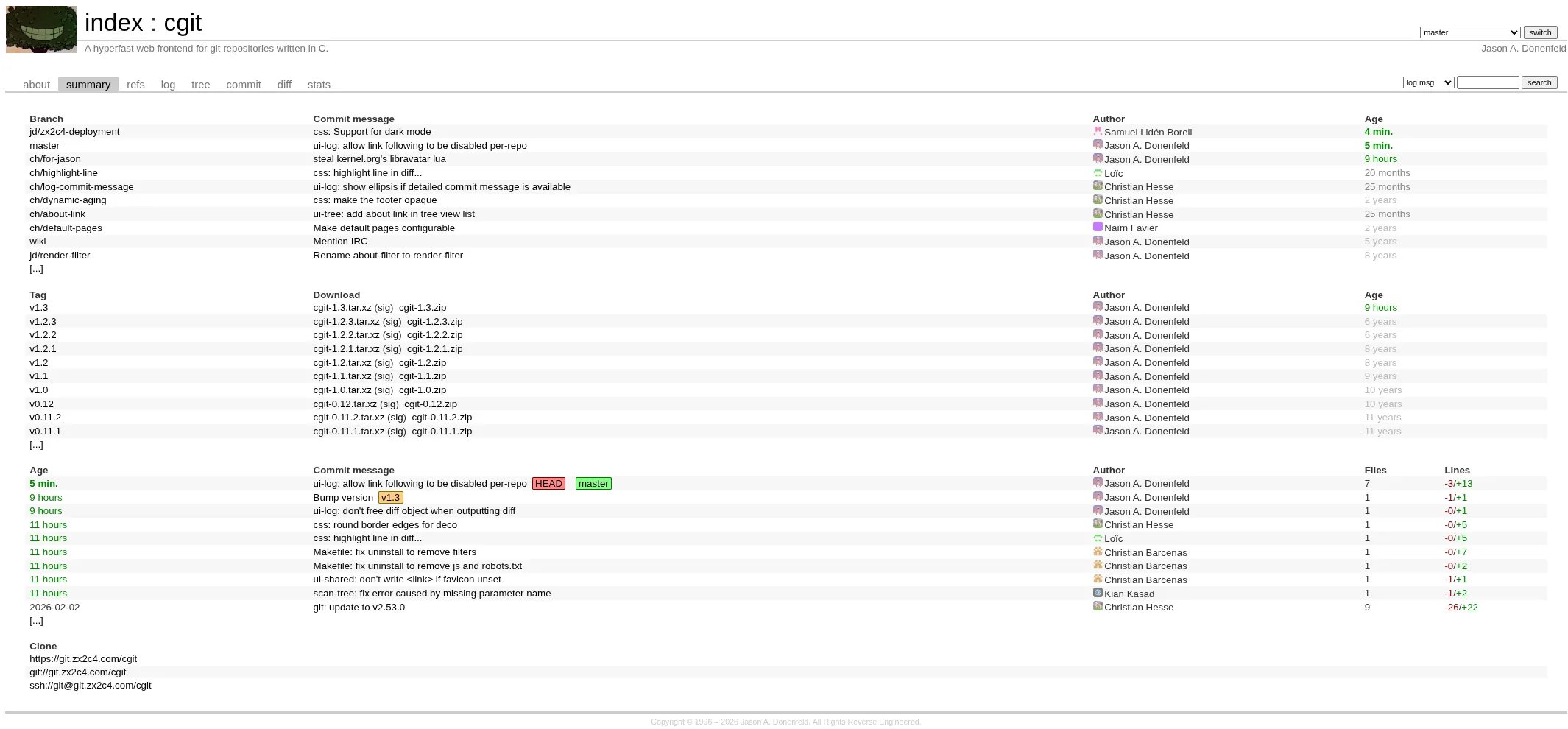
The return of active development to CGIT is particularly encouraging for the Linux kernel development community and other projects that rely on git.kernel.org. With Jason Donenfeld's proven track record in security and systems programming, CGIT is well-positioned to continue serving as a reliable foundation for Git repository hosting for years to come.
Comments
Please log in or register to join the discussion